
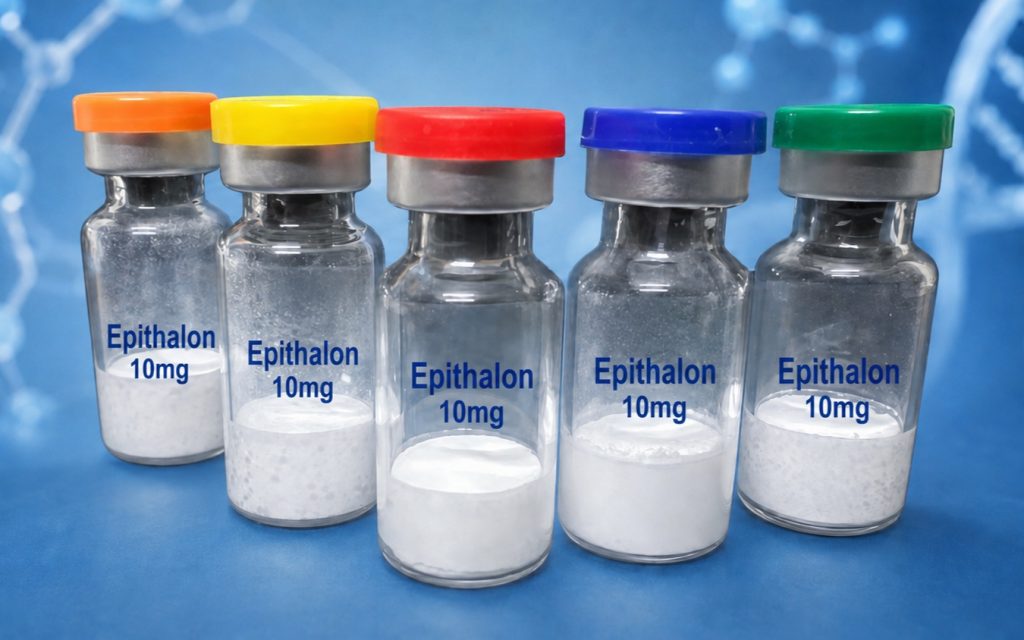
What Is Epithalon?
Epithalon, also commonly spelled Epitalon, is a synthetic tetrapeptide with the sequence:
Ala-Glu-Asp-Gly — AEDG
It is a chemically defined four-amino-acid peptide investigated in cellular biology, aging-related pathways, telomere biology and peptide signaling research.
SUNONE supplies research-grade Epithalon, CAS 307297-39-8, for qualified laboratory, analytical and manufacturing research.
SUNONE Epithalon Product Page:
Is Epitalon the Same as Epithalon?
In most research contexts:
Epitalon = Epithalon = AEDG
They are alternative spellings referring to the defined tetrapeptide Ala-Glu-Asp-Gly.
However, another similar name causes much more important confusion:
Epithalamin.
Epithalamin should not automatically be treated as another synonym for Epitalon.
Epitalon vs Epithalamin: What Is the Difference?
The distinction is chemical.
Epitalon / Epithalon
- Defined synthetic tetrapeptide
- Sequence: Ala-Glu-Asp-Gly
- Abbreviation: AEDG
- Defined molecular formula and molecular weight
Epithalamin
- Historically described as a pineal-derived peptide or polypeptide complex
- Contains multiple peptide components
- Not simply one defined AEDG tetrapeptide
Both belong to the same historical field of pineal peptide research, which explains why their names are frequently mixed online.
But:
shared research history ≠ identical molecular identity.
Why Does This Matter When Reading Epithalon Research?
A Google search for “Epithalon research” can return studies involving both Epitalon and Epithalamin.
That creates a major evidence problem.
If a study used a heterogeneous pineal peptide extract, its results should not automatically be described as evidence for a chemically synthesized AEDG tetrapeptide.
The reverse is also true.
Researchers should ask:
Which material was actually tested?
This is especially important when evaluating older studies involving aging, melatonin, immune biology or longevity.

What Does Current Telomere Research Show?
Epitalon has attracted considerable attention because of experimental research involving telomerase and telomeres.
A 2025 laboratory study examined Epitalon in human normal and cancer cell lines.
Researchers reported changes involving:
- telomere length;
- hTERT expression;
- telomerase activity;
- alternative lengthening of telomeres pathways.
These findings are biologically interesting.
However, they came from cell-culture experiments, not large controlled human clinical trials.
Therefore:
cellular telomere changes ≠ proven human longevity.
Claims that Epithalon has been conclusively proven to extend human lifespan go beyond what this evidence demonstrates.
Why “Anti-Aging Peptide” Is an Oversimplification
Epithalon is often marketed online as an:
“anti-aging peptide” or “telomere peptide.”
Those phrases may attract searches, but they compress a complex evidence base into a therapeutic-sounding claim.
A more accurate research framework is:
AEDG molecular identity → cellular signaling → telomerase research → telomere biology → evidence interpretation.
This approach separates experimental biology from clinical conclusions.
What Do Epithalon Reviews Say?
Current online Epithalon reviews are highly mixed.
Positive anecdotal comments sometimes mention:
- improved perceived sleep quality;
- feeling more rested;
- improved subjective memory or mental clarity;
- better perceived daily energy.
Negative or neutral comments include:
- no noticeable effect;
- disappointment after extended use;
- insomnia or disrupted sleep;
- uncertainty about whether any change occurred;
- concerns that effects are difficult to measure subjectively.
These reports are uncontrolled personal experiences.
They may involve different products, formulations, additional compounds and unknown material quality.
Therefore:
Epithalon reviews are anecdotal search sentiment—not controlled scientific evidence.

Why Molecular Identity Matters When Choosing an Epithalon Supplier
For laboratory research, the name on the vial is not enough.
Researchers evaluating a research-grade Epithalon supplier should verify that the supplied material corresponds to the intended AEDG tetrapeptide.
Important quality considerations include:
Sequence identity:
Ala-Glu-Asp-Gly.
Chemical identity:
The material should correspond to the defined Epitalon / Epithalon molecule rather than an undefined pineal extract.
HPLC purity:
Batch-specific chromatography should support the stated purity.
Mass characterization:
Appropriate analytical data can help confirm molecular identity.
Batch-specific COA:
The applicable Epithalon COA should correspond to the actual lot supplied.
SUNONE currently lists:
Product: Epithalon
Synonyms: Epitalon, Epithalon, Epithalone, AEDG
Sequence: Ala-Glu-Asp-Gly
CAS: 307297-39-8
Formula: C14H22N4O9
Molecular Weight: 390.35 g/mol
Purity: ≥99% HPLC
Form: Lyophilized
Grade: Research Grade
Storage: 2–8°C, protect from light
Final Thoughts
One of the most important questions in Epithalon research is not simply:
“Does Epithalon affect telomeres?”
A better first question is:
“Was the published experiment performed with defined AEDG Epitalon or with the Epithalamin peptide complex?”
That distinction creates a stronger evidence framework:
Epitalon / Epithalon → AEDG → defined molecular identity → experimental evidence
versus
Epithalamin → peptide complex → separate evidence base.
For laboratories comparing an Epithalon supplier, molecular identity, sequence confirmation, HPLC purity and batch-specific analytical documentation should take priority over broad longevity or anti-aging claims.
SUNONE research peptide is for qualified labrtorynt, diagnois, druc tor mmatct or veteimant, use.research only, Not for human consumption, clinical treame.
Leave a Reply