
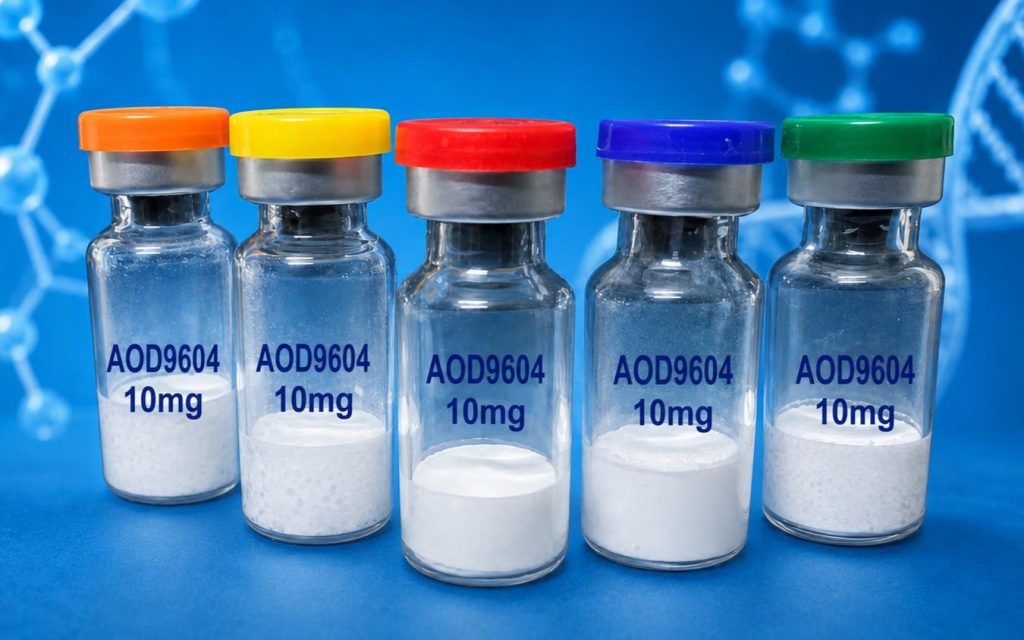
What Is AOD9604?
AOD9604, also written as AOD-9604, is a synthetic peptide derived from the C-terminal region of human growth hormone.
SUNONE currently lists the peptide sequence as:
YLRIVQCRSVEGSCGF
AOD9604 has been studied primarily for its relationship to lipid metabolism and the lipolytic region of human growth hormone.
SUNONE supplies research-grade AOD9604, CAS 221231-10-3, for qualified laboratory, analytical and manufacturing research.
SUNONE AOD9604 Product Page:
Why Did AOD9604 Attract Research Interest?
Early AOD9604 research was based on an interesting hypothesis:
Could researchers isolate part of the fat-metabolism activity associated with human growth hormone without reproducing the full biological profile of intact HGH?
Preclinical studies in obese rodents reported:
- increased lipolytic activity;
- increased fat oxidation;
- reduced body-weight gain;
- effects on beta-adrenergic signaling.
Some experiments also found that AOD9604 did not behave like full-length HGH at the human growth-hormone receptor.
These findings helped create strong scientific interest in the peptide.
But preclinical promise is only the first step.
What Happened in Human Obesity Research?
The most important evidence question is whether the early animal findings translated into meaningful human results.
A large randomized, double-blind, placebo-controlled obesity study enrolled more than 500 adults.
The study failed to demonstrate a statistically significant difference in weight loss between AOD9604 and placebo on its primary efficacy endpoint.
This is a critical research lesson:
preclinical lipolysis ≠ proven human weight loss.
Animal models can identify biological mechanisms, but they cannot guarantee clinical efficacy.
Why the Negative Trial Still Matters
A failed clinical endpoint does not make the earlier laboratory research meaningless.
Instead, it changes how the evidence should be interpreted.
For AOD9604, researchers should separate three evidence layers:
Preclinical evidence
Animal studies reported effects on lipolysis and fat oxidation.
Human clinical evidence
The major obesity development program did not establish significant weight-loss efficacy versus placebo.
Current research use
AOD9604 remains available in research settings for experimental investigation of peptide biology and metabolic pathways.
Keeping these categories separate prevents exaggerated claims.
Is AOD9604 the Same as Full-Length HGH?
No.
AOD9604 is a short synthetic peptide derived from a region of human growth hormone.
Full-length recombinant human growth hormone is a 191-amino-acid protein with a completely different molecular size, higher-order structure and receptor biology.
Published preclinical studies have reported that AOD9604 does not interact with the HGH receptor in the same way as intact HGH.
Therefore:
AOD9604 research evidence should not automatically be treated as HGH evidence.
Is AOD9604 the Same as HGH Fragment 176-191?
These names are frequently mixed together online, but laboratories should be careful.
AOD9604 has its own defined molecular identity and sequence.
Closely related HGH fragments may differ in:
- residue numbering;
- terminal chemistry;
- molecular mass;
- sequence composition.
For analytical research, similar names should not replace exact molecular identification.
What Do Current AOD9604 Reviews Say?
Current online AOD9604 reviews are mixed, although recent discussions often lean skeptical.
Some positive anecdotal reports mention:
- perceived reduction in waist measurements;
- changes in stubborn abdominal fat;
- subtle body-composition changes.
Negative and neutral reviews frequently mention:
- no noticeable effect;
- no meaningful weight change;
- little improvement after extended use;
- disappointment relative to cost.
There are also isolated reports of adverse experiences such as hypersensitivity or unusual sensory symptoms.
These comments are uncontrolled and may involve products from unidentified sources.
Therefore:
AOD9604 reviews are anecdotal search sentiment—not clinical evidence.
They also do not establish the safety or efficacy of SUNONE Research Grade AOD9604.
Why Research-Grade Quality Still Matters
A negative obesity trial does not eliminate the need for high-quality research material.
If laboratories are studying:
- peptide metabolism;
- adipocyte biology;
- beta-adrenergic pathways;
- HGH-derived fragment biology;
- peptide structure-function relationships,
then accurate material identity remains essential.
Important quality attributes include:
- correct peptide sequence;
- molecular mass;
- HPLC purity;
- related peptide impurities;
- batch consistency;
- analytical documentation.
What Should Researchers Check When Choosing an AOD9604 Supplier?
When comparing a research-grade AOD9604 supplier, laboratories should look for transparent specifications and batch-level documentation.
SUNONE currently lists:
Product: AOD9604
Synonyms: AOD-9604, AOD 9604
CAS: 221231-10-3
Formula: C78H123N23O23S2
Molecular Weight: 1815.1 g/mol
Sequence: YLRIVQCRSVEGSCGF
Purity: ≥99% HPLC
Form: Lyophilized Powder
Grade: Research Grade
Storage: 2–8°C, protect from light
Researchers should review the applicable batch-specific COA, SDS and specification documentation before experimental use.
Final Thoughts
A common Google search asks:
“Does AOD9604 burn fat?”
For researchers, a more precise question is:
“Why did promising preclinical lipolysis findings fail to produce a significant obesity endpoint in a large human trial?”
That question creates a stronger scientific framework:
HGH-derived sequence → preclinical lipolysis → animal mechanism → human clinical trial → evidence gap → research interpretation.
For laboratories comparing an AOD9604 supplier, correct molecular identity, HPLC purity and batch-specific analytical documentation should take priority over consumer weight-loss claims.
SUNONE research peptide is for qualified labrtorynt, diagnois, druc tor mmatct or veteimant, use.research only, Not for human consumption, clinical treame.
Leave a Reply