
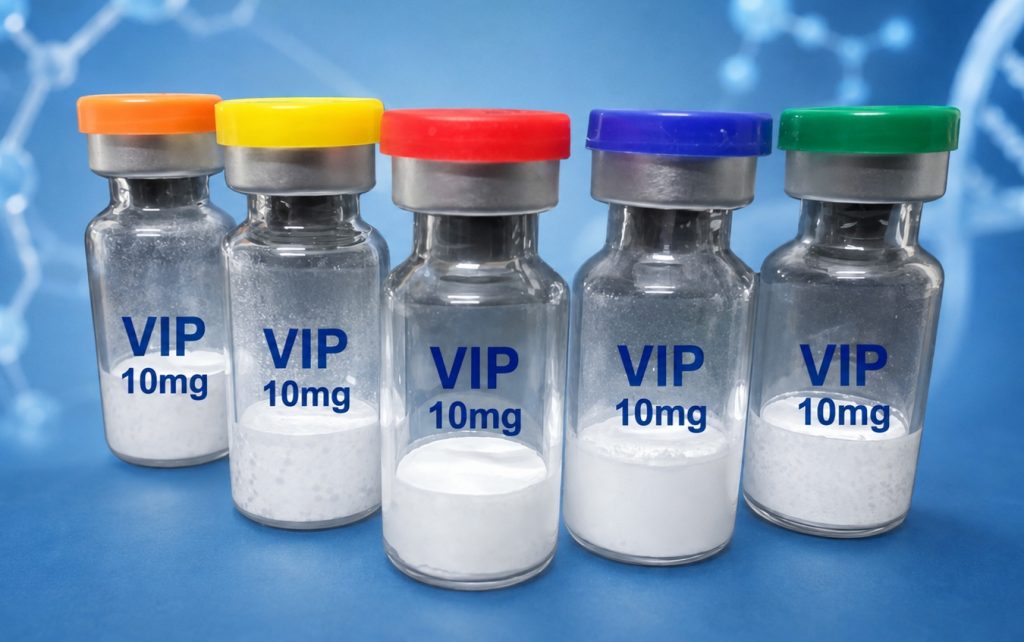
Vasoactive Intestinal Peptide (VIP) is a 28-amino-acid peptide studied in a broad range of biochemical, cellular, receptor-signaling, and neuropeptide research applications.
52YM supplies VIP research material for qualified laboratory, analytical, and scientific research. Product specifications and batch-specific analytical documentation should be reviewed before experimental use.
For research use only. Not for human consumption, clinical, diagnostic, therapeutic, or veterinary use.
Product Overview
Vasoactive Intestinal Peptide (VIP) Research Overview
Vasoactive Intestinal Peptide (VIP), also known as vasoactive intestinal polypeptide, is a 28-amino-acid peptide involved in multiple biological signaling pathways. VIP is widely investigated in experimental research involving peptide signaling, receptor biology, cellular communication, neuropeptide systems, and related molecular mechanisms.
The human VIP sequence consists of 28 amino acid residues and is represented by the one-letter sequence HSDAVFTDNYTRLRKQMAVKKYLNSILN.
52YM provides Vasoactive Intestinal Peptide as research material intended for qualified laboratory and analytical applications. Researchers should refer to batch-specific analytical documentation for verified product specifications.
VIP Chemical Information
Product Name: Vasoactive Intestinal Peptide (VIP)
Synonym: Vasoactive Intestinal Polypeptide
CAS Number: 37221-79-7
PubChem CID: 53314964
Molecular Formula: C147H237N43O43S
Molecular Weight: 3326.8 g/mol
Sequence Length: 28 amino acids
UNII: 6J2WVD66KR
Grade: Research Grade
Vasoactive Intestinal Peptide Sequence
Vasoactive Intestinal Peptide (VIP) consists of 28 amino acid residues.
One-letter sequence:
HSDAVFTDNYTRLRKQMAVKKYLNSILN
Three-letter sequence:
His-Ser-Asp-Ala-Val-Phe-Thr-Asp-Asn-Tyr-Thr-Arg-Leu-Arg-Lys-Gln-Met-Ala-Val-Lys-Lys-Tyr-Leu-Asn-Ser-Ile-Leu-Asn
Sequence length: 28 amino acids
Research Applications
Vasoactive Intestinal Peptide (VIP) may be used in qualified laboratory research involving:
- Neuropeptide signaling research
- Peptide–receptor interaction studies
- VPAC receptor-related research
- Cellular signaling studies
- Molecular and cellular biology
- Peptide characterization
- Structure–activity relationship studies
- Analytical method development
Specific experimental applications and conditions should be established by qualified researchers according to appropriate laboratory protocols.