
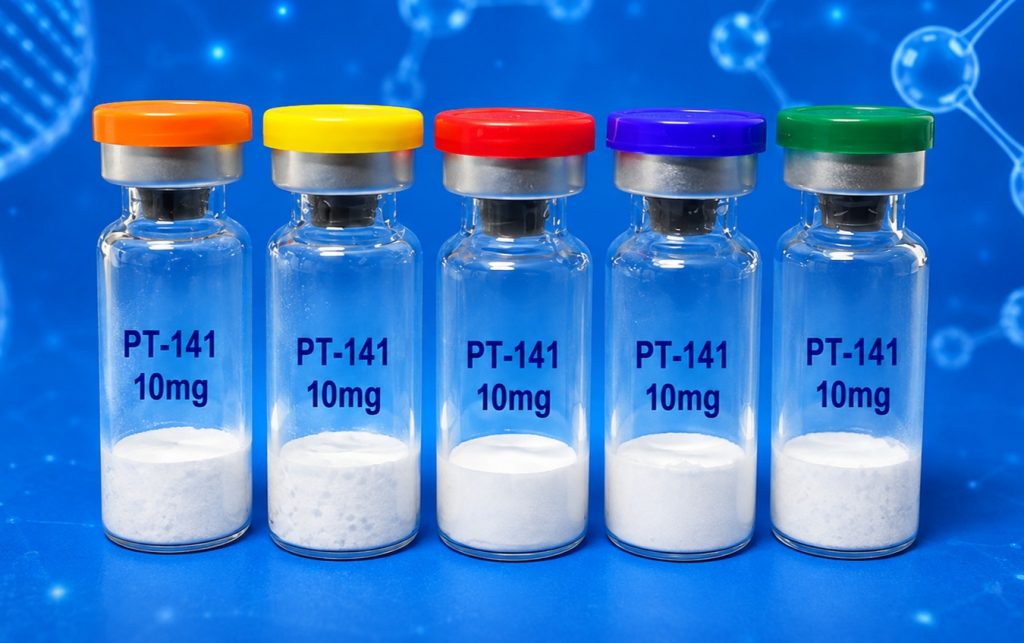
What makes PT-141 (Bremelanotide) unusual among researched peptides?
The answer is not simply what researchers study it for—but where its signaling begins.
While many compounds associated with sexual-response research focus on peripheral vascular pathways, PT-141 peptide research has focused on melanocortin signaling within the central nervous system.
That makes Bremelanotide an interesting example of how a small peptide can approach a biological response from a very different direction.
What Is PT-141 (Bremelanotide)?
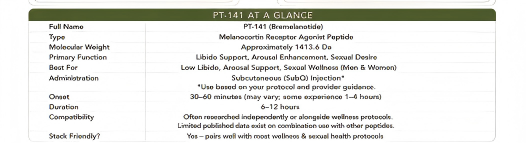
PT-141, also known as Bremelanotide, is a synthetic cyclic heptapeptide related to the melanocortin peptide family.
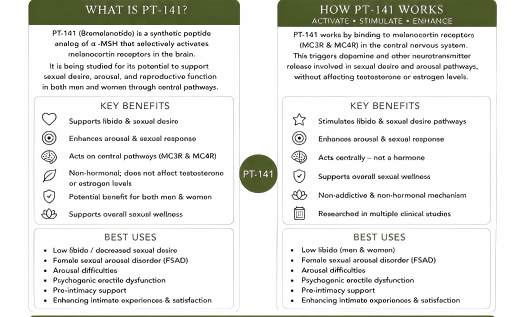
Research has demonstrated interactions between Bremelanotide and several melanocortin receptors, with MC3R and MC4R receiving particular attention in studies involving central nervous system signaling.
Instead of simply modifying peripheral blood flow, PT-141 research examines pathways associated with neurological regulation of sexual desire and arousal.
Researchers interested in product specifications can explore:PT-141 (Bremelanotide) – SUNONE
PT-141 vs Traditional Blood-Flow Approaches
This is where PT-141 Bremelanotide becomes particularly interesting from a research perspective.
PDE5 inhibitors are associated primarily with peripheral vascular signaling. Bremelanotide instead belongs to the melanocortin receptor agonist class.
In simplified terms:
Traditional PDE5 pathway → peripheral vascular response
PT-141 pathway → central melanocortin signaling
This distinction is more scientifically meaningful than simply describing PT-141 as another “performance peptide.”
What Do PT-141 Reviews Say?
Search for PT-141 reviews and the results are highly mixed.
Positive online experiences often describe noticeable changes in sexual desire or arousal.
Negative experiences frequently mention nausea, headache, flushing, delayed or inconsistent perceived effects, with some users reporting that adverse experiences outweighed the perceived benefits.
These discussions reveal an important point:
Anecdotal reviews are not clinical evidence.
Individual biology, product identity, purity, experimental conditions and other variables can dramatically affect uncontrolled online reports.
An Important Distinction: Molecule vs Product
Bremelanotide has an unusual position within peptide research because an FDA-approved prescription medicine containing bremelanotide exists.
However:
The existence of an FDA-approved drug containing bremelanotide does not make every PT-141 research product an FDA-approved medicine.
The distinction between a pharmaceutical product and a research material is essential when evaluating PT-141 peptide information online.
Researchers should focus on molecular identity, purity, analytical documentation and batch consistency rather than assuming equivalence based solely on the name “Bremelanotide.”
Why PT-141 Remains Interesting to Researchers
PT-141 demonstrates an important concept in peptide science: similar biological endpoints can be investigated through fundamentally different signaling pathways.
For PT-141 Bremelanotide, research interest extends beyond the endpoint itself toward questions involving:
- melanocortin receptor signaling;
- MC3R and MC4R pathways;
- central nervous system responses;
- peptide-receptor interactions;
- neurological regulation of sexual behavior.

That makes PT-141 peptide research particularly relevant to researchers studying melanocortin biology.
Final Thoughts
PT-141 (Bremelanotide) stands apart because its research story is primarily about signaling—not simply blood flow.
Its relationship with the melanocortin receptor system, MC4R signaling and central neurological pathways provides a distinctive model for peptide research.
For scientists evaluating PT-141, Bremelanotide peptide or melanocortin receptor research, understanding this mechanism is far more useful than relying on the hype surrounding online testimonials.
For qualified laboratory research only. Not for human consumption, clinical treatment, diagnosis, drug compounding or veterinary use.
Leave a Reply