
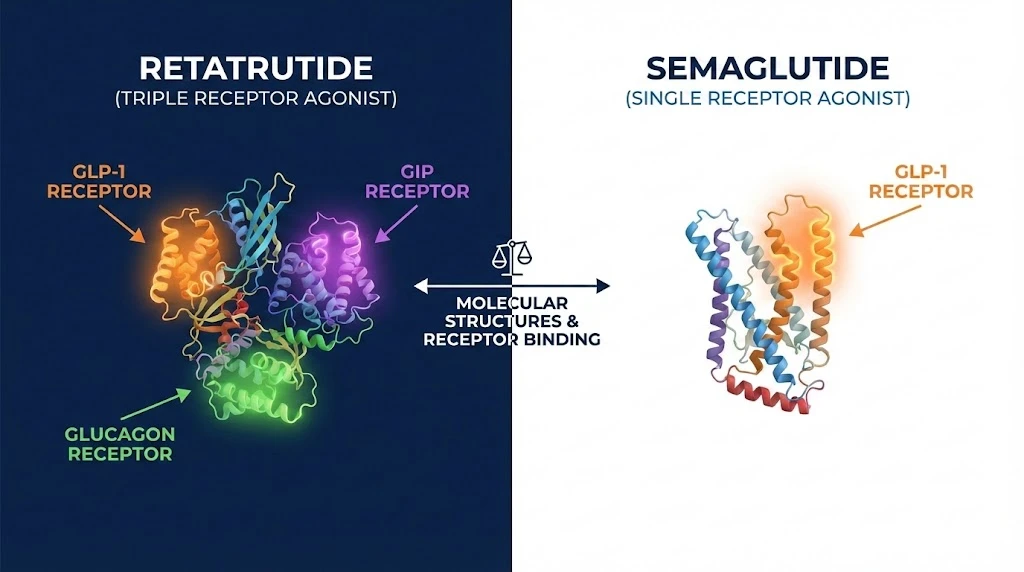
Semaglutide vs Retatrutide: One Target vs Three Targets
Semaglutide and Retatrutide are frequently discussed together, but from a molecular research perspective, their most interesting difference can be summarized in three words:
One target vs three.
Semaglutide primarily acts as a GLP-1 receptor agonist, while Retatrutide is being investigated as a GIP, GLP-1 and glucagon receptor triple agonist.
That difference makes Semaglutide vs Retatrutide an important comparison in modern metabolic peptide research.
What Is Semaglutide?
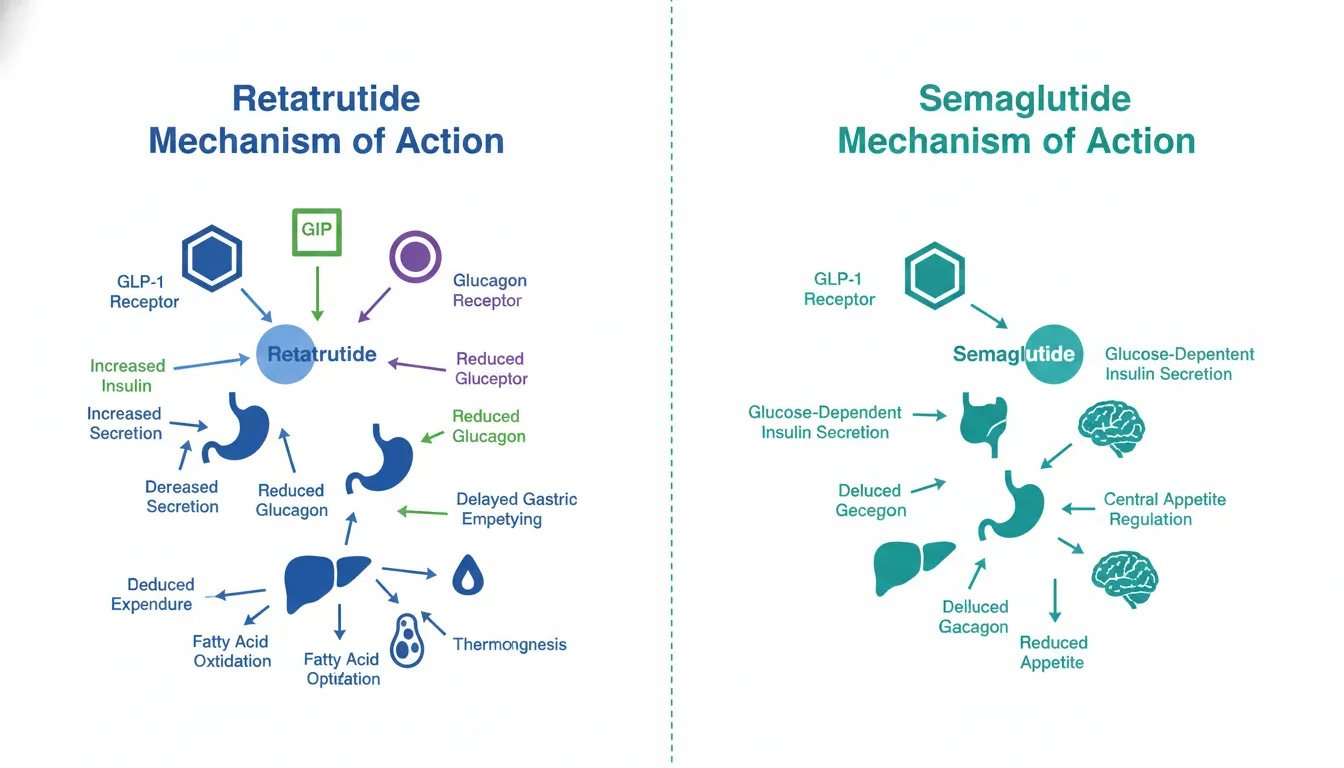
Semaglutide is a GLP-1 receptor agonist with an extensive clinical research history.
GLP-1 signaling is associated with multiple metabolic processes, including glucose-dependent insulin secretion, appetite regulation and gastric emptying.
Unlike many research peptides, semaglutide is also the active pharmaceutical ingredient in FDA-approved prescription medicines. However, this distinction is critical:
A research-grade Semaglutide peptide should not be represented as an FDA-approved pharmaceutical product simply because it contains the same named molecule.
Researchers interested in SUNONE’s Semaglutide peptide can view the product specifications here:

What Makes Retatrutide Different?
Retatrutide takes a different experimental approach.
Rather than targeting only GLP-1 receptors, Retatrutide is designed to activate three metabolic hormone receptors:
GIP + GLP-1 + glucagon receptors.
This triple-agonist architecture is one reason Retatrutide research has attracted substantial scientific attention.
Phase 3 research announced in 2026 reported substantial changes in body weight among trial participants, reinforcing scientific interest in multi-receptor metabolic signaling.
However, Retatrutide remains investigational and should not be described as an FDA-approved treatment.
For laboratory research information:

Semaglutide vs Retatrutide: The Molecular Difference
| Research Feature | Semaglutide | Retatrutide |
|---|---|---|
| GLP-1 receptor | ✓ | ✓ |
| GIP receptor | — | ✓ |
| Glucagon receptor | — | ✓ |
| Research architecture | Single-receptor agonist | Triple-receptor agonist |
| Human research | Extensive | Rapidly developing |
| FDA-approved molecule in medicines | Yes | No — investigational |
This comparison explains why calling Retatrutide simply a “stronger Semaglutide” is scientifically misleading.
More receptor targets do not automatically mean “better.” They represent a different pharmacological strategy that requires its own efficacy, safety and mechanistic investigation.
What Do Semaglutide and Retatrutide Reviews Say?
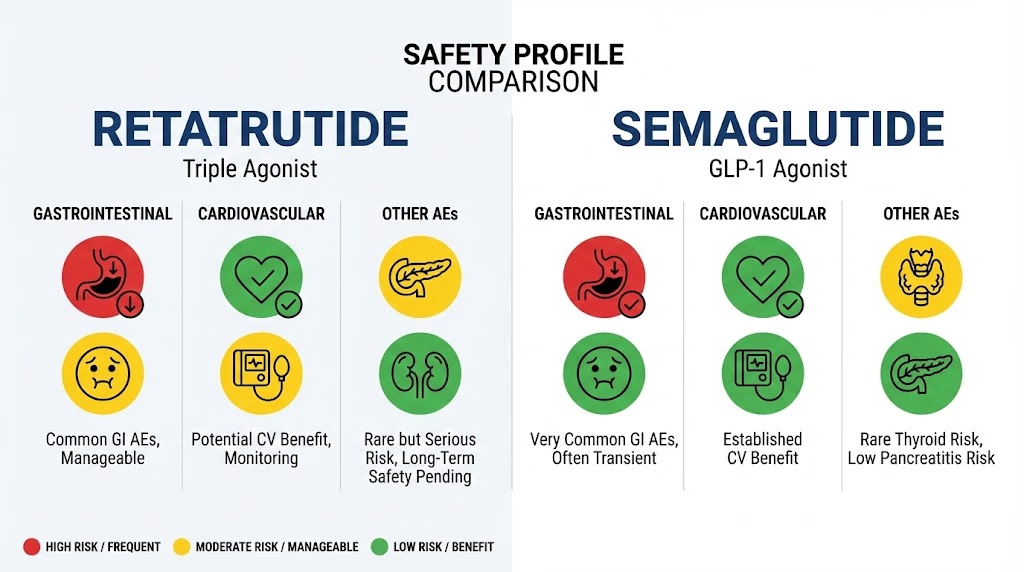
Google searches reveal both positive and negative experiences.
Online Semaglutide reviews frequently mention reduced appetite, earlier satiety and weight changes as positive experiences. Negative reports frequently discuss gastrointestinal symptoms such as nausea, vomiting, constipation and abdominal discomfort.
Retatrutide reviews similarly contain reports of appetite and weight changes, while other users describe nausea, gastrointestinal effects or results that did not match their expectations.
These testimonials have an important limitation: online reviews are anecdotes, not controlled research data.
For scientific research, compound identity, purity, analytical documentation and controlled experimental conditions are substantially more informative than social-media testimonials.
Why This Comparison Matters for Peptide Research
The evolution from Semaglutide to Retatrutide research illustrates a broader trend in metabolic science.
Researchers are moving from studying individual signaling pathways toward investigating whether coordinated activation of multiple metabolic receptors produces meaningfully different biological responses.
That makes the key question bigger than:
“Semaglutide or Retatrutide?”
A more scientifically useful question is:
“What changes when metabolic research moves from one receptor pathway to three?”
Answering that question requires controlled research—not online hype.
Final Thoughts
Semaglutide and Retatrutide represent two distinct approaches to metabolic signaling research.
Semaglutide provides an extensively studied GLP-1 receptor agonist framework, while Retatrutide expands the research model toward combined GIP/GLP-1/glucagon receptor activation.
For researchers comparing Semaglutide peptide, Retatrutide peptide, GLP-1 research and triple-agonist research, understanding this mechanistic difference is more valuable than simply asking which compound is “stronger.”
Disclaimer
This article is provided for scientific and educational information only. SUNONE research materials referenced in this article are intended for laboratory research purposes and are not presented as medicines or products for self-administration. Nothing in this article constitutes medical advice or a recommendation for weight loss, diagnosis, treatment, cure, or prevention of disease. Retatrutide remains investigational and is not FDA-approved. Research materials should not be confused with FDA-approved pharmaceutical products. Researchers should comply with all applicable laws, institutional requirements and laboratory safety procedures.
Leave a Reply