

Semax peptide has attracted growing attention in neuroscience and peptide research, particularly for its relationship with neurotrophic signaling, neuronal responses and experimental models of neuroprotection.
Online searches often describe Semax simply as a “nootropic peptide.” The underlying science, however, is considerably more interesting—and more complex.
This SUNONE research overview examines what Semax is, how it is studied and where scientific evidence should be separated from online claims.
What Is Semax?
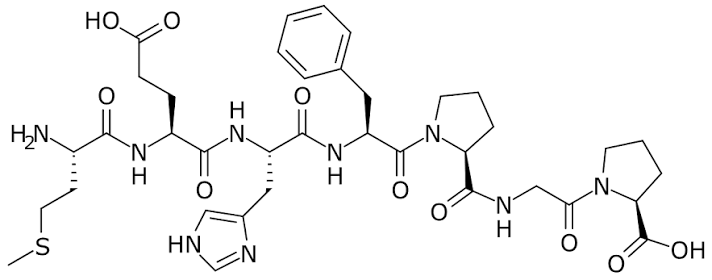
Semax is a synthetic peptide derived from a fragment of adrenocorticotropic hormone (ACTH).
Its sequence is:
Met–Glu–His–Phe–Pro–Gly–Pro
Semax is therefore a heptapeptide, containing seven amino-acid residues.
Unlike full-length ACTH, Semax was designed around a fragment associated with neurological activity rather than the classical adrenal-stimulating effects of the complete hormone.
This distinction has made Semax research particularly interesting in experimental neuroscience.
How Does Semax Work?
There is no single mechanism that fully explains every experimental observation involving Semax.
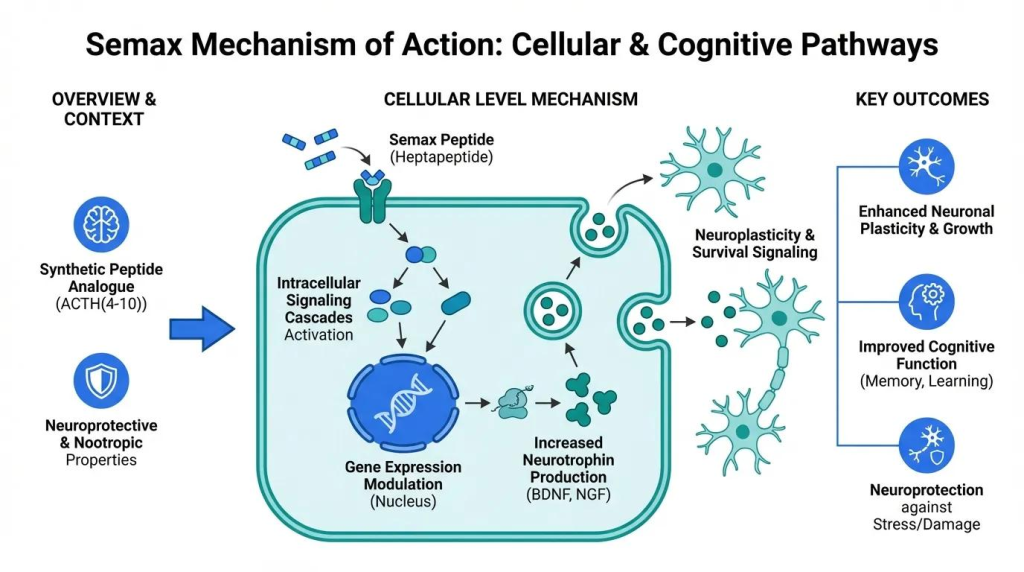
One of the most investigated areas, however, is neurotrophic signaling.
Experimental studies have explored Semax in relation to brain-derived neurotrophic factor (BDNF) and nerve growth factor (NGF).
BDNF is involved in neuronal survival, synaptic plasticity and learning-related processes, while NGF contributes to neuronal maintenance and signaling.
Researchers have also investigated Semax in connection with:
- Neurotrophic gene expression
- Neuronal signaling
- Synaptic plasticity
- Monoaminergic systems
- Oxidative stress responses
- Experimental cerebral ischemia
This broader biological profile is why describing Semax merely as a “focus peptide” does not adequately represent the scientific research.
Semax, BDNF and Neuroplasticity Research
Semax and BDNF have become an important research pairing.
Experimental studies suggest that Semax can influence the expression of genes associated with neurotrophic factors, including BDNF, under particular research conditions.
This has led scientists to investigate possible connections between Semax and neuroplasticity—the ability of neural systems to adapt and reorganize in response to biological signals and environmental conditions.
However, an important distinction must be maintained:
Changes in molecular markers such as BDNF do not automatically prove cognitive enhancement in humans.
Cellular, animal and mechanistic findings need to be interpreted according to the experimental model in which they were observed.
Why Is Semax Studied in Neuroprotection Research?
Another major area of Semax peptide research involves experimental models of cerebral ischemia and neurological stress.
Researchers have examined changes in gene expression, inflammatory signaling and neurotrophic pathways following Semax exposure.

These studies make Semax an interesting experimental peptide for investigating how a small ACTH-derived sequence can influence complex neuronal signaling networks.
Semax Reviews: Positive vs. Negative Experiences
Search for Semax reviews online and the results are strikingly inconsistent.
What positive reviews commonly report
Some users describe subjective changes involving:
- Focus and mental clarity
- Alertness
- Memory or verbal recall
- Motivation
- Mood
Others characterize the perceived effect as subtle rather than stimulant-like.
What negative reviews commonly report
Other users report no noticeable effect at all.
Negative anecdotal experiences include reports of:
- Headache
- Fatigue
- Nausea
- Dizziness
- Anxiety or overstimulation
- Brain fog
This disagreement is scientifically important.
Online Semax products can differ in identity, purity, formulation and storage history. Users may also be taking other compounds simultaneously.
Anecdotal Semax reviews therefore cannot establish efficacy, causation or adverse-event frequency.
Published experimental evidence and appropriately controlled research should carry substantially more weight than testimonials.
What Makes Semax Interesting to Researchers?
Rather than asking whether Semax is a “powerful nootropic,” a more useful scientific approach is to ask:
How does an ACTH-derived peptide influence neurotrophic signaling?
Which Semax-related changes in BDNF or gene expression are reproducible?
How does Semax affect neuronal responses under experimental stress?
Which findings translate—and which do not—between cellular, animal and human research?
These questions make Semax peptide an interesting subject for neuroscience, biochemical and peptide research.
Semax from SUNONE
SUNONE focuses on pharmaceutical biotechnology and peptide research materials.
Researchers can find additional information about SUNONE Semax Peptide on our product page.
When evaluating a Semax research peptide, researchers should consider peptide identity, analytical purity, batch consistency, appropriate storage and experimental design rather than relying on online testimonials or marketing claims.
Frequently Asked Questions About Semax

What is Semax peptide?
Semax is a synthetic ACTH-derived heptapeptide with the amino-acid sequence Met–Glu–His–Phe–Pro–Gly–Pro.
Is Semax associated with BDNF?
Experimental research has investigated Semax in connection with BDNF expression and neurotrophic signaling. These mechanistic observations should not automatically be interpreted as proof of cognitive benefits in humans.
Is Semax a nootropic?
Semax is frequently described online as a “nootropic peptide.” From a scientific perspective, it is more precise to describe it as an ACTH-derived peptide investigated in neurological and neurotrophic research.
Are online Semax reviews reliable?
They can identify topics worth investigating, but individual reviews cannot establish safety or effectiveness. Published research and controlled experiments provide stronger evidence.
Conclusion
Semax peptide research is more nuanced than the “cognitive enhancer” label commonly found online.
Its ACTH-derived structure and research involving BDNF, NGF, neurotrophic signaling, gene expression and experimental neuroprotection make Semax scientifically interesting.
At the same time, online experiences range from dramatic positive reports to no perceived response and unwanted effects.
For researchers, this contrast reinforces an important principle:
Semax should be investigated through reproducible experimental evidence—not internet hype.
Information presented by SUNONE is intended to discuss published research and publicly available scientific information. For qualified laboratory research only. Not for human consumption, clinical treatment, diagnosis, drug compounding or veterinary use.
Leave a Reply