
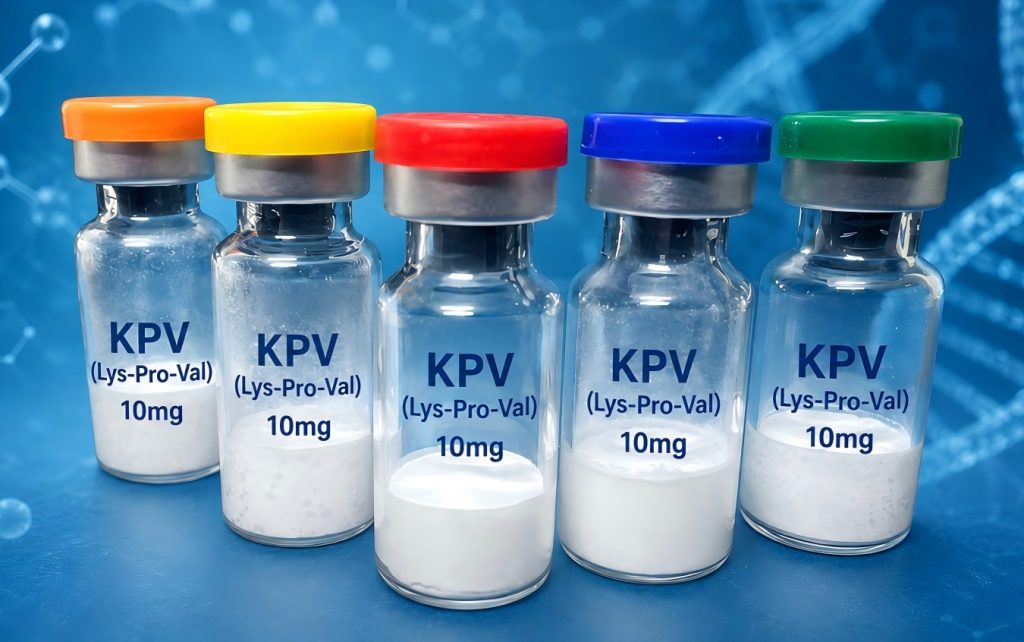
Some research peptides contain dozens of amino acids. KPV peptide contains only three: Lys-Pro-Val.
That simplicity raises an interesting scientific question:
How can such a short peptide become a distinct research molecule?
The answer begins with its relationship to alpha-melanocyte-stimulating hormone (α-MSH) and the biological activity researchers have observed in preclinical models.
KPV Is More Than Just a Short Peptide
KPV—Lys-Pro-Val—corresponds to the C-terminal amino-acid sequence of α-MSH.
What makes KPV scientifically interesting is that researchers have investigated whether this small fragment can retain certain biological properties associated with its parent peptide without representing the complete α-MSH molecule.
This makes KPV useful for studying a broader peptide-science question:
How much of a larger peptide is actually required for a particular biological interaction?
Why Is KPV Studied in Inflammation Research?

Published KPV research has primarily investigated inflammatory signaling in laboratory and animal models.
Areas explored include:
- NF-κB-associated inflammatory signaling
- Intestinal epithelial models
- PepT1-mediated peptide transport
- Experimental intestinal inflammation
- Skin and tissue inflammatory responses
The small size of KPV is particularly interesting in intestinal research because PepT1 is a transporter associated with the uptake of di- and tripeptides.
This relationship between molecular size, peptide transport and inflammatory signaling provides a more useful way to understand KPV than simply describing it as an “anti-inflammatory peptide.”
The Most Important KPV Research Gap
Online descriptions of KPV sometimes move quickly from preclinical findings to claims about human benefits.
The scientific evidence does not currently support that jump.
Existing KPV evidence is predominantly based on cellular and animal research, and controlled human clinical evidence remains absent.
That means researchers should distinguish carefully between:
Preclinical observation → Biological hypothesis → Human clinical evidence
These are not interchangeable stages of scientific evidence.
Why KPV Peptide Quality Matters
Because KPV contains only three amino acids, confirming the identity and quality of the research material remains important.
Researchers evaluating a KPV research peptide should consider:
Sequence identity · HPLC purity · Molecular verification · Batch traceability · COA documentation
At SUNONE, KPV is supplied as a research-grade peptide for laboratory and scientific applications, with quality specifications designed to support reproducible research.
For product specifications and available documentation, visit the SUNONE KPV Peptide Product Page.
SUNONE KPV Peptide Product Page

Final Takeaway
KPV demonstrates an important principle in peptide science:
A peptide does not need to be large to raise meaningful biological questions.
With only three amino acids—Lys-Pro-Val—KPV provides researchers with an interesting model for investigating peptide transport, inflammatory signaling and the relationship between peptide fragments and their parent molecules.
At the same time, promising preclinical findings should not be confused with established human clinical effects.
SUNONE — From molecular identity to reliable peptide research.
Disclaimer
This article is provided for scientific and educational purposes only. SUNONE KPV is supplied for laboratory research and manufacturing applications only. It is not intended for human or veterinary use, consumption, diagnosis, treatment or therapeutic applications. References to experimental or preclinical findings do not constitute claims of clinical efficacy or safety.
Leave a Reply