
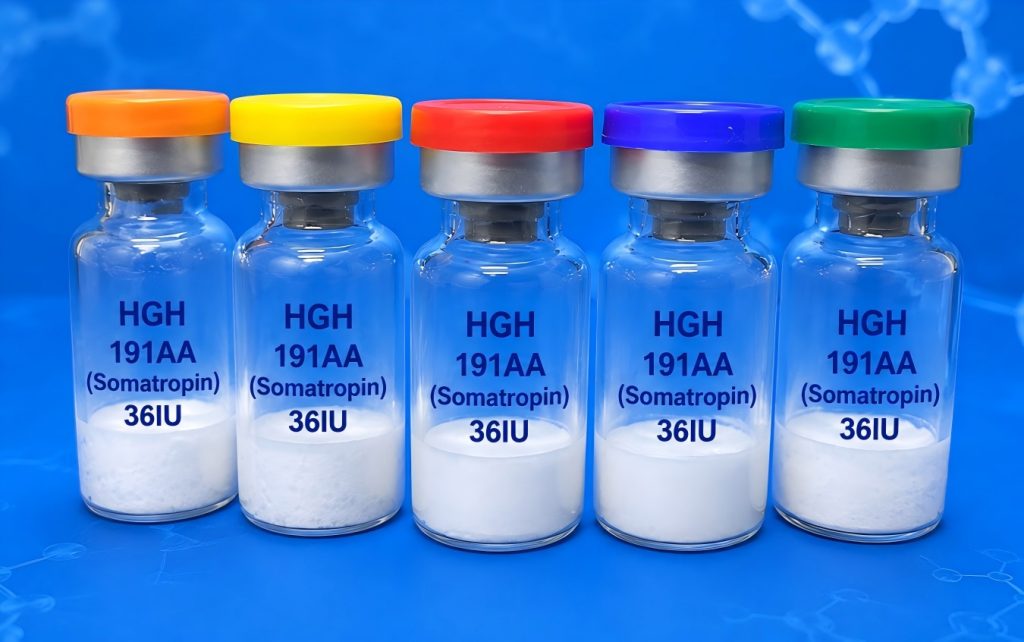
When researchers see the term HGH 191AA, attention often goes directly to purity.
But there is another important question:
Why does “191AA” matter?
For recombinant human growth hormone research, understanding molecular identity is just as important as reading a purity percentage.
What Is HGH 191AA?
HGH 191AA, also known as Somatropin or recombinant human growth hormone (rHGH), is a recombinant protein consisting of 191 amino acid residues.
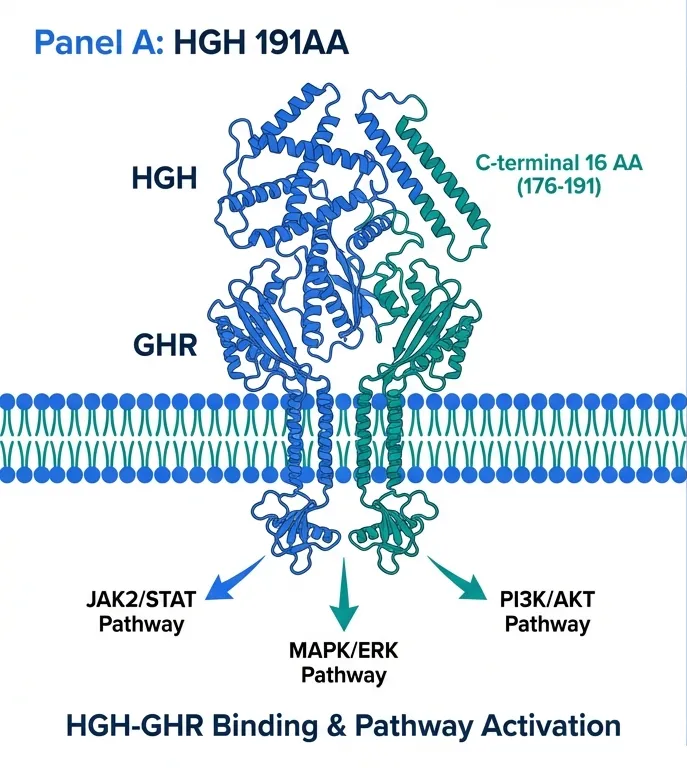
Its molecular mass is approximately 22.1 kDa.
The “191AA” designation refers to the amino-acid length of the protein and helps distinguish the intended molecular identity from other growth-hormone-related proteins, analogs or variants.
For laboratory research, this distinction matters because the material being tested should match the molecular system described in the experimental design.
Why Is HGH 191AA Studied?
HGH 191AA research is commonly associated with the growth hormone receptor (GHR) and the broader GH/IGF signaling axis.
Laboratory studies may investigate areas such as:
- Growth hormone receptor signaling
- GH/IGF-axis biology
- Endocrine signaling
- Cellular growth pathways
- Protein–receptor interactions
These research applications are different from consumer claims about “muscle building,” “fat loss” or “anti-aging.”
For scientific work, the more useful question is not simply what HGH supposedly “does,” but whether the research material has the correct identity and characteristics for the experimental model.
Is 99% Purity Enough?
Not necessarily.
A statement such as “99% HGH 191AA” tells researchers very little unless the analytical method, batch and molecular identity are also clear.
For a recombinant protein, laboratories should consider:
Identity → Purity → Molecular characteristics → Biological activity → Batch traceability
HPLC can provide useful purity information, but purity alone should not be confused with complete protein characterization.
This distinction is especially important for larger research molecules such as HGH 191AA.
What Can Online Somatropin Reviews Tell Researchers?
Online reviews of prescription somatropin include both positive and negative experiences.
Some patients report favorable experiences under medically supervised treatment, while others describe limited results, administration difficulties or adverse experiences.
However, these reviews concern specific pharmaceutical products, patient populations and clinical circumstances.
They should not be used as evidence for the performance, safety or efficacy of an HGH 191AA research reagent.
For laboratories:
Clinical drug experience and research-material characterization are two different questions.

What Should Researchers Check When Sourcing HGH 191AA?
Before selecting an HGH 191AA research protein, consider asking:
Is the 191-amino-acid identity clearly specified?
Is purity supported by analytical data?
Is the documentation batch-specific?
Are storage and handling conditions defined?
Is a COA available for the supplied lot?
SUNONE supplies HGH 191AA (Somatropin) as ≥99.7% research-grade lyophilized material with batch-specific quality documentation.
For specifications, available formats and analytical information, visit the SUNONE HGH 191AA (Somatropin) Product Page.
Final Takeaway
For HGH 191AA research, “191AA” should mean more than a keyword on a product label.
Molecular identity, analytical purity and batch documentation should work together to establish what research material is actually being supplied.
That is why researchers should look beyond a single purity percentage and evaluate the complete analytical picture.
SUNONE — Supporting biopharmaceutical research through defined identity, analytical quality and reliable batch documentation.
Disclaimer
This article is provided for scientific and educational purposes only. SUNONE HGH 191AA (Somatropin) is supplied for laboratory research and manufacturing use only. It is not intended for human or veterinary use, personal consumption, diagnosis, treatment, prevention or therapeutic applications. References to clinical literature or third-party experiences do not constitute claims regarding the efficacy or safety of SUNONE research materials.
Leave a Reply