
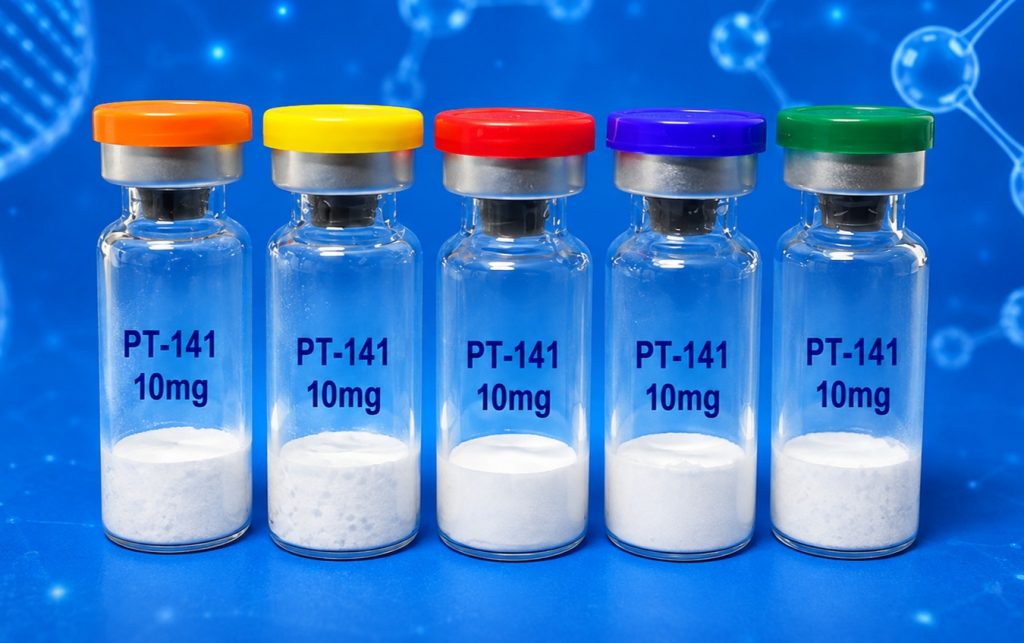
When researchers discuss PT-141, also known as Bremelanotide, it is often grouped together with compounds studied in sexual-function research.
Mechanistically, however, PT-141 is different.
Rather than being defined primarily by peripheral vascular signaling, PT-141 peptide research focuses on the central melanocortin system.
That difference makes Bremelanotide an interesting model for studying how peptide signaling in the brain may influence complex physiological responses.
What Is PT-141?
PT-141 (Bremelanotide) is a synthetic cyclic peptide derived from melanocortin research.
Its structure is designed to interact with melanocortin receptors (MCRs), a family of receptors involved in several neurological and physiological processes.
Among these receptors, MC4R has received particular attention in PT-141 research because it is expressed in areas of the central nervous system associated with behavioral and neuroendocrine signaling.
This gives PT-141 a different research profile from compounds whose primary mechanisms depend on peripheral blood-flow pathways.
Why Is the Melanocortin Pathway Interesting?

Melanocortins are naturally occurring signaling peptides related to α-melanocyte-stimulating hormone (α-MSH).
Experimental research involving PT-141 has investigated how melanocortin receptor activation may influence:
- Central nervous system signaling
- Hypothalamic pathways
- Dopaminergic signaling
- Sexual-response biology
- Neurobehavioral regulation
This creates a useful research question:
Can a peptide influence physiological behavior through central signaling rather than acting mainly through peripheral tissue?
That is one of the features that makes PT-141 scientifically distinctive.
PT-141 and Bremelanotide: Are They the Same Compound?
The names PT-141 and Bremelanotide generally refer to the same active peptide molecule.
However, researchers should distinguish between the molecular compound and a regulated pharmaceutical formulation.
Bremelanotide has been developed clinically and received FDA approval in the United States under the Vyleesi brand for a specific indication in premenopausal women.
A laboratory PT-141 research peptide, by contrast, should not be assumed to be equivalent to an approved pharmaceutical product simply because the active molecule has the same name.
Formulation, manufacturing controls, regulatory status and intended use all matter.
What Do Positive and Negative PT-141 Reviews Show?
Online Bremelanotide reviews are notably mixed.
Drugs.com currently reports an average rating of 7.2/10 from 43 reviews, with 63% describing a positive experience and 21% a negative experience.
Positive reviews commonly describe a perceived response to the approved drug.
Negative reports frequently mention experiences such as:
- Nausea
- Vomiting
- Headache
- Flushing
- Limited or inconsistent perceived effect
In the same review dataset, nausea is the most frequently mentioned adverse experience.
These comments are useful for understanding public discussion, but they should not be treated as evidence about SUNONE research material or as a replacement for controlled research.
Why Analytical Verification Matters for PT-141

PT-141 is a cyclic peptide, which means researchers should evaluate more than just a product name.
Important quality considerations include:
Molecular identity → Peptide structure → Purity → Batch traceability → Analytical documentation
HPLC can help characterize chromatographic purity, while mass spectrometry can support confirmation of expected molecular identity.
SUNONE supplies PT-141 (Bremelanotide) research peptide in lyophilized form with batch-specific analytical documentation.
For specifications, available pack sizes and quality documentation, visit the SUNONE PT-141 (Bremelanotide) Product Page.
Final Takeaway
The most interesting feature of PT-141 research is not simply that the molecule has been investigated in sexual-function studies.
It is where the signaling begins.
By targeting the melanocortin system and interacting with central nervous system pathways, Bremelanotide represents a fundamentally different research model from compounds studied primarily through peripheral vascular mechanisms.
For peptide researchers, that distinction helps connect:
Molecular structure → receptor biology → experimental design.
SUNONE — Supporting peptide research through defined identity, analytical quality and reliable batch documentation.
Disclaimer
This article is provided for scientific and educational purposes only. SUNONE PT-141 (Bremelanotide) is supplied for qualified laboratory research and manufacturing use only. It is not intended for personal use, human or veterinary consumption, diagnosis, prevention, treatment or therapeutic application. Researchers must comply with all applicable local regulations.
Leave a Reply