

Modern peptide research is increasingly moving from single-receptor signaling toward multi-receptor design.
Retatrutide (LY3437943) is a particularly interesting example.
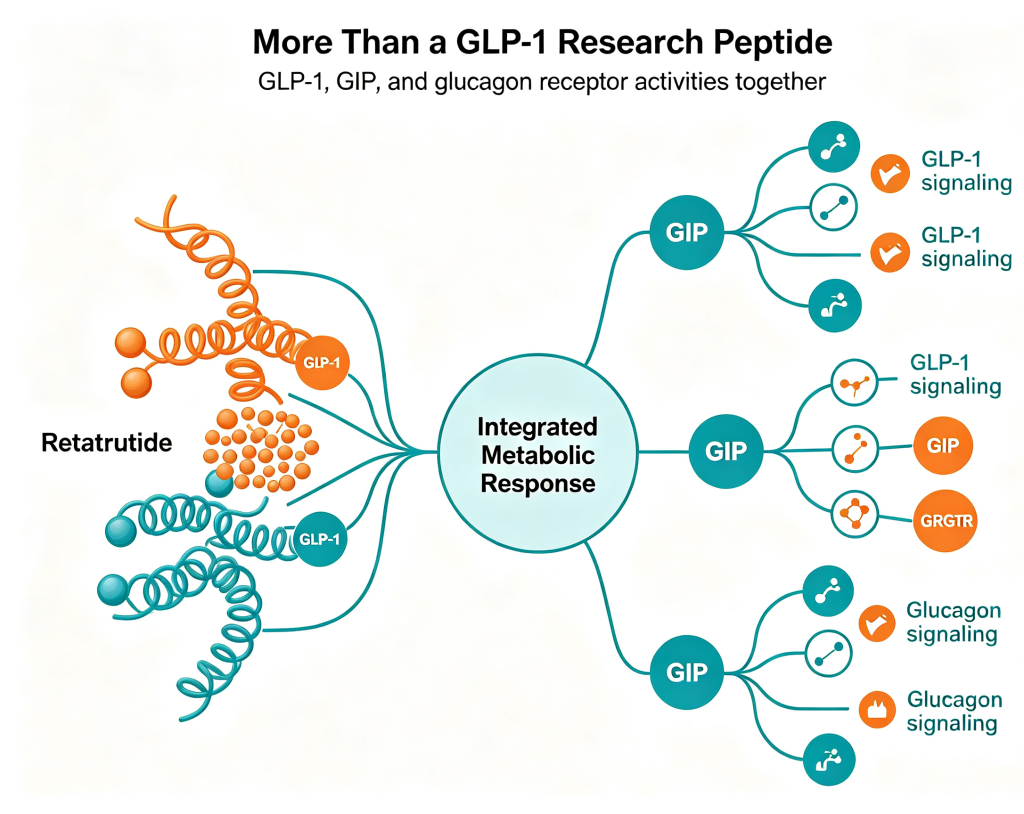
Unlike a conventional GLP-1 receptor agonist, Retatrutide is designed to activate three receptor systems: GIP, GLP-1 and glucagon receptors.
So why combine three signaling pathways in a single research molecule?
Retatrutide Is More Than a GLP-1 Research Peptide
Retatrutide is often discussed alongside GLP-1-related compounds, but describing it simply as a “GLP-1 peptide” misses an important part of its molecular design.
It is a GIP/GLP-1/glucagon triple receptor agonist.
Each receptor represents a different component of metabolic signaling:
- GIP receptor — involved in incretin and glucose-dependent signaling
- GLP-1 receptor — associated with glucose regulation, gastrointestinal and appetite-related signaling
- Glucagon receptor — involved in hepatic metabolism and energy regulation
Retatrutide therefore provides researchers with a model for studying what happens when several metabolic pathways are influenced by one engineered molecule.
Why Does Triple Agonism Matter?
This is where Retatrutide research differs from research involving single-receptor peptides.
Instead of asking:
“What happens when one pathway is activated?”
Researchers can investigate:
“How do three interconnected signaling systems behave when activated by the same molecule?”
That makes Retatrutide particularly relevant to research involving:
incretin biology → glucose metabolism → energy homeostasis → multi-receptor signaling
This multi-pathway design is one reason Retatrutide has attracted substantial scientific interest.
What Does Current Retatrutide Research Show?
Retatrutide has progressed beyond early laboratory research into large clinical development programs.
Published studies have investigated its effects on metabolic outcomes, while Phase 3 programs continue to evaluate the molecule across several conditions.
However, one distinction remains essential:
Promising clinical research does not mean an investigational molecule is an approved product.
Retatrutide remains under clinical development, and ongoing research continues to define its efficacy, safety and receptor-related effects.

What Can Positive and Negative Retatrutide Reviews Tell Us?
Online discussions about Retatrutide have grown rapidly.
Positive user reports frequently describe strong appetite-related effects and changes in eating behavior. Negative reports include experiences involving nausea, fatigue, gastrointestinal symptoms, insomnia or increased heart rate.
These experiences should be interpreted cautiously.
Products obtained outside controlled clinical research may differ in identity, purity, concentration or composition, and uncontrolled online experiences cannot establish whether Retatrutide caused a particular outcome.
For scientific interpretation:
A review is an observation—not controlled evidence.
Why Research-Grade Retatrutide Requires More Than a Purity Claim
The growing interest in Retatrutide creates another important question for laboratories:
How do you know the material being studied is actually the expected molecule?
When sourcing a Retatrutide research peptide, laboratories should consider:
Identity → Purity → Molecular specification → Batch traceability → COA/HPLC/MS documentation
A statement such as “99% purity” alone does not answer every quality question.
SUNONE supplies Retatrutide (LY3437943) research peptide as lyophilized research material with batch-specific analytical documentation.
For specifications, available formats and quality information, visit the SUNONE Retatrutide Research Peptide Product Page.
Final Perspective
The most interesting question about Retatrutide is not simply whether it produces a larger response than another metabolic peptide.
Its molecular design raises a broader research question:
Can one peptide coordinate multiple metabolic signaling pathways more effectively than targeting those pathways individually?
That question makes Retatrutide triple agonist research an important area within modern multi-receptor peptide science.
SUNONE — Supporting peptide research through defined molecular identity, analytical quality and reliable batch documentation.
Disclaimer
SUNONE Retatrutide is supplied for qualified laboratory research and manufacturing purposes only and is not intended for personal use, self-administration, diagnosis, prevention or treatment. References to experimental or clinical research do not constitute claims of efficacy or safety. Always follow applicable laws, institutional requirements and product-specific safety documentation.
Leave a Reply