

Selank peptide contains only seven amino acids:
Thr-Lys-Pro-Arg-Pro-Gly-Pro (TKPRPGP)
But its sequence tells an interesting story.
The first four amino acids correspond to tuftsin, while the final Pro-Gly-Pro (PGP) sequence extends the molecule.
That raises a more interesting research question than simply asking about “Selank benefits”:
Why was the original peptide extended at all?
Selank Starts With Tuftsin
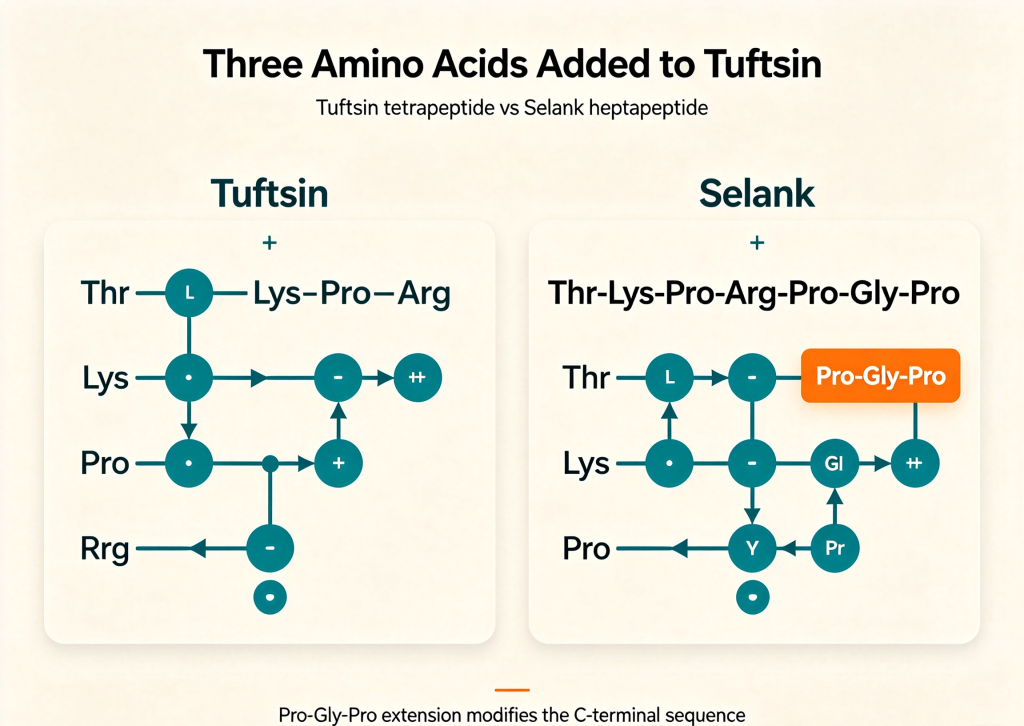
Selank is a synthetic heptapeptide developed from tuftsin, an endogenous tetrapeptide with the sequence:
Thr-Lys-Pro-Arg
Tuftsin has historically been studied in connection with immune and biological signaling.
Selank retains this four-amino-acid sequence but adds:
Pro-Gly-Pro
to its C-terminus.
This makes Selank a useful example of peptide engineering—how modifying a naturally occurring sequence can create a new research molecule with different stability and biological characteristics.
Why Does the Pro-Gly-Pro Sequence Matter?
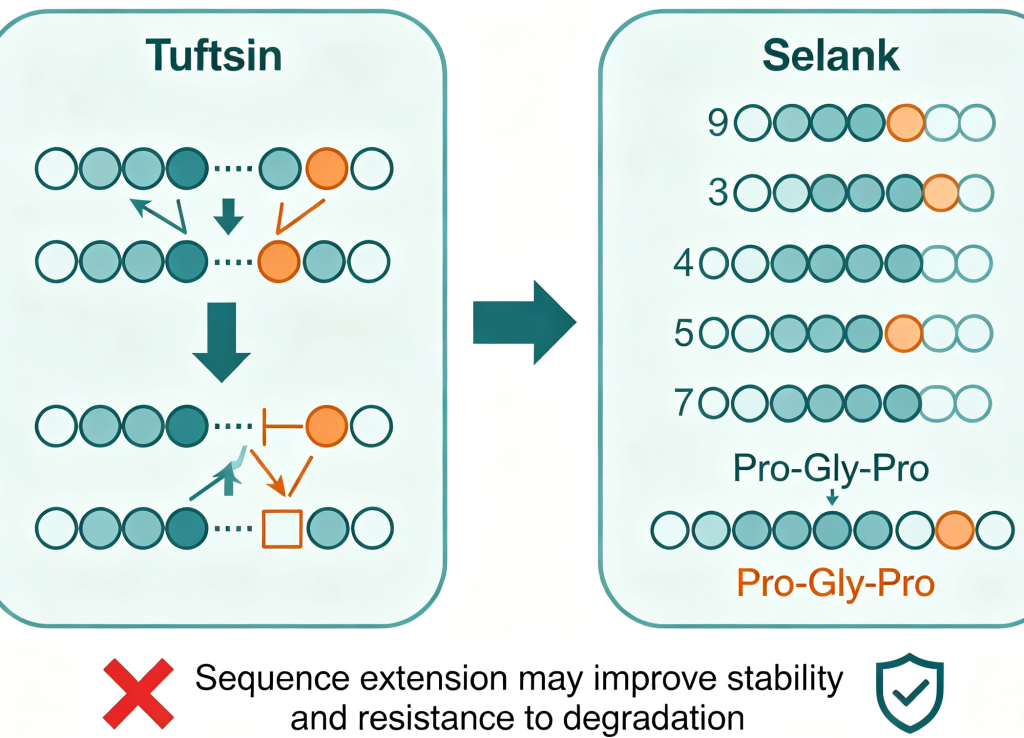
Short natural peptides can be rapidly broken down by peptidases.
The additional PGP sequence in Selank has been associated with improved metabolic stability compared with the parent peptide, allowing researchers to investigate a more persistent peptide analogue.
This distinction matters:
Selank is derived from tuftsin, but Selank is not simply another name for tuftsin.
The sequence modification creates a chemically distinct research compound.
What Has Selank Research Investigated?
Published Selank research has explored several biological areas, including:
- GABA-related signaling
- Gene-expression changes
- Neuroplasticity-associated pathways
- Stress-response mechanisms
- Neuroimmune interactions
- Anxiety-related experimental models
Small human studies have also reported anxiety-related outcomes. However, the clinical evidence base remains limited and is concentrated largely in Russian-language research.
That means laboratory findings and early clinical signals should not be converted directly into broad claims about human efficacy.
Why Are Online Selank Reviews So Different?
Search for Selank reviews and the experiences can appear contradictory.
Some users describe feelings of calmness or improved wellbeing, while others report no clear effect or experiences such as overstimulation, anxiety, nausea, headache or brain fog.
There is a simple scientific problem with these reports:
The peptide identity, purity, route, co-administered compounds and experimental conditions are usually uncontrolled.
Anecdotal experiences may suggest questions worth investigating, but they cannot establish whether Selank is effective or safe.
For Researchers, Sequence Comes Before Claims
When evaluating a Selank research peptide, the most important information is not an online testimonial.
Researchers should verify:
Sequence → Molecular identity → Purity → Batch traceability → Analytical documentation
SUNONE supplies Selank as a lyophilized research peptide for laboratory applications.
For specifications and available quality documentation, visit the SUNONE Selank Research Peptide product page:
Final Takeaway
The interesting story behind Selank begins with seven amino acids.
Its TKPRPGP sequence, tuftsin origin and added Pro-Gly-Pro segment demonstrate how a relatively small structural modification can create a different peptide research tool.
Instead of asking only “What are the benefits of Selank?”, researchers can ask a more fundamental question:
How does modifying a natural peptide sequence change its stability and experimental behavior?
SUNONE — Supporting peptide research through defined molecular identity, analytical quality and reliable batch documentation.
Disclaimer
This article is provided for scientific and educational purposes only. SUNONE Selank is supplied for laboratory research and manufacturing use only. It is not intended for human or veterinary use, personal consumption, diagnosis, prevention, treatment or therapeutic applications. Researchers must comply with all applicable local regulations.
Leave a Reply