
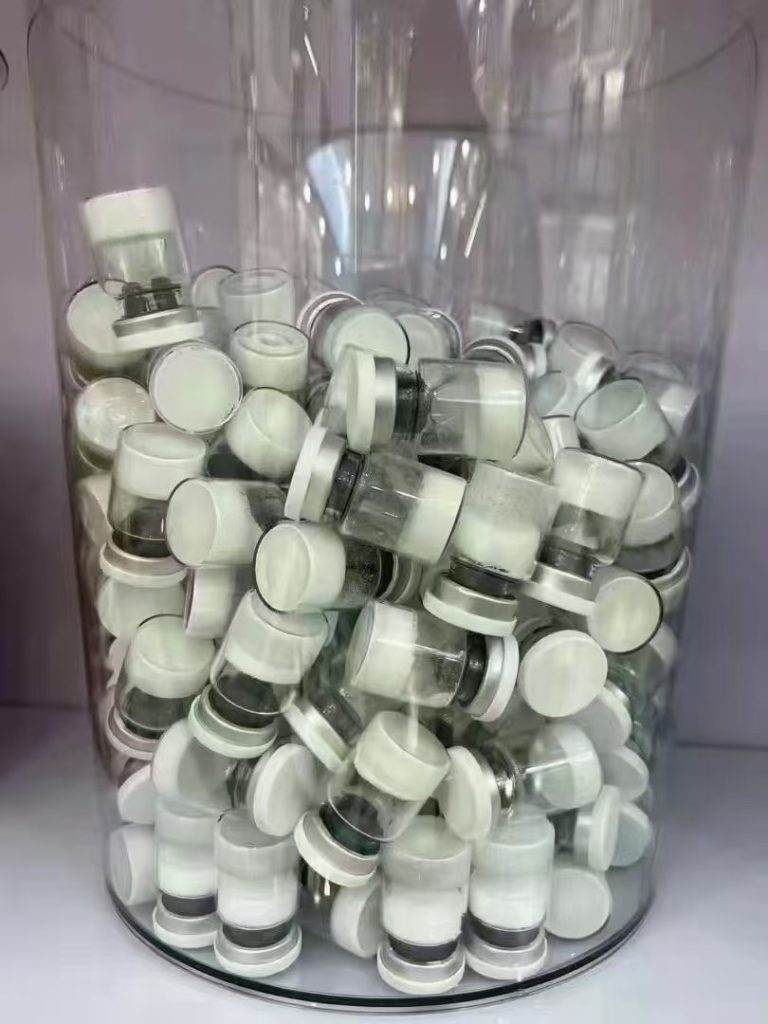
Search for HGH Fragment 176-191 and another name quickly appears: AOD-9604.
They are often discussed as though they were interchangeable.
For researchers, however, “almost the same peptide” is not the same as the same molecular identity.
That distinction is exactly why HGH Fragment 176-191 deserves closer attention.
What Is HGH Fragment 176-191?
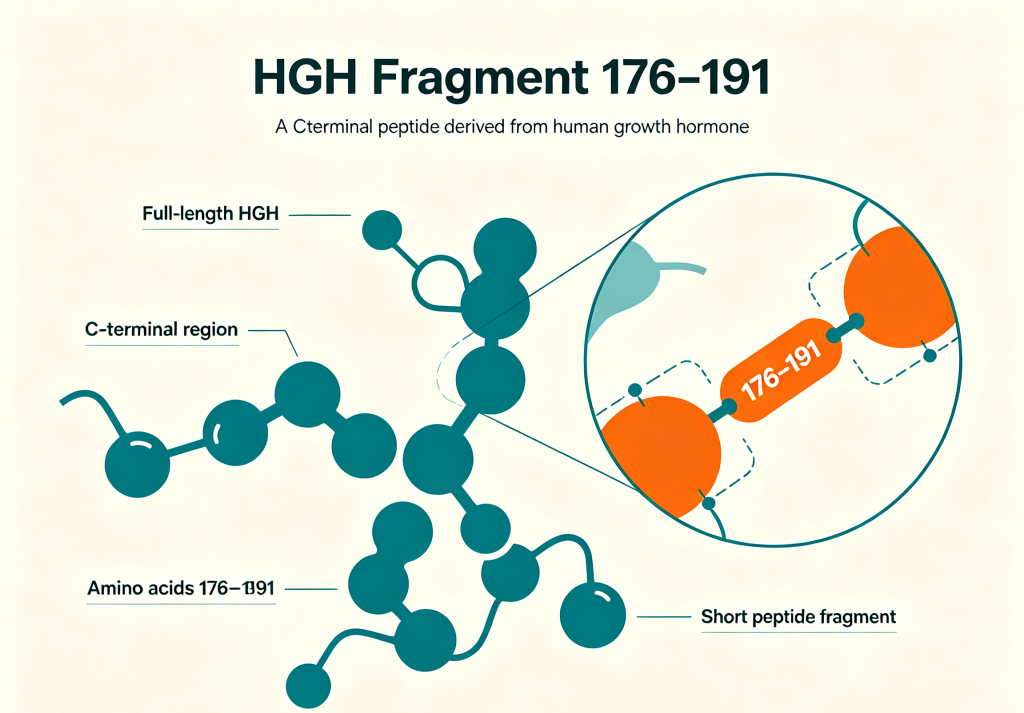
HGH Fragment 176-191 is a short peptide associated with the C-terminal region of human growth hormone (hGH).
Full-length human growth hormone contains 191 amino acids. Fragment research emerged from attempts to determine whether biological activities associated with the full protein could be mapped to smaller regions of the molecule.
Early research investigated synthetic C-terminal hGH sequences in lipid-metabolism models.
This makes HGH Fragment 176-191 interesting from a structure-function perspective:
How much biological information can a short region retain when separated from a much larger protein?
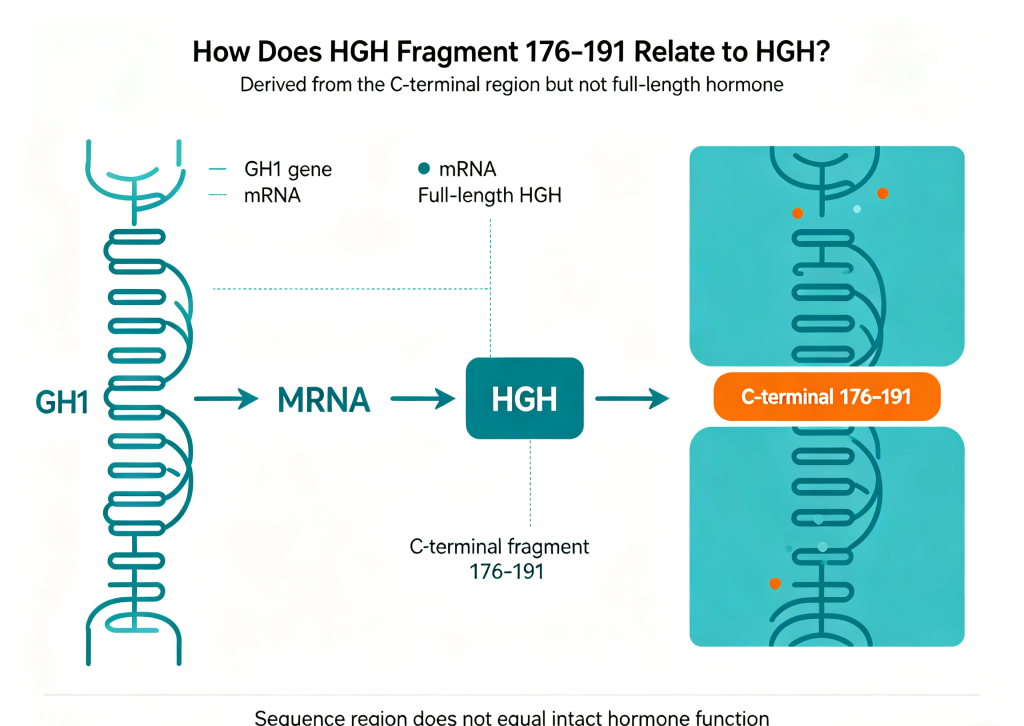
HGH Fragment 176-191 Is Not Full-Length HGH
The name “HGH Fragment” can create another misconception.
A peptide derived from the sequence of human growth hormone should not automatically be interpreted as miniature HGH.
Removing most of a protein changes its molecular architecture dramatically.
Full-length HGH contains structural regions required for its broader receptor interactions. A short C-terminal fragment represents only a small portion of that architecture.
Researchers should therefore distinguish between:
Full-length HGH → 191-amino-acid protein
and
HGH Fragment 176-191 → short C-terminal research peptide
Evidence for one cannot automatically be transferred to the other.
Is HGH Fragment 176-191 the Same as AOD-9604?
This is where online information becomes confusing.
AOD-9604 was developed from the C-terminal lipolytic region of human growth hormone and is closely related to HGH Fragment 176-191.
However, the published and commercial literature contains different naming conventions for these related sequences. AOD-9604 is commonly described as an engineered analog associated with the hGH 177-191 region and an N-terminal tyrosine modification.
That means researchers should not rely on a familiar product name alone.
Instead, verify:
Exact sequence → Molecular mass → Chemical form → Analytical identity
This is especially important when two research peptides differ by only a small structural modification.
What Does the Research Actually Show?
Early laboratory research on C-terminal hGH fragments investigated effects on lipid metabolism in animal and tissue models.
Related research on the modified analog AOD-9604 also reported metabolic activity in animal models.
But this evidence needs careful interpretation.
Much of the mechanistic literature is preclinical, and research performed on AOD-9604 should not automatically be cited as direct evidence for every material marketed as HGH Fragment 176-191.
This creates a simple but important evidence rule:
Related molecule ≠ identical molecule ≠ identical evidence base.
What Do Positive and Negative Reviews Say?
Public discussions around HGH Fragment 176-191 are highly mixed.
Some anecdotal reports describe favorable changes in body composition or weight while reporting few noticeable adverse experiences.
Other users report little or no perceived effect and question whether the compound provided meaningful value.
Neither side resolves the scientific question.
Uncontrolled reviews can be influenced by diet, activity, other compounds, source quality, product identity and many other variables.
For research interpretation:
Anecdotal experience generates questions. Controlled research tests them. Analytical testing verifies what material was actually studied.
Why Analytical Identity Matters
For an HGH Fragment 176-191 research peptide, purity is important—but purity alone is not enough.
Researchers should also verify that the material actually corresponds to the intended peptide.
A practical quality framework is:
Sequence identity → Molecular mass → Purity → Batch consistency → Analytical documentation
Techniques such as HPLC and mass spectrometry can therefore play complementary roles in peptide characterization.
SUNONE supplies HGH Fragment 176-191 research peptide for qualified laboratory and analytical research.
Explore specifications and available research formats through the SUNONE Products Catalog.
Final Takeaway
HGH Fragment 176-191 provides a useful lesson that extends far beyond one peptide.
In peptide research, similar names do not guarantee identical molecules—and similar molecules do not automatically share identical evidence.
When evaluating HGH Fragment 176-191, AOD-9604 or full-length HGH, researchers should begin with molecular identity before interpreting biological claims.
SUNONE — Supporting peptide research through defined molecular identity, analytical quality and reliable batch documentation.
Disclaimer
This article is provided solely for scientific, analytical and educational purposes. SUNONE HGH Fragment 176-191 is supplied for qualified laboratory research and manufacturing purposes only. It is not intended for personal use, human or veterinary administration, diagnosis, prevention, treatment or therapeutic application. Researchers must comply with all applicable local regulations.
Leave a Reply