
Liraglutide, also known as NN2211, is often introduced simply as a GLP-1 analog.
But one of the most interesting features of the molecule is easy to overlook:
Liraglutide carries a C16 fatty-acid-related side chain.
Why attach a lipid structure to a peptide?
The answer illustrates an important principle in modern peptide engineering: changing how a molecule travels through a biological system can be just as important as changing the receptor it targets.
What Is Liraglutide?
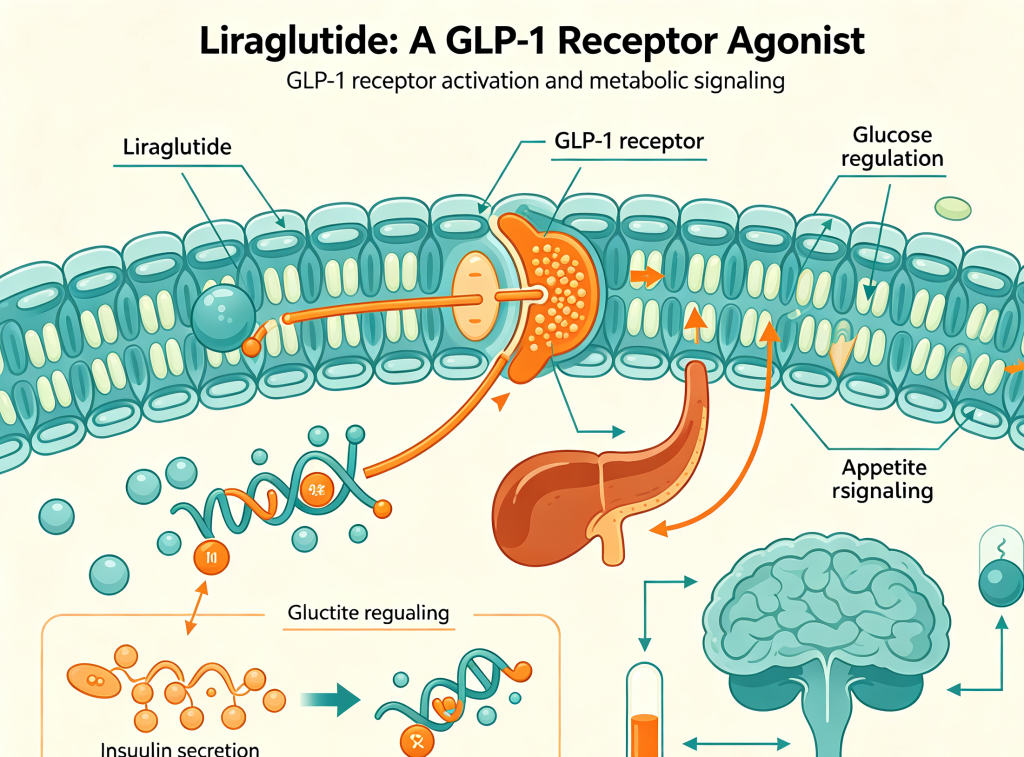
Liraglutide is an acylated glucagon-like peptide-1 (GLP-1) analog designed to activate the GLP-1 receptor.
Its structure remains closely related to native human GLP-1, but specific molecular modifications change its pharmacological behavior.
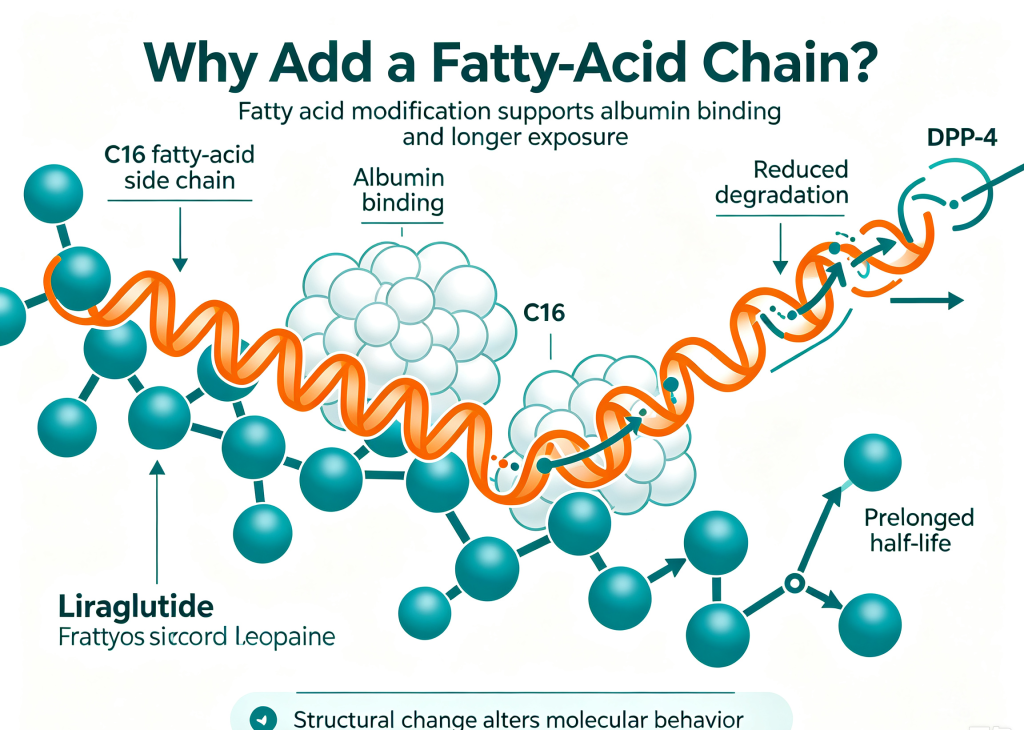
One of the most important is the attachment of a C16 fatty-acid chain through a linker.
That structural feature is central to understanding Liraglutide research.
Why Add a Fatty-Acid Chain to a Peptide?
Native peptide hormones can be cleared or degraded rapidly.
Liraglutide uses a different strategy.
Its fatty-acid-related modification promotes reversible association with albumin, an abundant plasma protein.
Albumin association helps alter the molecule’s exposure and protects it from rapid elimination.
This creates a useful peptide-engineering concept:
Modify the molecule → change protein association → change molecular persistence.
The fatty-acid chain is therefore not simply an extra structural decoration. It is part of the molecular engineering strategy behind Liraglutide.
Liraglutide Shows Why Sequence Is Only Part of Peptide Design
Researchers often begin peptide characterization by looking at amino-acid sequence.
For modified peptides, however, sequence alone may not tell the whole story.
Liraglutide demonstrates why researchers may also need to consider:
Sequence + modification + protein binding + receptor activity
Two peptides can interact with the same receptor while displaying very different experimental behavior because their structures influence stability and molecular exposure differently.
This is particularly relevant when comparing native GLP-1, Liraglutide, Semaglutide and other incretin-related molecules.
They belong to related research areas, but they should not be treated as interchangeable materials.
What Do Positive and Negative Liraglutide Reviews Tell Us?
Public experiences with pharmaceutical Liraglutide are mixed.
Positive reports commonly describe changes in appetite, food-related thoughts and body-weight outcomes.
Negative reports include gastrointestinal discomfort, nausea, fatigue and, in some individual accounts, mood-related concerns or limited perceived effect.
These reports may help identify questions worth investigating, but they cannot establish the identity, purity or performance of a laboratory research material.
A user review evaluates an experience. Analytical testing evaluates a molecule.
Those are different forms of evidence.
What Should Researchers Verify When Sourcing Liraglutide?
For Liraglutide research peptide, a product name alone is insufficient.
Researchers should consider:
Molecular identity → Acylated structure → Purity → Analytical verification → Batch consistency
SUNONE supplies Liraglutide (NN2211) as ≥98% HPLC research-grade lyophilized peptide with batch-specific quality documentation for qualified laboratory and manufacturing applications.
For specifications and available formats, visit the SUNONE Liraglutide Research Peptide Product Page.
Final Takeaway
Liraglutide provides a useful lesson in peptide engineering.
Its research significance is not limited to GLP-1 receptor activation. The molecule also demonstrates how adding a fatty-acid-related modification can influence albumin association and molecular persistence.
For researchers, that leads to a broader principle:
Peptide function is influenced not only by where a molecule binds—but also by how the molecule itself has been engineered.
SUNONE — Supporting peptide research through defined molecular identity, analytical quality and reliable batch documentation.
Disclaimer
This article is provided solely for scientific, analytical and educational purposes. SUNONE Liraglutide (NN2211) is supplied for qualified laboratory research and manufacturing use only. It is not intended for personal use, human or veterinary administration, diagnosis, prevention, treatment or therapeutic application. References to approved pharmaceutical products, published studies or third-party experiences do not establish the safety, efficacy or regulatory status of SUNONE research material.
Leave a Reply