
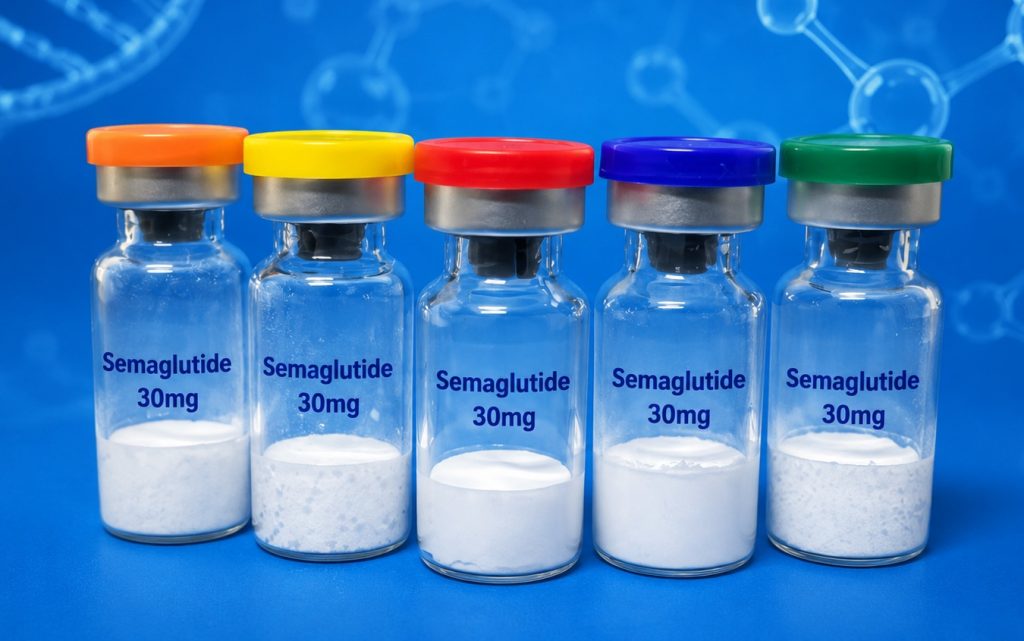
Semaglutide is usually discussed in terms of what it does.
For peptide researchers, another question may be more interesting:
How was a naturally short-lived GLP-1 signal engineered into a much longer-lasting peptide molecule?
The answer lies in molecular design.
Semaglutide combines amino-acid substitution, lipidation and albumin binding—making it a useful example of how peptide engineering can change pharmacokinetic behavior.
What Is Semaglutide?
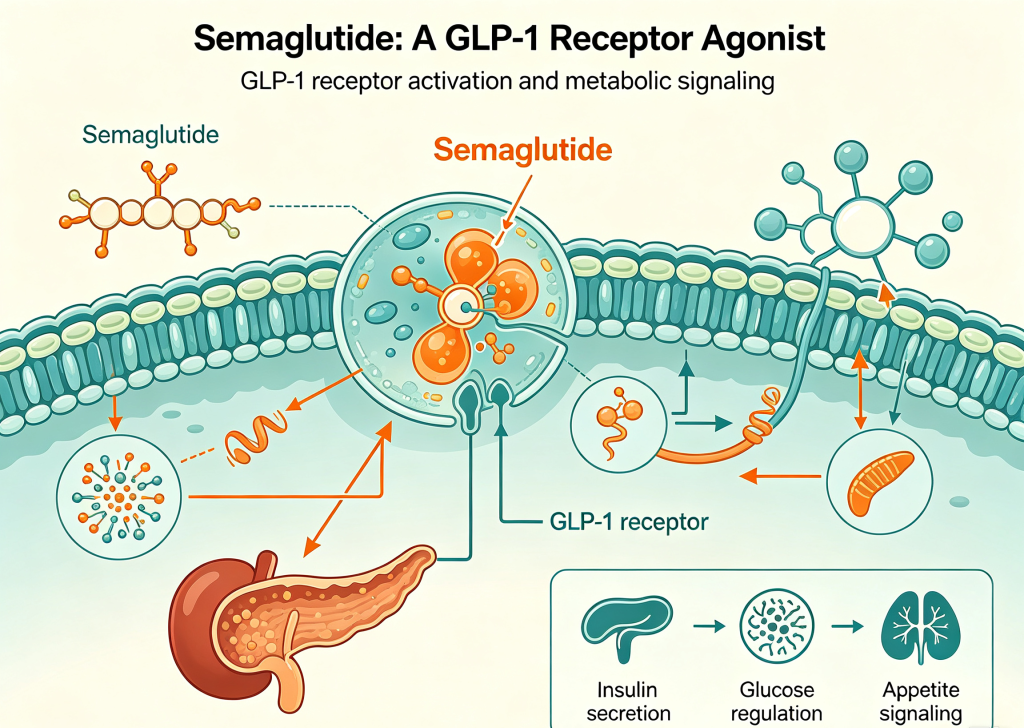
Semaglutide is a synthetic GLP-1 analogue designed to activate the glucagon-like peptide-1 receptor (GLP-1R).
Its molecular formula is C187H291N45O59, with a molecular weight of approximately 4113.58 g/mol.
Although Semaglutide is structurally related to native GLP-1, it is not simply a copy of the endogenous peptide.
Several deliberate molecular modifications help explain its distinctive research profile.
Modification #1: Protecting the Peptide From DPP-4
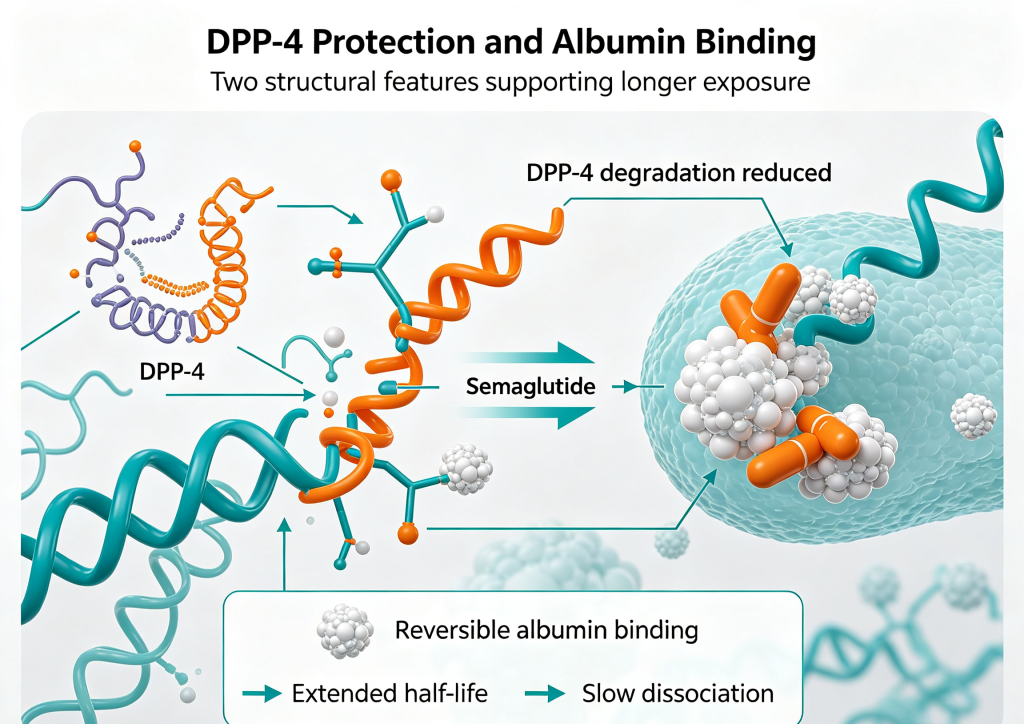
Native GLP-1 is rapidly degraded by the enzyme dipeptidyl peptidase-4 (DPP-4).
Semaglutide changes this problem at the molecular level.
At position 8, the native alanine is replaced by Aib (2-aminoisobutyric acid).
This modification increases resistance to DPP-4-mediated degradation.
It demonstrates an important principle in peptide engineering:
Changing one strategically selected residue can substantially change molecular stability.
Modification #2: Engineering Albumin Binding
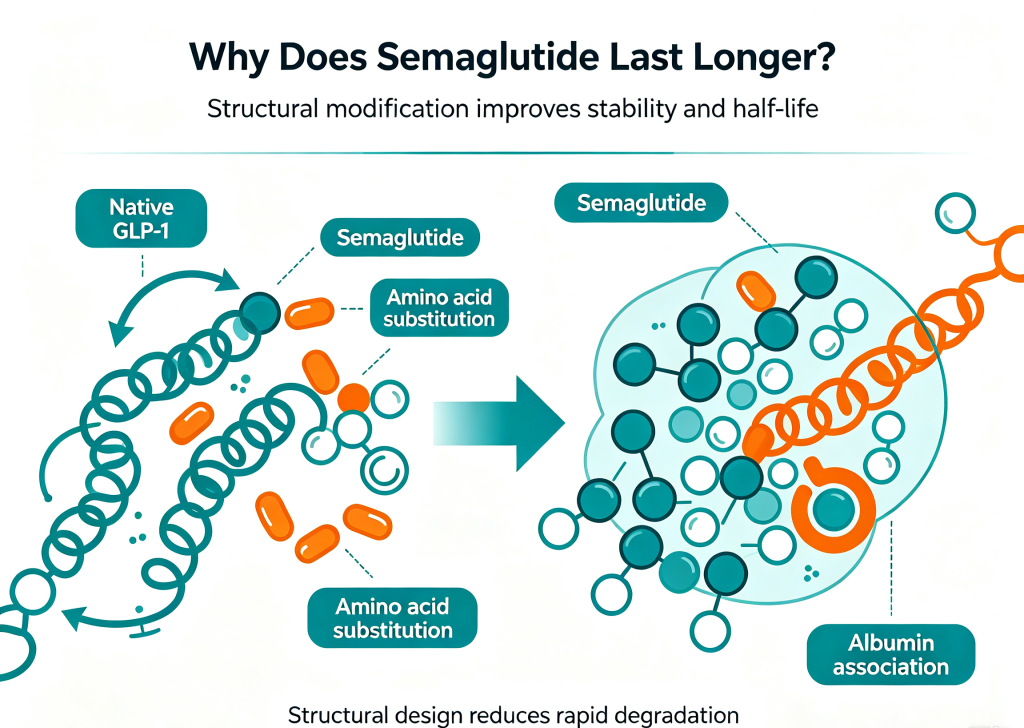
Semaglutide contains another important structural feature at Lys26.
A C18 fatty diacid side chain is attached through a linker.
Why add a lipid chain to a peptide?
Because this structural modification promotes reversible interaction with serum albumin.
Albumin binding can reduce rapid clearance and influence the circulating behavior of lipidated peptides.
Recent molecular research continues to investigate exactly how Semaglutide’s fatty-acid side chain interacts with human serum albumin.
This makes Semaglutide more than a GLP-1 receptor research molecule—it is also an interesting model for studying peptide half-life engineering.
Semaglutide Research Is Also a Structure Question
Structural studies of Semaglutide bound to GLP-1R show how the engineered peptide interacts with its receptor while maintaining GLP-1 receptor agonist activity.
This creates an important research challenge.
A peptide engineer cannot simply maximize stability.
The molecule must balance:
Receptor interaction → Proteolytic stability → Albumin affinity → Molecular exposure
Too much structural modification can potentially change receptor interactions.
Too little may leave the peptide vulnerable to rapid degradation.
Semaglutide illustrates how several design variables can be engineered within one GLP-1 analogue.
What Do Positive and Negative Semaglutide Reviews Show?
Semaglutide has a very large volume of online user feedback.
Positive reviews frequently describe perceived improvements in appetite control, body weight or metabolic management.
Negative reviews commonly discuss gastrointestinal experiences such as nausea, vomiting, constipation or other tolerability concerns, while some users report limited perceived benefit.
These experiences relate primarily to regulated pharmaceutical Semaglutide products used in clinical settings.
They should not be interpreted as reviews of SUNONE research-grade Semaglutide.
More importantly for researchers, user reviews cannot verify peptide identity, purity or molecular structure.
A testimonial describes an experience. Analytical data describes the material.
What Should Researchers Verify When Sourcing Semaglutide?
Because Semaglutide is a chemically modified GLP-1 analogue, laboratories should evaluate more than a headline purity percentage.
A useful framework is:
Identity → Molecular structure → Purity → Chemical form → Batch documentation
SUNONE supplies Semaglutide research peptide as ≥99.2% HPLC-certified lyophilized material for qualified laboratory and manufacturing research.
For specifications, available formats and analytical information, visit the SUNONE Semaglutide Research Peptide Product Page.
Final Takeaway
Semaglutide provides a useful lesson in modern peptide engineering.
Its scientific interest is not limited to GLP-1 receptor signaling.
The molecule also demonstrates how researchers can use:
amino-acid substitution + lipidation + albumin binding
to alter the behavior of a peptide while preserving receptor activity.
That makes Semaglutide an important research model not only for incretin biology, but also for understanding how molecular engineering can transform peptide stability and pharmacokinetics.
SUNONE — Supporting peptide research through defined molecular identity, analytical quality and reliable batch documentation.
Disclaimer
This article is provided for scientific and educational purposes only. SUNONE Semaglutide is supplied strictly for qualified laboratory research and manufacturing use. It is not intended for personal use, human or veterinary consumption, diagnosis, prevention, treatment or therapeutic application. Researchers must comply with all applicable local regulations.
Leave a Reply