
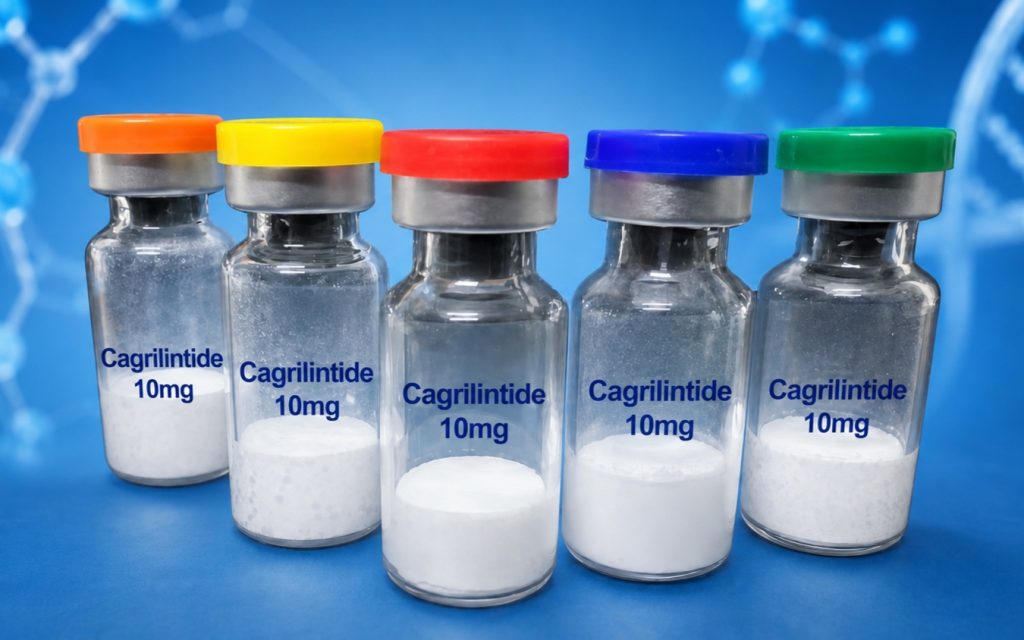
What Is Cagrilintide?
Cagrilintide is a synthetic, long-acting analogue of amylin, a peptide hormone naturally co-secreted with insulin by pancreatic beta cells.
Unlike the increasingly familiar GLP-1 research peptides, Cagrilintide peptide is primarily associated with the amylin signaling pathway. Its molecular design is intended to provide greater stability and a longer duration of activity than native amylin, making it an important molecule in current metabolic and appetite-regulation research.
Cagrilintide is also known in scientific literature as AM833, AM-833 and NN0174-0833.
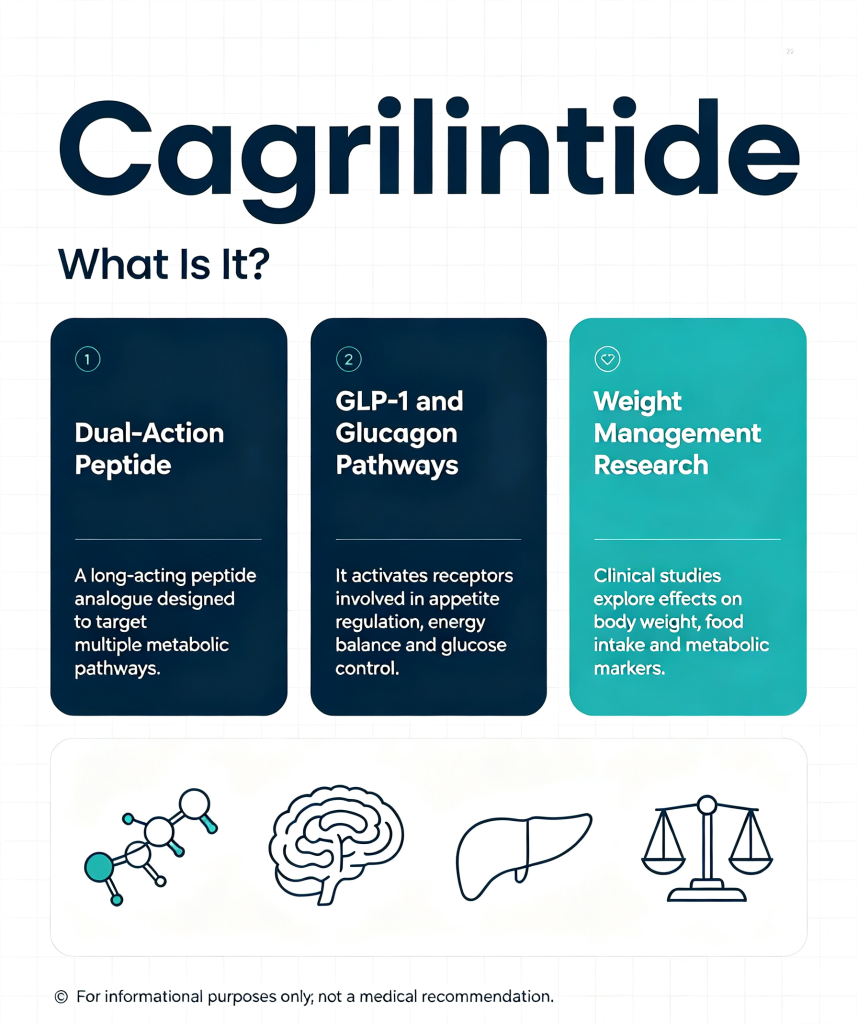
Cagrilintide Molecular Profile
Researchers evaluating a Cagrilintide research peptide should first verify its molecular identity.
Key reference information includes:
- Product Name: Cagrilintide
- Synonyms: AM833, AM-833, NN0174-0833
- CAS Number: 1415456-99-3
- Molecular Formula: C194H312N54O59S2
- Molecular Weight: approximately 4409 g/mol
- Classification: Long-acting amylin analogue
- Typical Research Form: Lyophilized peptide
These characteristics distinguish Cagrilintide from GLP-1 receptor agonists and make it particularly relevant to research involving amylin receptor signaling and metabolic regulation.
Why Is Cagrilintide Being Studied?
Amylin participates in physiological processes associated with satiety and energy regulation. However, native amylin has characteristics that limit its suitability as a long-acting research molecule.
Cagrilintide was developed as an acylated long-acting amylin analogue, creating a molecule with properties suitable for extended pharmacological investigation.
Published clinical research has examined Cagrilintide in people with overweight or obesity, while newer research programs continue to investigate both Cagrilintide alone and its combination with semaglutide.
An important distinction is that Cagrilintide and CagriSema are not the same research material.
Cagrilintide refers to the amylin analogue itself. CagriSema combines cagrilintide with semaglutide, a GLP-1 receptor agonist. Results reported for the combination should therefore not automatically be attributed to Cagrilintide alone.
What Do Online Cagrilintide Reviews Say?
Searches for Cagrilintide reviews reveal mixed anecdotal experiences.
Positive online discussions frequently mention perceived appetite suppression, increased satiety and reduced “food noise.” At the same time, other users report limited perceived effects.
Negative discussions commonly mention experiences such as nausea, fatigue, dizziness or other tolerability concerns.
These online comments require considerable caution.
Anecdotal reviews are not controlled scientific studies, and the identity, purity and source of materials discussed online often cannot be independently verified. Differences in other compounds being used and individual variables further limit meaningful comparison.
For these reasons, Cagrilintide reviews should not be interpreted as evidence of clinical efficacy or safety.
Why Cagrilintide Peptide Quality Matters
For laboratories sourcing research grade Cagrilintide, analytical quality can directly affect the reliability and reproducibility of experimental results.
Researchers and B2B buyers should consider:
Identity Verification
Analytical methods such as mass spectrometry can support confirmation of peptide identity.
Purity Analysis
HPLC analysis can provide information about peptide purity and related impurities.
Batch-Specific COA
A Cagrilintide COA should correspond to the specific manufacturing batch rather than simply provide generic product information.
Batch Traceability
Documented lot information helps researchers compare materials across experiments and production runs.
Storage and Handling
Research peptides require appropriate storage and handling procedures to help maintain sample integrity.
These factors can be particularly important when comparing a Cagrilintide supplier or Cagrilintide manufacturer for ongoing laboratory projects.
SUNONE Cagrilintide Research Peptide
SUNONE supplies Cagrilintide peptide for qualified laboratory research and biopharmaceutical applications, supported by peptide manufacturing and analytical quality-control capabilities.
For researchers, biotechnology companies, distributors and other qualified B2B customers, product specifications and available documentation can be found here:
View SUNONE Cagrilintide Peptide
When evaluating Cagrilintide research materials, researchers should consider molecular identity, analytical purity, batch documentation and manufacturing consistency rather than relying solely on nominal peptide quantity or online claims.

Final Thoughts
Cagrilintide represents a different direction in metabolic peptide research from conventional GLP-1-focused compounds.
As a long-acting amylin analogue, Cagrilintide has attracted significant scientific interest in appetite regulation, metabolic signaling and combination approaches involving complementary biological pathways.
At the same time, researchers should clearly distinguish published scientific evidence from anecdotal online reviews—and distinguish research involving Cagrilintide alone from CagriSema combination studies.
For laboratories sourcing Cagrilintide research peptide, verified identity, analytical purity, batch-specific documentation and consistent manufacturing remain important considerations.
For more information, please click:
Disclaimer
This article is provided solely for scientific, educational and laboratory research information. It does not constitute medical advice and should not be interpreted as a claim regarding the diagnosis, prevention, treatment or cure of any disease.
SUNONE Cagrilintide products are intended for qualified laboratory research and manufacturing applications only. They are not intended for personal use, self-administration, human or veterinary consumption, diagnostic use or therapeutic use unless separately registered and authorized under applicable laws and regulations.
Leave a Reply