
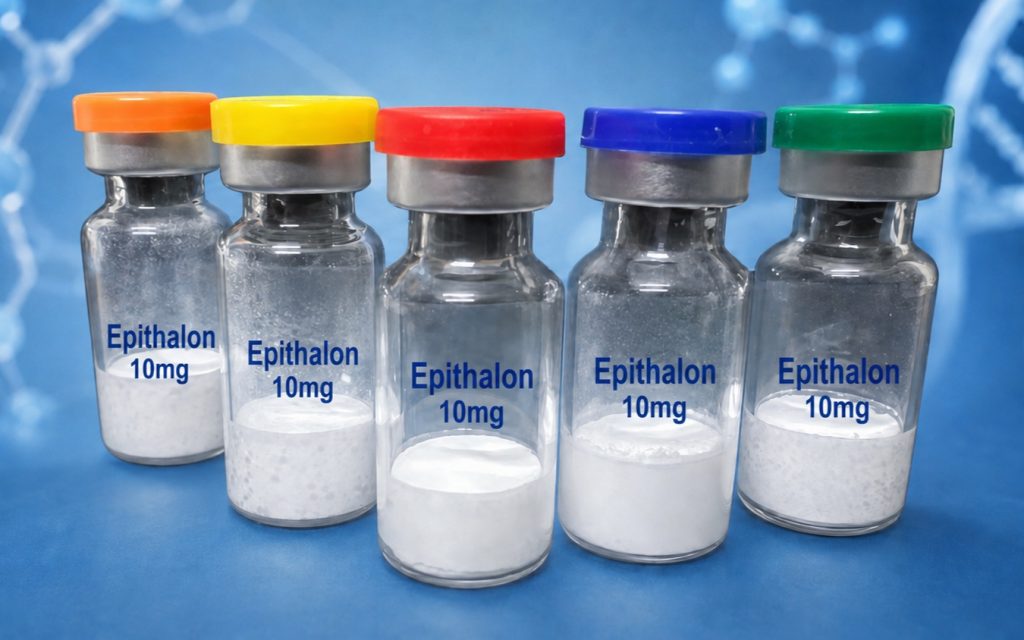
What Is Epithalon?
Epithalon, also widely known as Epitalon, is a remarkably small research peptide.
While many peptides contain dozens of amino acids, Epithalon consists of only four:
Ala–Glu–Asp–Gly (AEDG)
This simple tetrapeptide has attracted research interest in cellular aging, telomere biology, telomerase activity, circadian pathways and peptide signaling.
Its small size also makes Epithalon an interesting model for studying a broader scientific question:
How can a four-amino-acid peptide influence complex cellular pathways?
Epithalon at a Glance
Key reference information for Epithalon research peptide includes:
- Name: Epithalon
- Alternative Name: Epitalon
- Sequence: Ala-Glu-Asp-Gly
- Abbreviation: AEDG
- CAS Number: 307297-39-8
- Molecular Formula: C14H22N4O9
- Molecular Weight: 390.35 g/mol
- Peptide Length: 4 amino acids
- Research Form: Lyophilized peptide
The terms Epithalon, Epitalon and AEDG peptide are therefore frequently encountered when searching scientific literature and research-peptide databases.
Why Is Epitalon Associated With Telomere Research?
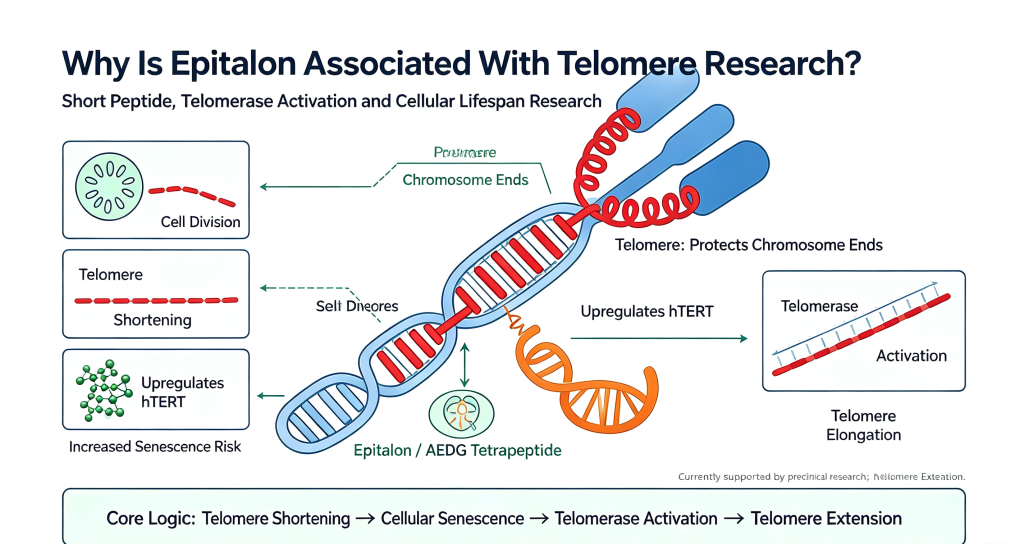
Much of the scientific attention surrounding Epitalon peptide comes from experimental studies involving telomeres and telomerase.
Telomeres are repetitive DNA structures located at chromosome ends. They help protect genomic material, but telomere length can change as cells repeatedly divide.
Telomerase is one of the biological mechanisms capable of influencing telomere maintenance.
Earlier laboratory research reported that Epithalon exposure in cultured human cells was associated with increased telomerase activity and changes in telomere length.
More recent cell-based research has continued investigating Epitalon in relation to hTERT expression, telomerase activity and alternative lengthening of telomeres (ALT).
This explains why searches for “Epitalon telomerase” and “Epitalon telomere research” frequently appear alongside the peptide.
Does That Mean Epithalon Is an “Anti-Aging Peptide”?
This is where careful scientific language matters.
Cellular observations are not the same as demonstrated longevity outcomes in humans.
A laboratory study showing changes in telomerase activity or telomere length can provide valuable mechanistic evidence—but it does not independently establish that a compound extends human lifespan or reverses human aging.
Epithalon has also been investigated in experimental work involving circadian biology, melatonin-related pathways, gene expression and cellular differentiation.
These findings make the peptide scientifically interesting.
They do not make every “anti-aging” claim found online scientifically established.
For researchers, the more accurate description is:
Epithalon is a tetrapeptide studied in experimental models involving telomere biology, cellular aging and related signaling pathways.
What Do Online Epithalon Reviews Tell Us?
Searches for Epitalon reviews produce an unusually mixed picture.
Some online users describe perceived improvements in sleep patterns, circadian rhythm or general well-being.
Others report exactly the opposite: little or no noticeable change. Some discussions also mention fatigue, altered sleep or other unwanted experiences.
This inconsistency highlights an important limitation of anecdotal evidence.
Online experiences usually do not control for:
- Material identity
- Peptide purity
- Storage history
- Other compounds being used
- Individual biological variables
- Experimental conditions
For that reason, online Epithalon reviews should not be treated as evidence of efficacy or safety.
Anecdotes describe experiences. Controlled experiments test hypotheses.
Why Epithalon Quality Verification Still Matters
Epithalon contains only four amino acids, but a short sequence does not eliminate the need for analytical verification.
When comparing an Epithalon supplier or Epitalon manufacturer, researchers should look beyond the product name printed on the vial.
HPLC Purity
HPLC can provide information about the chromatographic purity of a sample and detectable related components.
However, a “99% HPLC” statement alone should not automatically be interpreted as complete proof of material identity.
Molecular Identity
Identity analysis can provide additional evidence that the material corresponds to the expected AEDG peptide.
Batch-Specific COA
A useful Epithalon COA should be connected to the actual production batch being supplied.
This is more informative than a generic certificate used across unrelated lots.
Traceability
Lot numbers, analytical records and product specifications help connect the physical research material with its quality documentation.
For reproducible laboratory research, that connection matters.
SUNONE Epithalon Research Peptide

SUNONE supplies Epithalon (Epitalon/AEDG) research peptide for qualified laboratory, analytical and biopharmaceutical research applications.
SUNONE Epithalon is supplied as ≥99% HPLC lyophilized research material, with applicable analytical and batch documentation available according to product specifications.
Researchers, biotechnology companies, distributors and qualified B2B customers can review product specifications here:
View SUNONE Epithalon Research Peptide
When sourcing research grade Epithalon, laboratories should evaluate molecular identity, analytical purity, batch-specific documentation, traceability and manufacturing consistency together rather than relying on a single headline purity percentage.
Final Thoughts
Epithalon is a useful example of why peptide research requires careful interpretation.
The molecule itself is simple—just four amino acids: AEDG.
The biological questions surrounding it are not.
Research into Epitalon, telomerase and telomere biology provides interesting mechanistic findings, while newer studies continue to investigate how this small peptide interacts with cellular pathways.
But mechanistic evidence should not be transformed into unsupported promises about human longevity.
For laboratories studying Epithalon peptide, the strongest approach remains the same:
Start with verified material, examine the analytical evidence, and let controlled research—not online claims—determine the conclusion.
For more information, please click here.
Disclaimer
All compounds available from SUNONE Peptides are intended strictly for in vitro research and laboratory use only. They are not intended for human consumption, therapeutic application, or any form of bodily introduction. Researchers must comply with all applicable local regulations.
Leave a Reply