
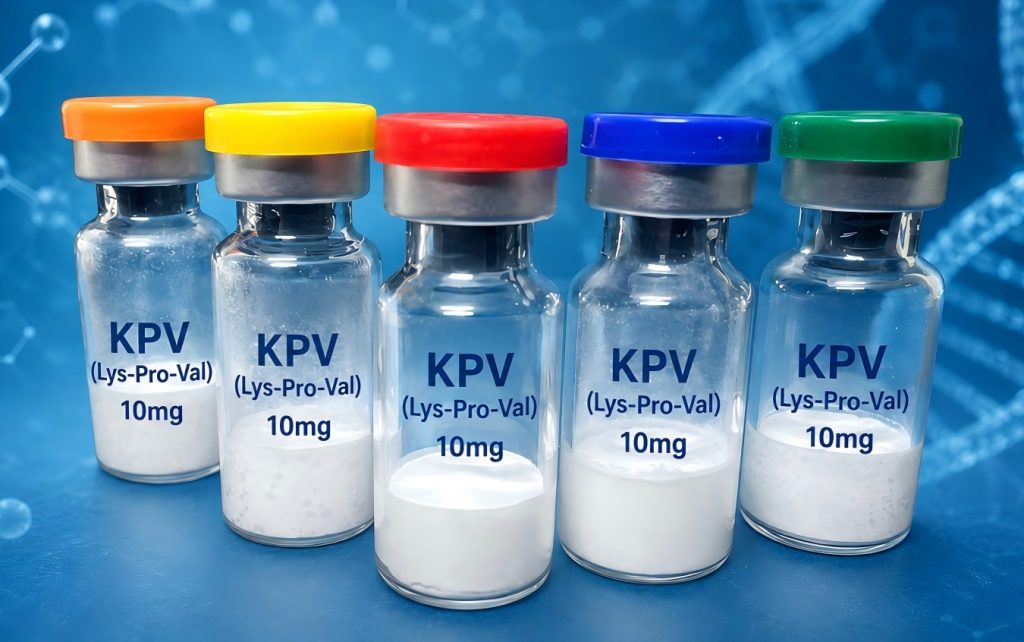
KPV Contains Only Three Amino Acids—Why Is It Studied?
Some research peptides contain dozens of amino acids.
KPV contains only three:
Lys–Pro–Val
Yet this small tripeptide has generated research involving inflammatory signaling, immune-cell biology and epithelial models.
The reason becomes clearer when we look at where KPV comes from.
KPV corresponds to the C-terminal sequence of α-melanocyte-stimulating hormone (α-MSH), commonly described as MSH (11–13).
That creates an interesting research question:
How can a three-amino-acid fragment retain part of the biological activity associated with a much larger parent peptide?
KPV Peptide at a Glance
Key reference information for KPV research peptide includes:
- Name: KPV
- Sequence: Lys-Pro-Val
- Alternative Names: Lysyl-Prolyl-Valine, MSH (11–13)
- CAS Number: 67727-97-3
- Molecular Formula: C16H30N4O4
- Molecular Weight: approximately 342.43 g/mol
- Peptide Length: 3 amino acids
- Research Classification: α-MSH-derived tripeptide
KPV is therefore one of the shortest peptides commonly encountered in inflammatory-signaling research.
KPV and α-MSH: Related, but Not Identical
α-MSH is a 13-amino-acid melanocortin peptide involved in several biological signaling systems.
KPV represents only its final three amino acids.
Experimental literature has reported that this C-terminal sequence retains some of the biological activity associated with α-MSH, particularly in inflammatory and immune models.
But that does not mean:
KPV = α-MSH
Removing ten amino acids changes the molecule.
The two compounds differ in size, structure and potentially in receptor interactions and intracellular signaling.
For researchers, the relationship is better described as:
α-MSH → C-terminal sequence → KPV (Lys-Pro-Val)
Structural origin can help explain research interest without making the two molecules biologically interchangeable.
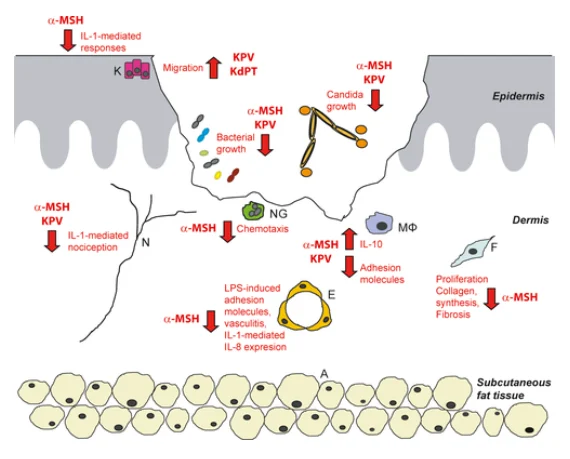
Why Does NF-κB Appear in KPV Research?
One of the most frequently discussed pathways in KPV peptide research is NF-κB.
NF-κB is a transcription-factor system involved in regulating inflammatory and immune responses.
Experimental studies involving α-MSH and related fragments have investigated their effects on NF-κB activation and downstream inflammatory signaling.
KPV has therefore appeared in laboratory models involving inflammatory mediators and immune-cell responses.
This helps explain the popularity of search terms such as:
KPV NF-kB
KPV inflammation research
and
KPV immune signaling
However, pathway research requires careful interpretation.
A compound influencing NF-κB activity in a cellular model does not automatically establish that it treats an inflammatory disease in humans.
Mechanism is evidence—but it is not the same level of evidence as a clinical outcome.
Does KPV Work Through the Same Receptor as α-MSH?
This is where the story becomes more interesting.
α-MSH is strongly associated with melanocortin receptors, including MC1R.
Research has also investigated KPV in melanocortin-related signaling.
But experimental studies suggest that the intracellular behavior of short α-MSH fragments may not always reproduce the signaling profile of the full parent peptide.
This means KPV research should not simply assume:
Same sequence origin = same signaling mechanism.
For laboratories, that uncertainty is scientifically useful.
It creates opportunities to study how much biological information can be retained when a larger signaling peptide is reduced to a minimal three-amino-acid sequence.
Why Are Gut and Skin Research Frequently Associated With KPV?
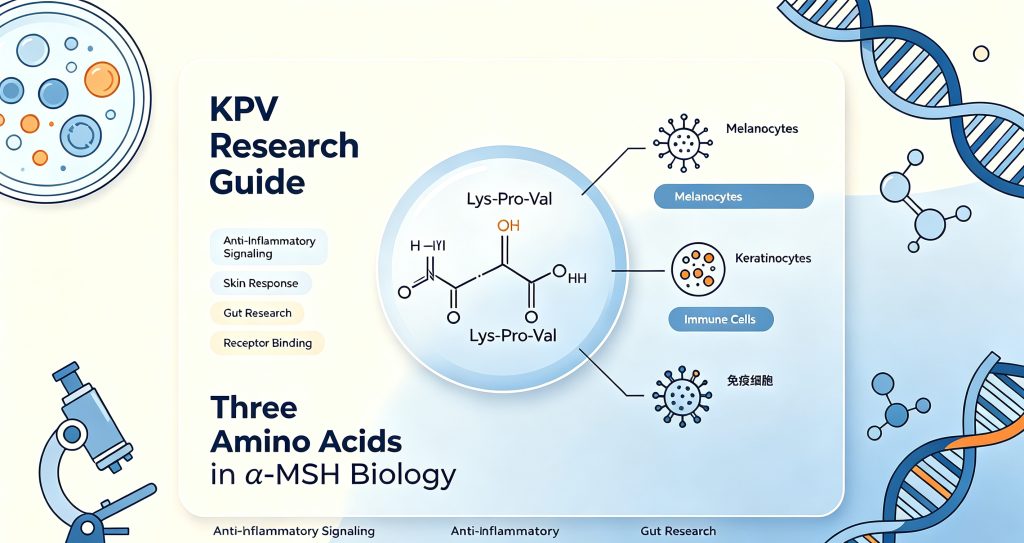
Searches for KPV gut research and KPV skin research are increasingly common.
There is a scientific reason for that association.
α-MSH-related peptides have been investigated in experimental inflammatory models involving epithelial tissues, immune cells and skin biology.
KPV has also appeared in research examining inflammatory signaling in gastrointestinal and cutaneous models.
But the evidence boundary remains important.
Experimental activity in a cell or animal model should not automatically become claims that KPV “heals the gut,” “treats eczema,” or “repairs skin.”
A more accurate description is:
KPV is an α-MSH-derived tripeptide investigated in inflammatory, immune and epithelial signaling models.
What Do Online KPV Reviews Actually Show?
Searches for KPV reviews reveal highly mixed experiences.
Some users describe perceived improvements involving skin appearance, inflammatory symptoms, histamine-related symptoms or gastrointestinal comfort.
Others report little or no noticeable change.
Negative online experiences include reports of:
- Headaches or migraine
- Fatigue
- Sleep disruption
- Skin redness or dryness
- Gastrointestinal changes
- Mood changes
- General flu-like discomfort
These reports should not be treated as controlled evidence.
Online anecdotes rarely allow independent verification of:
- Whether the material was actually KPV
- Peptide purity
- Actual peptide content
- Product formulation
- Storage conditions
- Other compounds being used
- Individual biological variables
More importantly, KPV currently lacks the large controlled human evidence base required to establish broad claims about efficacy or long-term safety.
Reviews describe experiences. Research tests hypotheses.
Why Does KPV Quality Still Matter If It Is Only Three Amino Acids?
A shorter peptide is not automatically easier to evaluate scientifically.
For laboratories comparing a KPV supplier, several analytical questions remain important.
Molecular Identity
The intended KPV sequence is:
Lys-Pro-Val
Analytical identity data should support that molecular assignment.
HPLC Purity
KPV HPLC analysis can provide information about chromatographic purity and detectable related components.
But:
Purity ≠ identity.
A high main-peak percentage does not independently establish that the material is Lys-Pro-Val.
Peptide Content
Chromatographic purity and actual peptide quantity are also separate specifications.
Researchers conducting quantitative experiments should understand exactly what the analytical documentation reports.
Batch-Specific COA
A useful KPV COA should correspond to the actual production lot supplied.
Ideally, researchers should be able to connect:
Vial → Lot Number → KPV Identity → Purity Data → Applicable Specification
That relationship supports experimental traceability.

SUNONE KPV Research Peptide
SUNONE supplies KPV (Lys-Pro-Val / MSH 11-13) for qualified laboratory, analytical and biopharmaceutical research applications.
SUNONE KPV is supplied as ≥99.1% research-grade material with applicable SDS, Certificate of Analysis and product specification documentation.
Available research configurations include 5 mg and 10 mg vial formats.
Researchers, biotechnology companies, distributors and qualified B2B customers can review the product here:
View SUNONE KPV Research Peptide
When comparing research grade KPV, laboratories should evaluate molecular identity, purity, peptide content, batch documentation and manufacturing traceability together rather than relying on broad “anti-inflammatory peptide” marketing terminology.
Final Thoughts
KPV demonstrates an interesting principle in peptide science:
A peptide does not need to be large to raise a complex biological question.
Three amino acids—
Lys-Pro-Val
—represent only a small fragment of α-MSH, yet experimental research has associated this sequence with inflammatory and immune-signaling pathways.
The important scientific questions are therefore not simply whether KPV is “anti-inflammatory.”
They are:
Which part of α-MSH biology does KPV retain?
Which signaling mechanisms are actually involved?
Which findings come from cells, animals or humans?
And can the identity and analytical quality of the research material be verified?
For KPV research, those distinctions are considerably more useful than a list of online “benefits.”
For more information, please click here.
Disclaimer
This article is provided solely for scientific, educational and laboratory research information. It does not constitute medical advice and does not claim that KPV prevents, diagnoses, treats, heals or cures inflammatory, gastrointestinal, dermatological, immune or any other medical condition.
SUNONE KPV products are intended for qualified laboratory research and manufacturing applications only. They are not intended for personal use, self-administration, human or veterinary consumption, diagnostic use or therapeutic use unless separately registered and authorized under applicable laws and regulations.
References to published experimental studies describe the scientific research history of KPV and related α-MSH peptides and should not be interpreted as evidence that SUNONE research-grade KPV is an approved medicinal product.
Leave a Reply