
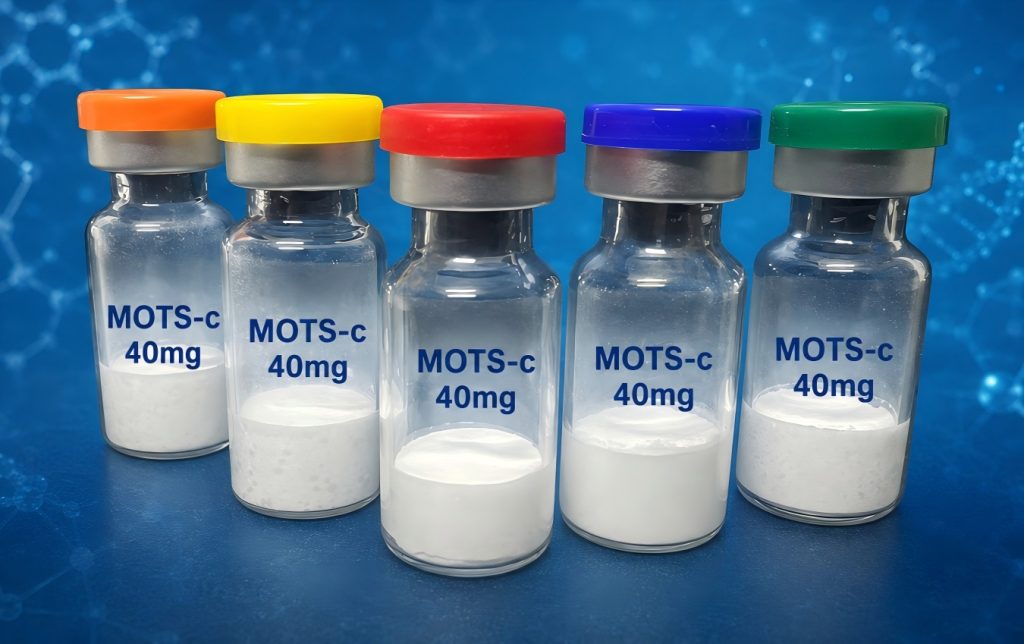
What Makes MOTS-c an Unusual Research Peptide?
Most discussions about peptides begin with what they do.
With MOTS-c, an equally interesting question is where it comes from.
MOTS-c—short for Mitochondrial Open Reading Frame of the 12S rRNA-c—is a 16-amino-acid mitochondrial-derived peptide associated with a short open reading frame within mitochondrial DNA.
That makes MOTS-c particularly interesting for researchers studying communication between mitochondria, cellular energy sensing and the nucleus.
Rather than thinking of mitochondria only as cellular “power plants,” MOTS-c research helps illustrate a broader concept:
Mitochondria can also participate in cellular signaling.
MOTS-c at a Glance
Key reference information for MOTS-c research peptide includes:
- Name: MOTS-c
- Full Name: Mitochondrial Open Reading Frame of the 12S rRNA-c
- CAS Number: 1627580-64-6
- Sequence: MRWQEMGYIFYPRKLR
- Peptide Length: 16 amino acids
- Molecular Formula: C101H152N28O22S2
- Molecular Weight: approximately 2174.6 Da
- Classification: Mitochondrial-derived peptide
- Typical Research Form: Lyophilized peptide
These characteristics make MOTS-c different from many conventional synthetic research peptides.

Why Is AMPK Important in MOTS-c Research?
One of the most frequently studied pathways associated with MOTS-c peptide is AMPK signaling.
AMP-activated protein kinase—or AMPK—acts as an important cellular energy sensor. It helps cells respond when energy availability and metabolic demand change.
Experimental research has linked MOTS-c with the folate–AICAR–AMPK pathway and metabolic adaptation.
More recent research has also examined how MOTS-c influences skeletal-muscle mitochondrial bioenergetics through mechanisms involving both AMPK and PGC-1α.
This is why searches for terms such as “MOTS-c AMPK,” “MOTS-c mitochondrial function” and “MOTS-c metabolic research” frequently appear in scientific discussions.
Can a Mitochondrial Peptide Communicate With the Nucleus?
This is perhaps the most interesting part of MOTS-c biology.
Research has shown that under metabolic stress, MOTS-c can translocate to the nucleus and participate in the regulation of stress-responsive gene expression.
This process is relevant to a concept known as mitonuclear communication—the exchange of biological signals between mitochondria and the nucleus.
In other words, MOTS-c research is not simply about “producing more energy.”
It provides a model for investigating how mitochondrial signals may influence broader cellular adaptation.
That distinction matters because popular descriptions of MOTS-c often oversimplify the peptide as an “energy peptide.”
Its research biology is considerably more complex.

What Do Online MOTS-c Reviews Actually Show?
Searches for MOTS-c reviews reveal highly mixed anecdotal experiences.
Some online users describe perceived improvements in sustained energy, exercise endurance or mental focus.
Others report the opposite—including fatigue, low energy or a noticeable midday “crash.”
A few discussions even contain both experiences: an initially positive response followed later by fatigue or little noticeable effect.
For researchers, this inconsistency should encourage caution rather than conclusions.
Online experiences rarely control for:
- Identity and purity of the material
- Other compounds being used
- Diet and energy intake
- Exercise conditions
- Individual metabolic differences
- Storage and handling
- Experimental design
For these reasons, anecdotal MOTS-c reviews cannot establish efficacy or safety.
User experiences can generate research questions. Controlled experiments are required to test them.
Why MOTS-c Quality Verification Matters
Growing interest in mitochondrial peptides also makes analytical verification increasingly important.
When comparing a MOTS-c supplier or MOTS-c manufacturer, researchers should look beyond a product name and headline purity percentage.
Sequence and Identity
The expected MOTS-c sequence is:
MRWQEMGYIFYPRKLR
Analytical identity testing can provide supporting evidence that the supplied material corresponds to the intended research peptide.
HPLC Purity
HPLC can provide information about chromatographic purity and detectable related components.
However, an HPLC percentage alone does not answer every question about peptide identity or overall material quality.
Batch-Specific COA
A useful MOTS-c COA should correspond to the actual production lot being supplied.
Researchers should be able to connect the product, batch identifier and analytical documentation.
Traceability
Lot-level records are particularly valuable for laboratories performing repeated experiments where batch-to-batch consistency matters.
SUNONE MOTS-c Research Peptide
SUNONE supplies MOTS-c research peptide for qualified laboratory, analytical and biopharmaceutical research applications.
SUNONE MOTS-c is supplied as research-grade material, with applicable analytical and batch documentation available according to product specifications.
Researchers, biotechnology companies, distributors and qualified B2B customers can review the product here:
View SUNONE MOTS-c Research Peptide
When evaluating research grade MOTS-c, laboratories should consider molecular identity, purity analysis, batch-specific documentation, traceability and manufacturing consistency together rather than relying on a single marketing specification.

Final Thoughts
MOTS-c represents an unusual chapter in peptide biology.
It is only 16 amino acids long, yet its research connects several important areas: mitochondrial signaling, AMPK, metabolic stress, skeletal-muscle bioenergetics and communication between mitochondria and the nucleus.
This also explains why describing MOTS-c simply as an “energy peptide” misses much of the scientific story.
For laboratories studying MOTS-c peptide, a better approach is to begin with three questions:
Is the material correctly identified?
Is the analytical evidence linked to the actual batch?
And does the experimental conclusion match what the scientific evidence can actually support?
In mitochondrial peptide research, those questions matter more than online claims.
For more information, please click here.
SUNONE MOTS-c research peptide is for qualified labrtorynt, diagnois, druc tor mmatct or veteimant, use.research only, Not for human consumption, clinical treame.
Leave a Reply