
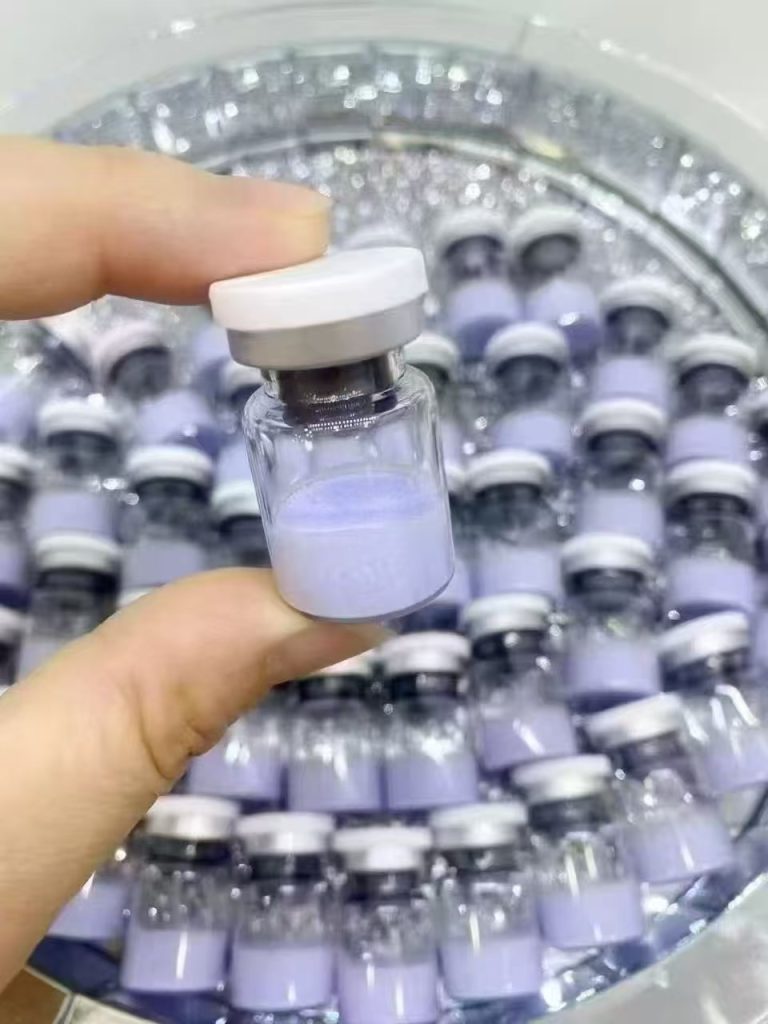
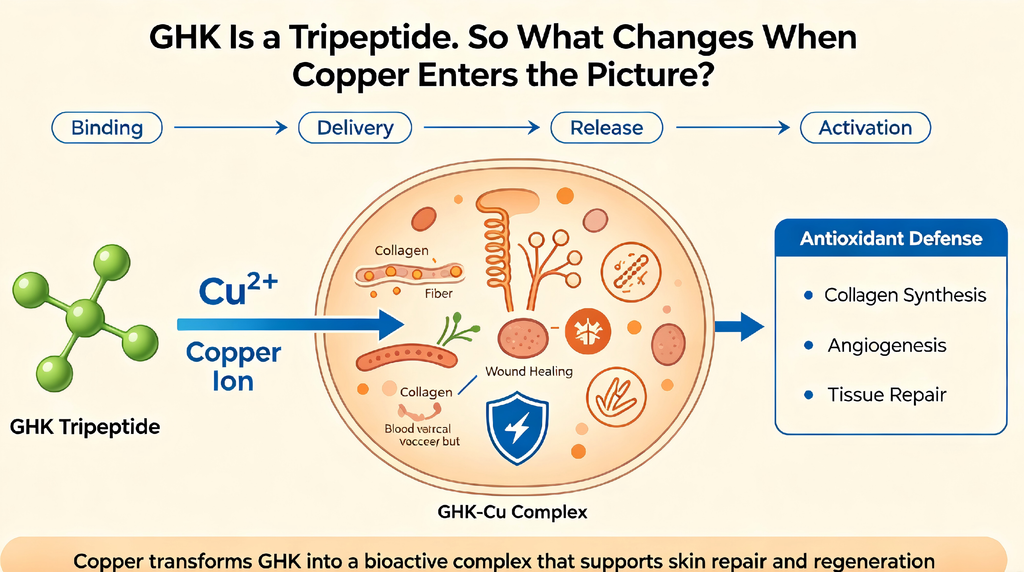
GHK Is a Tripeptide. So What Changes When Copper Enters the Picture?
GHK-Cu is often introduced simply as a “copper peptide.”
That description is accurate—but it leaves out the most interesting part of the science.
GHK (Gly-His-Lys) is a three-amino-acid peptide with a strong affinity for copper ions. When GHK coordinates Cu²⁺, it forms the complex commonly known as GHK-Cu or Copper Tripeptide-1.
This relationship makes GHK-Cu particularly interesting in laboratory research involving copper-peptide interactions, fibroblast biology and extracellular-matrix signaling.
It also raises an important analytical question:
When a research material is both a peptide and a metal complex, what exactly should researchers verify?
GHK-Cu at a Glance
Key reference information for GHK-Cu research peptide includes:
- Name: GHK-Cu
- Common Name: Copper Tripeptide-1
- Peptide Component: Gly-His-Lys
- CAS Number: 300801-03-0
- Molecular Formula: C28H48CuN12O8
- Molecular Weight: approximately 744.3 g/mol
- Classification: Copper-binding tripeptide complex
- Typical Research Form: Lyophilized powder
GHK-Cu is therefore more accurately understood as a copper-peptide complex rather than simply another short synthetic peptide.
Why Is GHK-Cu Studied in Collagen and Extracellular-Matrix Research?
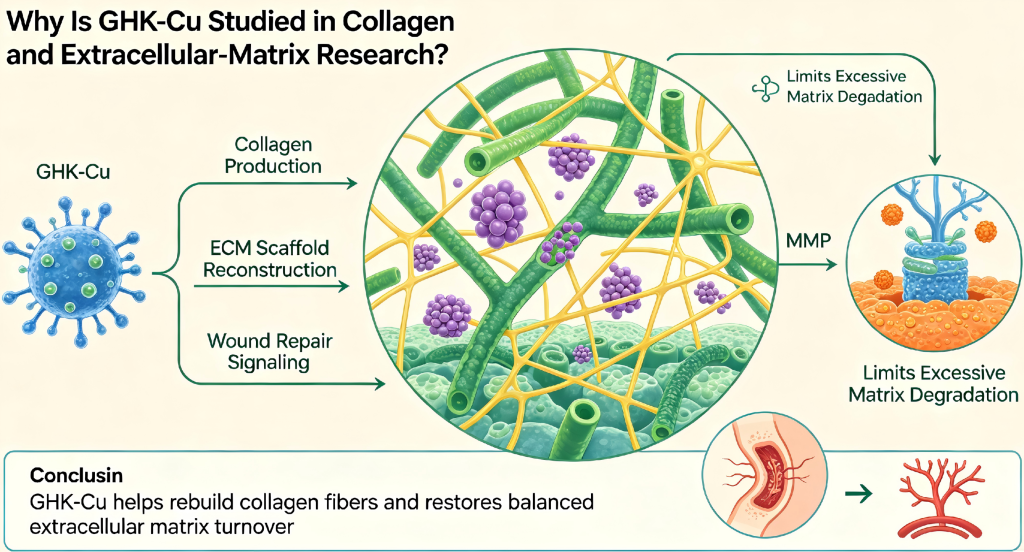
Much of the scientific interest surrounding GHK-Cu peptide comes from research involving tissue remodeling and the extracellular matrix.
Classic fibroblast studies reported changes in collagen synthesis after exposure to GHK-Cu.
Additional experimental research has investigated the peptide complex in relation to matrix metalloproteinases (MMPs), tissue inhibitors of metalloproteinases (TIMPs), glycosaminoglycans and other components involved in extracellular-matrix turnover.
This distinction is important.
Healthy tissue remodeling is not simply a matter of “making more collagen.”
The extracellular matrix is dynamic. Proteins are synthesized, organized, modified and degraded continuously.
For researchers, GHK-Cu therefore provides a more interesting question than the familiar marketing claim of “boosting collagen”:
How does a copper-binding peptide influence the balance between extracellular-matrix synthesis and remodeling?
Is GHK-Cu an “Anti-Aging Peptide”?
This term appears frequently in online searches, but it can oversimplify the evidence.
GHK-Cu has a substantial history of experimental research involving fibroblasts, collagen-related pathways, extracellular-matrix biology and skin models.
More recent studies have continued investigating GHK-Cu in cosmetic science, including combinations with materials such as hyaluronic acid.
However, laboratory mechanisms, animal models, ex-vivo skin experiments and human cosmetic outcomes are different levels of evidence.
A result observed in cultured fibroblasts should not automatically become a claim about reversing human aging.
For scientific communication, “copper peptide studied in skin and extracellular-matrix biology” is more accurate than treating “anti-aging” as an established universal outcome.
What Do Online GHK-Cu Reviews Actually Tell Us?
Searches for GHK-Cu reviews produce many positive experiences.
Users commonly discuss perceived changes in skin appearance, fine lines, texture or hair.
Negative experiences are also reported, including irritation and other unwanted effects. Some online discussions involving non-cosmetic use mention symptoms such as headaches or nausea.
But there is a major problem with comparing these reviews:
They are often describing completely different products and conditions.
A topical Copper Tripeptide-1 cosmetic serum is not the same research material or experimental context as a laboratory-grade lyophilized GHK-Cu reagent.
Product concentration, formulation, purity, route, storage and other variables may all differ.
Online reviews can therefore identify questions worth investigating, but they cannot establish the efficacy or safety of GHK-Cu research peptide.

Why Is GHK-Cu Quality Verification Different?
For many peptides, researchers focus on sequence identity and chromatographic purity.
GHK-Cu adds another variable:
Copper coordination.
This makes quality evaluation particularly interesting.
HPLC Purity
HPLC can provide useful information about chromatographic composition and detectable related species.
But a headline “99% HPLC” result should not automatically be interpreted as complete characterization of the copper-peptide complex.
Molecular Identity
Analytical identity information can complement HPLC results and provide evidence that the expected molecular material is present.
Copper-Complex Form
Because GHK-Cu is a coordinated copper-peptide system, researchers should verify the applicable product specification and copper-complex form rather than assuming all materials sold as “GHK-Cu” are analytically equivalent.
Batch-Specific COA
A GHK-Cu COA is most useful when it corresponds directly to the production lot supplied.
Researchers should be able to connect the physical material with its lot number and analytical documentation.
This distinction becomes particularly important when comparing a GHK-Cu supplier or GHK-Cu manufacturer for repeat laboratory studies.
SUNONE GHK-Cu Research Peptide
SUNONE supplies GHK-Cu (Copper Tripeptide-1) for qualified laboratory, analytical, cosmetic-formulation and biopharmaceutical research applications.
SUNONE GHK-Cu is supplied as research-grade lyophilized material with applicable analytical documentation according to product specifications.
Researchers, cosmetic R&D laboratories, biotechnology companies, distributors and qualified B2B customers can review specifications here:
View SUNONE GHK-Cu Copper Peptide
When evaluating research grade GHK-Cu, laboratories should consider peptide identity, chromatographic purity, copper-complex form, batch documentation, storage requirements and traceability together rather than relying on a single purity number.
Final Thoughts
GHK-Cu demonstrates why a three-amino-acid peptide can become more scientifically interesting when another element enters the picture.
Gly-His-Lys + Cu²⁺ → GHK-Cu
That copper-binding relationship connects a remarkably small peptide with research involving fibroblasts, collagen, extracellular-matrix remodeling and copper-dependent cellular pathways.
But it also creates a valuable analytical lesson.
For researchers sourcing GHK-Cu peptide, the question should not stop at:
“What is the HPLC purity?”
A more complete question is:
“Can the peptide identity, copper-complex form, analytical purity and specific batch all be verified?”
For copper-peptide research, understanding what is actually being measured is as important as the purity number itself.
For more information, please click here.
SUNONE GHK-Cu research peptide is for qualified labrtorynt, diagnois, druc tor mmatct or veteimant, use.research only, Not for human consumption, clinical treame.
Leave a Reply