
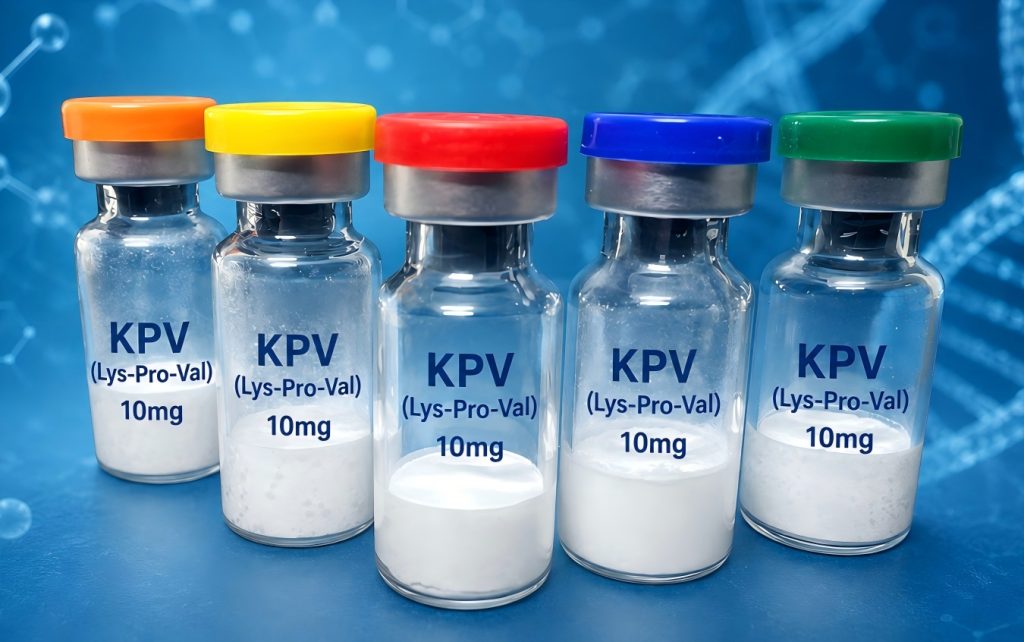
KPV Is Only Three Amino Acids—So Why Study It?
Peptides do not need to be large to raise interesting biological questions.
KPV peptide is a good example.
KPV consists of just three amino acids:
Lysine – Proline – Valine (Lys-Pro-Val)
It corresponds to the C-terminal sequence of alpha-melanocyte-stimulating hormone (α-MSH) and is therefore also referred to as MSH (11-13).
Despite its minimal structure, KPV has been investigated in laboratory models involving inflammatory signaling, intestinal epithelial biology, peptide transport and cellular responses.
That makes KPV useful for exploring a surprisingly complex question:
How much biological signaling can be retained in only three amino acids?
KPV Peptide at a Glance
Key reference information for KPV research peptide includes:
- Name: KPV
- Sequence: Lys-Pro-Val
- Alternative Name: MSH (11-13)
- CAS Number: 67727-97-3
- Molecular Formula: C16H30N4O4
- Molecular Weight: approximately 342.43 g/mol
- Peptide Length: 3 amino acids
- Research Classification: α-MSH-derived tripeptide
- Typical Research Form: Lyophilized powder
Its unusually short sequence is one reason KPV continues to attract interest in peptide signaling research.
What Does KPV Have to Do With α-MSH?
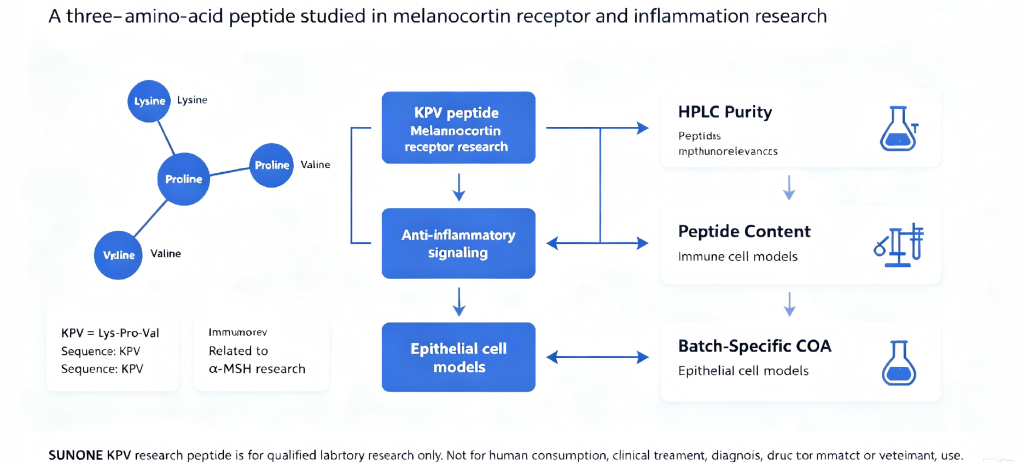
α-MSH is a larger peptide involved in several biological signaling pathways.
Researchers found that its C-terminal Lys-Pro-Val sequence retained interesting biological activity in experimental inflammation models.
However, KPV should not simply be treated as “mini α-MSH.”
Research comparing KPV with other α-MSH-derived peptides suggests that its experimental effects may involve mechanisms that differ from conventional melanocortin receptor signaling.
This makes KPV tripeptide research particularly interesting from a structure-function perspective: removing most of the parent peptide does not necessarily remove every measurable biological interaction.
Why Does PepT1 Appear in KPV Research?
One of the more distinctive aspects of KPV research involves PepT1, a peptide transporter expressed in intestinal epithelial cells.
Because KPV contains only three amino acids, researchers have investigated whether this transporter can participate in cellular uptake of the peptide.
Experimental studies using intestinal epithelial and immune-cell models have reported PepT1-mediated KPV transport followed by changes in inflammatory signaling.
This provides a useful mechanistic link between:
KPV → PepT1 transport → intracellular signaling
and helps explain why KPV gut research has become one of the peptide’s most frequently discussed experimental areas.
What About KPV and NF-κB?
Another frequently searched term is “KPV NF-kB.”
NF-κB is a transcriptional signaling system involved in regulating many genes associated with cellular inflammatory responses.
Preclinical studies involving KPV have reported changes in pathways involving NF-κB, MAPK and inflammatory mediators under specific experimental conditions.
This does not mean that KPV has been clinically proven to treat inflammatory disease.
That distinction is important.
Much of the current KPV evidence comes from cellular and animal research models, so mechanistic findings should not automatically be translated into human therapeutic claims.
What Do Online KPV Reviews Actually Tell Us?
Searches for KPV reviews produce very different experiences.
Some users describe perceived improvements involving inflammation, skin-related issues or general well-being.
Others report little noticeable effect.
Negative discussions also include experiences such as fatigue, headaches, migraine-like symptoms or generalized discomfort.
There is a major problem with interpreting these reports scientifically:
The experimental variables are unknown.
Online anecdotes often provide no reliable way to verify:
- Material identity
- Peptide purity
- Product composition
- Storage history
- Other compounds being used
- Individual biological variables
For this reason, positive and negative KPV reviews should not be treated as controlled evidence of efficacy or safety.
Anecdotal reports can identify questions. Controlled research is needed to answer them.
Why KPV Quality Still Matters for Such a Small Peptide
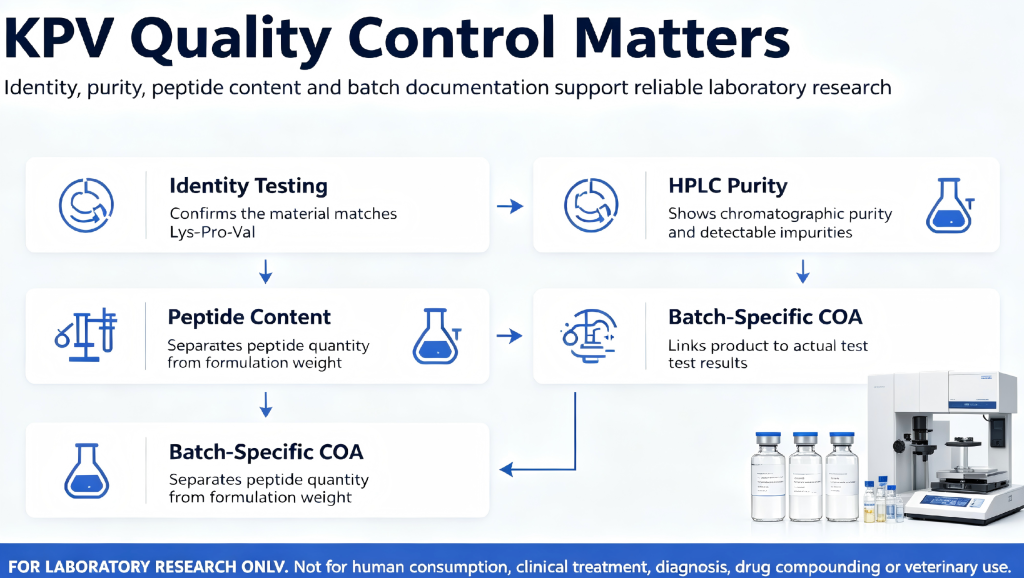
It may seem intuitive that a three-amino-acid peptide should be easy to evaluate.
But sequence length does not eliminate the need for analytical verification.
Researchers comparing a KPV supplier or KPV manufacturer should consider several questions.
Is the Material Actually Lys-Pro-Val?
Identity and purity are not identical concepts.
Analytical identity testing provides information that complements chromatographic purity measurements.
What Does the HPLC Result Show?
HPLC can help characterize the chromatographic composition of a sample.
However, a high HPLC percentage alone should not automatically be interpreted as proof of every aspect of peptide identity or material quality.
Does the COA Match the Batch?
A KPV COA is most useful when it can be linked to the specific manufacturing lot being supplied.
Researchers should compare the product name, lot identifier, analytical result and applicable documentation rather than relying on a generic purity statement.
Can the Material Be Traced?
Batch traceability helps laboratories connect experimental results with the exact research material used.
For reproducibility, that connection can matter even with a peptide as small as KPV.
SUNONE KPV Research Peptide
SUNONE supplies KPV (Lys-Pro-Val) research peptide for qualified laboratory, analytical and biopharmaceutical research applications.
SUNONE KPV is available as research-grade lyophilized material with applicable product specifications and batch documentation.
Researchers, biotechnology companies, distributors and qualified B2B customers can review the product here:
View SUNONE KPV Research Peptide
When evaluating research grade KPV, laboratories should consider peptide identity, purity, analytical documentation, storage requirements and batch traceability together rather than relying on a single specification.
Final Thoughts
KPV demonstrates why peptide size and biological complexity are not necessarily the same thing.
The molecule contains only:
Lys – Pro – Val.
Yet research surrounding this three-amino-acid sequence touches α-MSH biology, PepT1 peptide transport, NF-κB signaling, epithelial biology and experimental inflammation models.
The scientific evidence also illustrates an equally important lesson:
Mechanistic research is not the same as demonstrated clinical efficacy.
For laboratories studying KPV peptide, careful experimental design should therefore begin with correctly characterized research material and end with conclusions that remain within the limits of the evidence.
Sometimes three amino acids are enough to create a surprisingly complex research question.
For more information, please click here.
Disclaimer
This article is provided solely for scientific, educational and laboratory research information. It does not constitute medical advice and does not claim that KPV prevents, diagnoses, treats or cures inflammation or any disease.
SUNONE KPV products are intended for qualified laboratory research and manufacturing applications only. They are not intended for personal use, self-administration, human or veterinary consumption, diagnostic use or therapeutic use unless separately registered and authorized under applicable laws and regulations.
Leave a Reply