
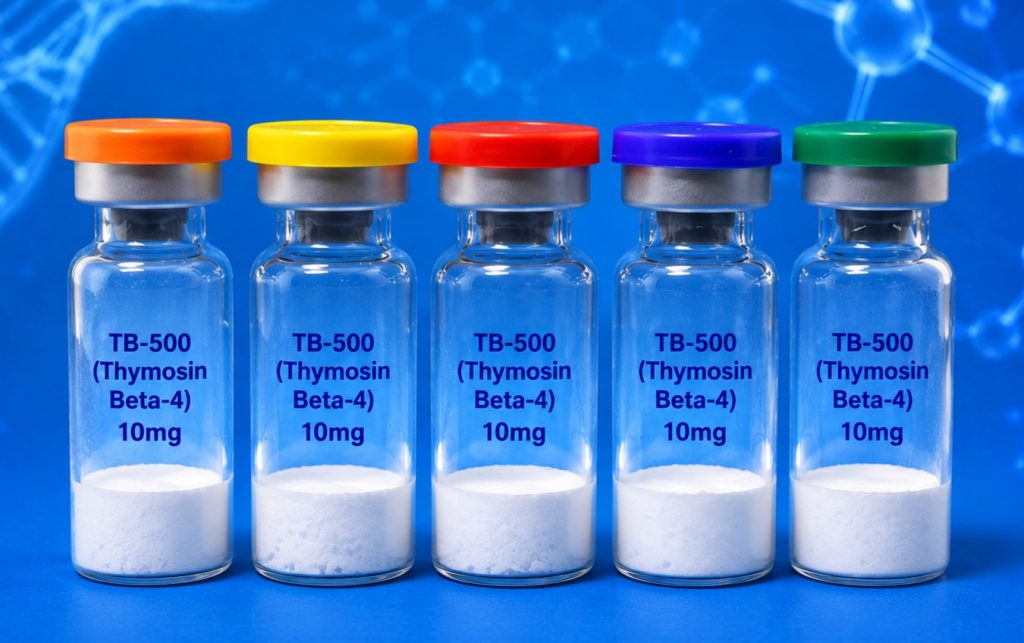
TB-500 or Thymosin Beta-4: Does the Name Matter?
Search for TB-500 peptide online and you may encounter two descriptions:
“TB-500 is Thymosin Beta-4.”
Or:
“TB-500 is a fragment associated with Thymosin Beta-4.”
Those descriptions are not analytically interchangeable.
Thymosin Beta-4 (Tβ4) is a 43-amino-acid peptide. Materials identified as TB-500 / Thymosin β4 Fragment 17-23, by contrast, may refer to a much shorter peptide sequence associated with a biologically interesting region of Tβ4.
For laboratory research, that difference matters.
Before asking what a peptide does, researchers should first ask:
What molecule is actually being studied?
TB-500 Fragment at a Glance
Reference information associated with TB-500 research peptide / Thymosin β4 Fragment 17-23 includes:
- Name: TB-500
- Alternative Name: Thymosin β4 Fragment 17-23
- Sequence: Ac-LKKTETQ
- CAS Number: 885340-08-9
- Molecular Formula: C38H68N10O14
- Molecular Weight: approximately 889.01 Da
- Peptide Length: 7 amino acids
- Typical Research Form: Lyophilized peptide
These identifiers are important because products marketed under the general term “TB-500” do not always describe the same molecular material.

Why Is Thymosin Beta-4 Relevant?
Full-length Thymosin Beta-4 has a substantial experimental research history.
Tβ4 is associated with actin binding and has been investigated in laboratory models involving cellular migration, tissue remodeling, angiogenesis and wound-related biological processes.
A particularly important region contains the LKKTETQ sequence, which is associated with actin interaction.
This biological relationship helps explain why shorter Tβ4-derived sequences have attracted research interest.
But it creates a common interpretation problem:
Evidence for full-length Thymosin Beta-4 should not automatically be assigned to every shorter peptide fragment associated with it.
Structural relationship does not make two molecules experimentally identical.
Why Molecular Identity Comes Before “Benefits”
Many TB-500 articles begin by listing potential benefits.
For laboratory researchers, the order should be reversed.
Imagine two papers:
One investigates full-length 43-amino-acid Thymosin Beta-4.
The other investigates a shorter Tβ4-derived fragment.
Even if the two materials share a biologically relevant sequence, differences in molecular size, stability, distribution and biological behavior may influence experimental results.
Before comparing studies, researchers should therefore verify:
Which sequence was studied?
Was it full-length Tβ4 or a fragment?
How was the research material characterized?
This simple check can prevent conclusions from being transferred between chemically different materials.

What Do Online TB-500 Reviews Actually Show?
Searches for TB-500 reviews produce mixed anecdotal experiences.
Positive discussions sometimes describe perceived changes involving physical recovery, old injuries or exercise-related discomfort.
Other users report little noticeable effect.
Negative discussions include reports of fatigue, headaches, anxiety, brain fog, palpitations, gastrointestinal discomfort and other unwanted experiences.
These reports cannot establish efficacy or safety.
The identity of materials discussed online is often uncertain—and with TB-500, the naming problem makes this particularly important.
Researchers usually cannot verify:
- Whether the material was full-length Tβ4 or a fragment
- Peptide identity
- Purity
- Actual quantity
- Batch documentation
- Storage history
- Other compounds being used
Online experiences can generate questions, but controlled experiments are required to answer them.
Three Things to Verify Before Comparing TB-500 Research
1. Sequence Identity
The first question should be:
Which TB-500 molecule does the supplier mean?
For a material identified as Thymosin β4 Fragment 17-23 / Ac-LKKTETQ, the sequence and molecular information should correspond to that fragment.
This prevents confusion with full-length Thymosin Beta-4.
2. HPLC Purity
HPLC can provide useful information about chromatographic purity and detectable related components.
However, TB-500 HPLC purity and TB-500 molecular identity are different analytical questions.
A high main-peak percentage does not by itself establish that the peak corresponds to the intended peptide sequence.
3. Batch-Specific Documentation
A useful TB-500 COA should be connected to the specific manufacturing lot supplied.
Researchers should ideally be able to trace:
Product → Sequence → Lot Number → Identity Data → Purity Data
This becomes particularly important when the same commercial name is used for different molecular forms.
SUNONE TB-500 Research Peptide
SUNONE supplies TB-500 (Thymosin β4 Fragment 17-23) for qualified laboratory, analytical and biopharmaceutical research applications.
SUNONE identifies the material as Ac-LKKTETQ, CAS 885340-08-9, supplied as ≥99.1% HPLC lyophilized research material with applicable product and batch documentation.
Researchers, biotechnology companies, distributors and qualified B2B customers can review the product specifications here:
View SUNONE TB-500 Research Peptide
When comparing a TB-500 supplier or TB-500 manufacturer, laboratories should look beyond the product name.
Sequence identity, molecular form, analytical purity and batch-specific documentation should all be evaluated together.
For more information, please click here.
Final Thoughts
TB-500 illustrates an important rule in peptide research:
Names are useful. Molecular identities are better.
Full-length Thymosin Beta-4 and a shorter Thymosin β4-derived fragment may be biologically related, but that does not make them analytically or experimentally identical.
That distinction should come before claims about tissue remodeling, angiogenesis or other biological effects.
For laboratories sourcing TB-500 peptide, three questions therefore matter:
Which sequence is being supplied?
Does analytical testing support its identity and purity?
Can those results be traced to the actual batch?
In peptide research, knowing exactly what is in the vial is the foundation for interpreting everything that comes after.
SUNONE TB-500 research peptide is for qualified labrtorynt, diagnois, druc tor mmatct or veteimant, use.research only, Not for human consumption, clinical treame.
Leave a Reply