
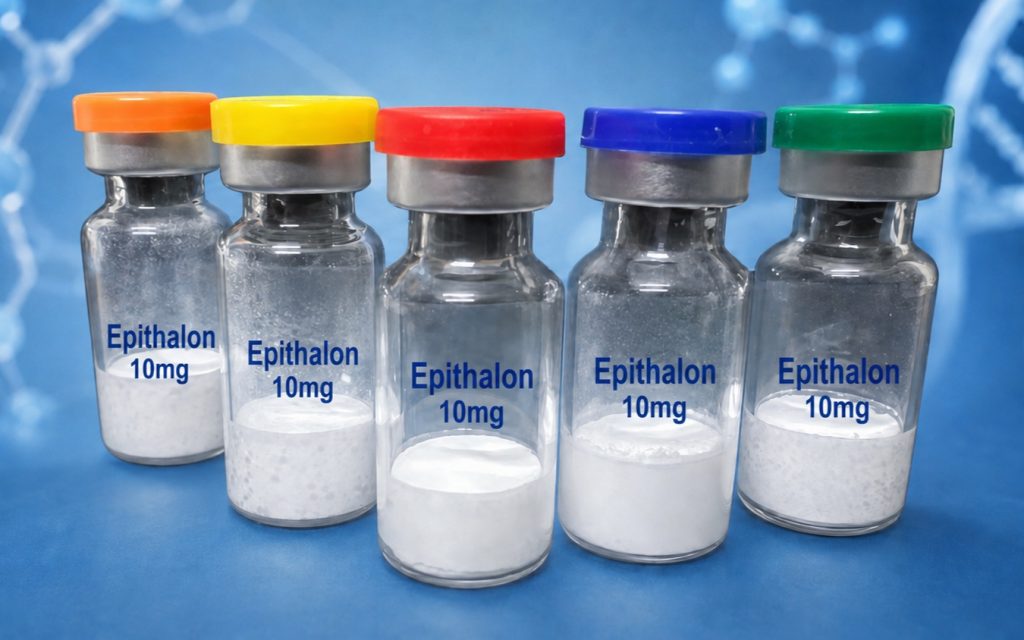
Four Amino Acids—and a Very Big Longevity Claim
Few research peptides illustrate the gap between a laboratory finding and an online headline better than Epitalon peptide.
Epitalon—also written as Epithalon or Epithalone—contains only four amino acids:
Ala–Glu–Asp–Gly
or simply:
AEDG
Yet search for Epitalon online and the discussion quickly moves to telomeres, telomerase, biological aging and even longevity.
That creates an important research question:
What has Epitalon actually shown in telomere research—and what remains unproven?
Epitalon at a Glance

Key reference information for Epitalon research peptide includes:
- Names: Epitalon, Epithalon, Epithalone
- Sequence: Ala-Glu-Asp-Gly
- Abbreviation: AEDG
- CAS Number: 307297-39-8
- Molecular Formula: C14H22N4O9
- Molecular Weight: approximately 390.35 g/mol
- Peptide Length: 4 amino acids
- Typical Research Form: Lyophilized peptide
Its small size makes Epitalon structurally simple.
The biological questions surrounding it are considerably less simple.
Why Is Epitalon Associated With Telomerase?
Telomeres are repetitive DNA-protein structures located at chromosome ends.
In many somatic cells, telomeres become progressively shorter during repeated cell division.
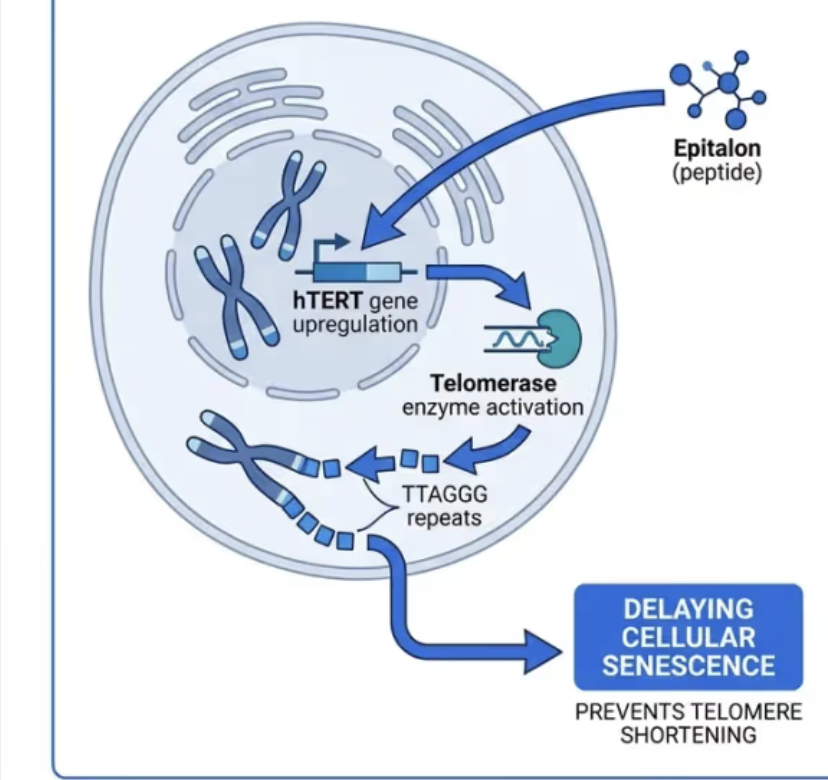
Telomerase is an enzyme complex capable of adding telomeric DNA sequences, which is why telomerase regulation has become an important area of cellular-aging research.
Early experimental studies involving Epithalon reported changes in telomerase activity and telomere length in cultured human cells.
More recently, researchers have continued investigating Epitalon in human cell lines, including its relationship with hTERT expression, telomerase activity and alternative lengthening of telomeres (ALT).
These findings help explain why Epitalon telomerase and Epitalon telomere research have become major search topics.
But Does Longer Telomere Mean Longer Human Life?
This is where scientific language matters.
A laboratory study showing telomere elongation in cultured cells does not establish that a compound extends human lifespan.
These are different questions:
Cellular finding:
Did telomere length change under a specific experimental condition?
Clinical finding:
Does an intervention safely improve a meaningful outcome in humans?
Longevity finding:
Does it actually extend healthy human lifespan?
Moving directly from the first question to the third skips a substantial amount of evidence.
For this reason, describing Epitalon simply as a “longevity peptide” or “anti-aging peptide” can imply more certainty than current evidence supports.
A more precise description is:
Epitalon is an AEDG tetrapeptide investigated in telomere, telomerase and aging-related cellular research.
Why Recent Epitalon Research Is Interesting
Epitalon research did not end with the early telomerase studies.
A 2025 cell-line study again examined the peptide in relation to telomere length and telomerase-related pathways.
Interestingly, the study investigated both normal and cancer cell lines and reported different pathway characteristics, including ALT-related activity in cancer-cell models.
This illustrates why telomere biology cannot be reduced to:
“Longer telomeres = better.”
Telomere maintenance and cellular proliferation are complex biological processes.
For researchers, the more useful question is how Epitalon influences these pathways under defined experimental conditions—not whether it can be assigned a universal “anti-aging” label.

What Do Online Epitalon Reviews Actually Show?
Searches for Epitalon reviews reveal highly mixed experiences.
Some users describe perceived changes involving sleep timing, circadian rhythm or general well-being.
Others report no noticeable effect at all.
This inconsistency is scientifically important because online anecdotes rarely allow researchers to verify:
- Whether the material was actually Epitalon
- Peptide purity
- Actual peptide content
- Product formulation
- Storage conditions
- Other compounds being used
- Individual biological variables
There is also frequent online confusion between Epitalon and Epithalamin, which are not simply interchangeable names for the same research material.
For these reasons, positive and negative reviews cannot establish Epitalon efficacy or safety.
Anecdotes generate hypotheses. Controlled experiments test them.
Why Epitalon Quality Verification Matters
Epitalon contains only four amino acids, but a short sequence does not eliminate the need for analytical verification.
Researchers comparing an Epitalon supplier or Epithalon manufacturer should consider several separate questions.
Sequence Identity
The expected sequence is:
Ala-Glu-Asp-Gly (AEDG)
Analytical identity testing can provide evidence supporting whether the supplied material corresponds to the intended peptide.
HPLC Purity
Epitalon HPLC analysis can characterize chromatographic purity and detectable related components.
However:
Purity ≠ identity.
A high main-peak percentage does not independently prove that the peak corresponds to AEDG.
Molecular Mass
Mass analysis can provide complementary information supporting molecular identity.
For Epitalon, the expected molecular weight is approximately 390.35 g/mol.
Batch-Specific COA
A useful Epitalon COA should correspond to the actual manufacturing lot supplied.
Researchers should ideally be able to connect:
Product → AEDG Identity → Lot Number → HPLC Data → Applicable Specification
That relationship supports traceability and reproducibility.
SUNONE Epithalon Research Peptide
SUNONE supplies Epithalon (Epitalon / AEDG) for qualified laboratory, analytical and biopharmaceutical research applications.
SUNONE Epithalon is supplied as ≥99% HPLC lyophilized research material, with applicable COA, HPLC, specification, SDS and batch documentation available according to product requirements.
Researchers, biotechnology companies, distributors and qualified B2B customers can review the product here:
When evaluating research grade Epitalon, laboratories should consider sequence identity, chromatographic purity, molecular characterization and batch traceability together rather than relying on a “longevity peptide” label or a single purity percentage.
Final Thoughts
Epitalon asks a fascinating biological question with only four amino acids:
AEDG
Research has connected this small peptide with telomerase activity, telomere biology and aging-related cellular mechanisms.
But the strength of scientific communication depends on knowing where the evidence ends.
Telomerase activity is not the same as proven anti-aging efficacy.
Telomere elongation in cells is not the same as extending human lifespan.
And an online longevity claim is not a substitute for controlled evidence.
For laboratories studying Epitalon peptide, the strongest starting point is therefore not the promise of longevity.
It is a much simpler question:
What does this molecule actually do under a defined and reproducible experimental condition?
That question leaves considerably more room for good science.
Disclaimer
This article is provided solely for scientific, educational and laboratory research information. It does not constitute medical advice and does not claim that Epitalon/Epithalon slows, prevents or reverses human aging, extends lifespan, or prevents, diagnoses, treats or cures any disease.
SUNONE Epithalon products are intended for qualified laboratory research and manufacturing applications only. They are not intended for personal use, self-administration, human or veterinary consumption, diagnostic use or therapeutic use unless separately registered and authorized under applicable laws and regulations.
Leave a Reply