
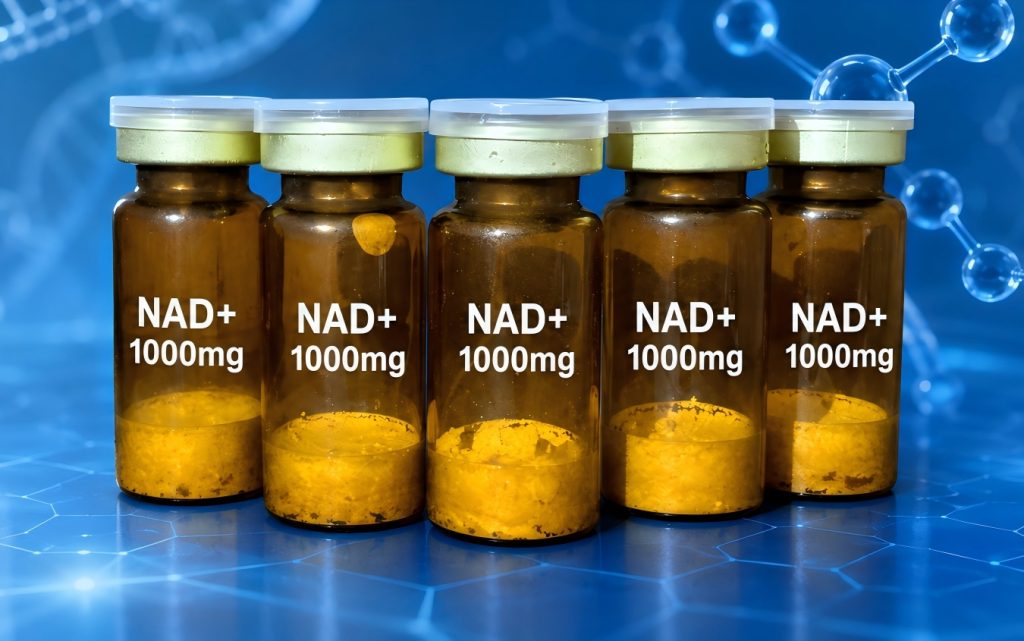
NAD+ Is Called an “Energy Molecule”—But What Does That Actually Mean?
Few molecules in healthy-aging research have received as much attention as NAD+.
NAD+—Nicotinamide Adenine Dinucleotide—is often described online as an “energy molecule” or even an “anti-aging molecule.”
Both descriptions are incomplete.
NAD+ is an essential biochemical cofactor involved in cellular redox reactions. It also serves as a substrate for several enzyme families involved in DNA repair, cellular signaling and metabolic regulation.
So a better research question is not:
“Does NAD+ give cells more energy?”
It is:
“How does NAD+ connect cellular energy metabolism with signaling and repair?”
NAD+ at a Glance
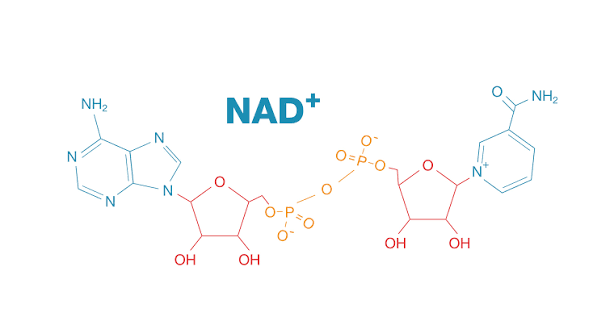
Key reference information for NAD+ research includes:
- Name: Nicotinamide Adenine Dinucleotide
- Abbreviation: NAD+
- Alternative Names: NAD(+), beta-NAD, Nadide, Coenzyme I, DPN+
- CAS Number: 53-84-9
- Molecular Formula: C21H27N7O14P2
- Molecular Weight: approximately 663.4 g/mol
- Research Areas: Redox biology, cellular metabolism, mitochondrial research and NAD-dependent enzyme signaling
Unlike the peptides frequently discussed in laboratory research, NAD+ is a dinucleotide coenzyme.
That difference matters when interpreting both its biology and its analytical specifications.
Why Is NAD+ Essential to Cellular Energy Research?
One of NAD+’s best-established roles is in oxidation-reduction reactions.
NAD+ accepts electrons to form NADH, while NADH can subsequently participate in reactions associated with mitochondrial energy metabolism.
This relationship is commonly represented as:
NAD+ ⇄ NADH
But describing NAD+ simply as cellular “fuel” is misleading.
NAD+ is better understood as part of the biochemical machinery that allows cells to transfer electrons and coordinate metabolic reactions.
More NAD+ therefore does not automatically translate into proportionally more ATP or more perceived human energy.
Cellular metabolism is a system—not a fuel tank.
NAD+ Also Connects Metabolism With Cellular Signaling
The NAD+ story becomes more interesting when we move beyond redox chemistry.
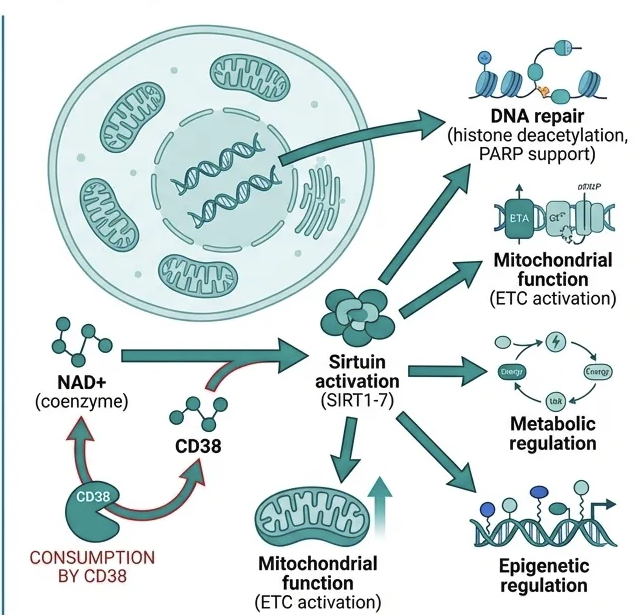
Several important enzyme systems consume NAD+ as part of their activity.
Sirtuins
Sirtuins are NAD+-dependent enzymes involved in metabolic regulation, stress responses and chromatin biology.
This relationship is one reason NAD+ and sirtuins frequently appear together in healthy-aging research.
PARPs
Poly(ADP-ribose) polymerases (PARPs) use NAD+ during cellular processes that include DNA-damage responses and repair.
CD38
CD38 is another major NAD-consuming enzyme and has attracted research interest in age-related changes in NAD metabolism.
Together, these pathways create a broader picture:
NAD+ → Metabolism + Signaling + DNA Repair + Cellular Stress Responses
This is considerably more complex than calling NAD+ an “energy booster.”
Does NAD+ Decline With Age?
This claim appears almost everywhere online.
The scientific answer requires more context.
Age-related changes in NAD+ metabolism have been observed in experimental models and some human tissues.
However, NAD+ is not distributed uniformly throughout the body.
Different tissues—and even different compartments within the same cell—can maintain different NAD+ pools.
Recent scientific reviews therefore emphasize that NAD+ biology should be considered in a tissue-specific and compartment-specific context.
That distinction matters because a change measured in blood does not necessarily describe NAD+ metabolism inside skeletal muscle, liver, brain or mitochondria.
Does Increasing NAD+ Prove an Anti-Aging Effect?
No.
This is one of the most important distinctions in current NAD+ research.
Human studies involving NAD+ precursors such as NR and NMN have demonstrated that NAD-related biomarkers can be altered.
But changing a biomarker is not the same as demonstrating a meaningful clinical outcome.
Recent systematic evidence indicates that human results involving metabolic function, vascular outcomes and physical performance remain mixed.
The evidence supporting direct parenteral NAD+ for broad “anti-aging” or “wellness” outcomes is even more limited.
Therefore:
Higher NAD-related biomarkers ≠ proven longer lifespan.
And:
Cellular NAD+ biology ≠ established anti-aging treatment.
For laboratory communication, those distinctions are essential.

What Do Online NAD+ Reviews Actually Show?
Searches for NAD+ reviews reveal highly inconsistent experiences.
Some people describe perceived improvements in energy, mental clarity or physical endurance.
Others report little or no noticeable difference.
Negative experiences reported online include nausea, stomach discomfort, headache, fatigue and other unwanted symptoms, particularly in discussions involving NAD+ infusions.
There is an additional problem:
Not all “NAD+ reviews” are actually discussing the same compound or delivery method.
Online discussions may refer to:
- NAD+ itself
- Nicotinamide riboside (NR)
- Nicotinamide mononucleotide (NMN)
- Oral supplements
- Infusion products
- Other formulations
These materials and experimental contexts should not be treated as interchangeable.
For this reason, online reviews cannot establish the efficacy or safety of a research grade NAD+ material.
Anecdotal experiences generate questions. Controlled experiments answer them.
What Should Laboratories Verify When Sourcing NAD+?
Because NAD+ is not a peptide, quality evaluation should reflect the chemical material actually being supplied.
Chemical Identity
Researchers should verify the applicable CAS number, molecular form and other chemical identifiers against the actual batch documentation.
For beta-NAD+, a commonly referenced identifier is:
CAS 53-84-9
Purity
A headline purity value can provide useful information, but laboratories should understand the analytical method used to generate that result.
Purity and chemical identity remain separate analytical questions.
Material Form
NAD+ may be supplied in different protonation, salt or hydration states.
Researchers should therefore avoid assuming that every product labeled “NAD+” is chemically identical.
The exact material should be checked against the applicable specification.
Batch-Specific COA
A useful NAD+ COA should correspond to the manufacturing lot actually supplied.
Ideally, researchers should be able to connect:
Product → Chemical Identity → Lot Number → Purity Data → Specification
That chain supports traceability and experimental reproducibility.
SUNONE NAD+ Research Compound
SUNONE supplies NAD+ (Nicotinamide Adenine Dinucleotide) for qualified laboratory, analytical and biopharmaceutical research applications.
SUNONE NAD+ is available as ≥99.7% research-grade solid/powder material, with applicable SDS, COA and product specifications available according to batch requirements.
Available research configurations include 100 mg, 500 mg and 1000 mg vial formats.
Researchers, biotechnology companies, distributors and qualified B2B customers can review product specifications here:
When comparing a NAD+ supplier or NAD+ manufacturer, laboratories should evaluate chemical identity, purity, material form, batch documentation, storage conditions and traceability together rather than relying on an “anti-aging” label or a single purity percentage.
Final Thoughts
NAD+ is scientifically interesting precisely because it cannot be reduced to one function.
It participates in redox metabolism.
It interacts with mitochondrial energy pathways.
It is consumed by sirtuins, PARPs and CD38.
And its metabolism varies between tissues and cellular compartments.
That complexity is why the phrase “more NAD+ = more energy” misses much of the scientific story.
For laboratories studying NAD+, better questions are:
Which NAD+ pool is being measured?
Which metabolic or signaling pathway is being studied?
Does the experimental result demonstrate a biomarker change or a functional outcome?
And can the identity and quality of the research material be verified?
Those questions turn an “energy molecule” headline into a much more useful research framework.
Disclaimer
This article is provided solely for scientific, educational and laboratory research information. It does not constitute medical advice and does not claim that NAD+ increases human energy, slows or reverses aging, extends lifespan, or prevents, diagnoses, treats or cures any disease.
SUNONE NAD+ products are intended for qualified laboratory research and manufacturing applications only. They are not intended for personal use, self-administration, human or veterinary consumption, diagnostic use or therapeutic use unless separately registered and authorized under applicable laws and regulations.
Leave a Reply