
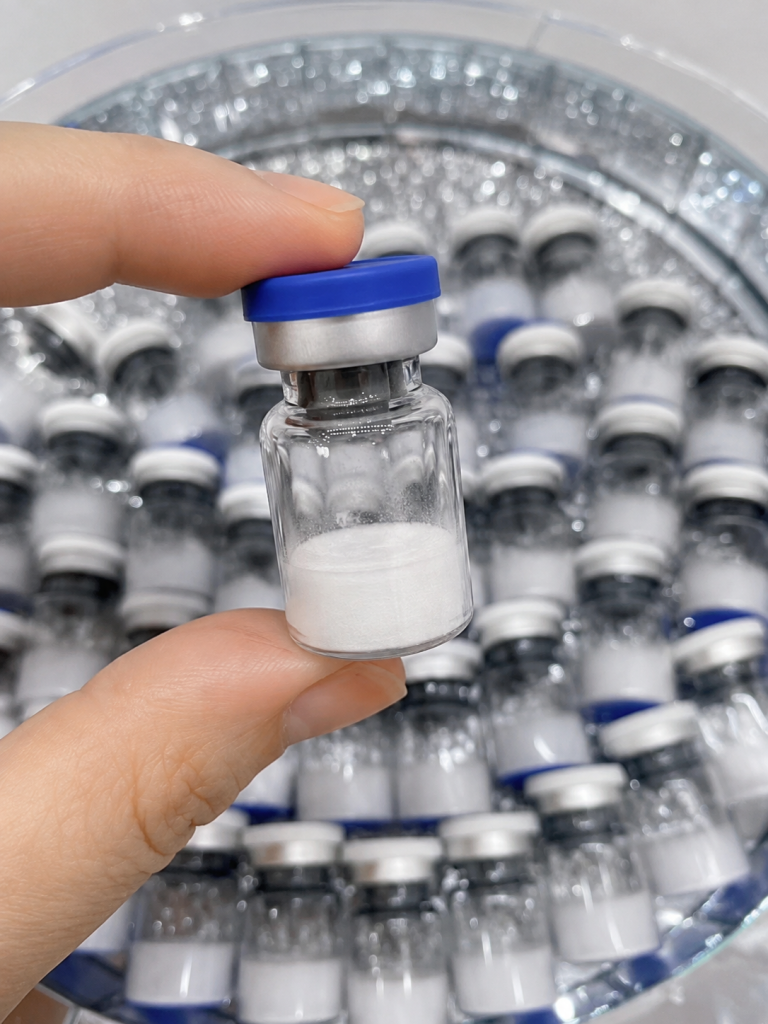
Selank Contains Only Seven Amino Acids—Why Is It Interesting?
Peptide size does not necessarily predict biological complexity.
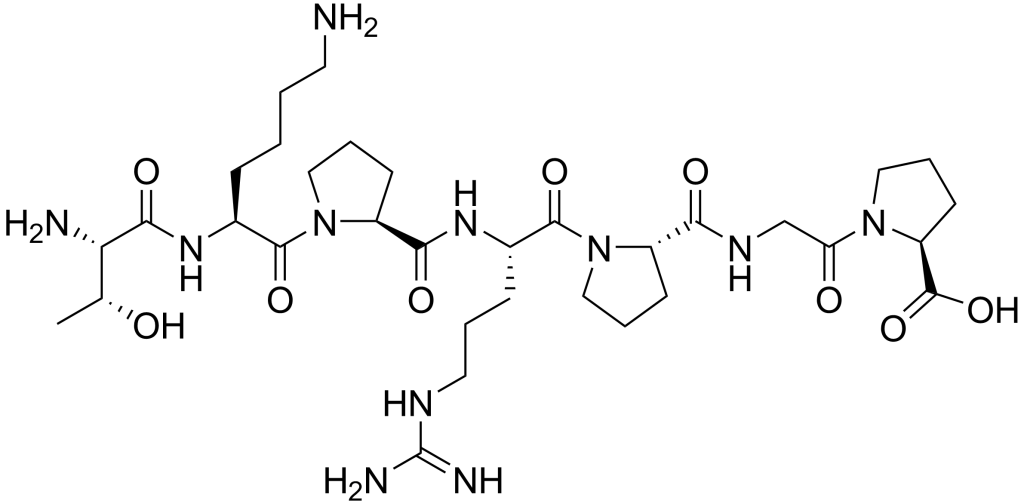
Selank peptide, also known as Selanc or TP-7, contains only seven amino acids:
Thr–Lys–Pro–Arg–Pro–Gly–Pro
or:
TKPRPGP
Despite its compact structure, Selank has attracted experimental interest in neurobiology, peptide regulation and related signaling pathways.
This creates a more useful research question than simply asking what Selank “does”:
How can a seven-amino-acid peptide interact with complex neurobiological systems?
Selank at a Glance
Key reference information for Selank research peptide includes:
- Name: Selank
- Alternative Name: Selanc
- Research Code: TP-7
- Sequence: Thr-Lys-Pro-Arg-Pro-Gly-Pro
- Abbreviation: TKPRPGP
- CAS Number: 129954-34-3
- Molecular Formula: C33H57N11O9
- Molecular Weight: approximately 751.9 g/mol
- Peptide Length: 7 amino acids
- Typical Research Form: Lyophilized peptide
These identifiers are particularly useful when comparing Selank materials across research suppliers and analytical documentation.
Why Is Selank Studied in Neurobiology?
Selank is a synthetic peptide structurally related to tuftsin, a naturally occurring tetrapeptide associated with immune and peptide-regulatory biology.
Research involving Selank has explored several neurobiological areas, including neurotransmitter-related pathways, gene-expression responses and behavioral models.
This has led to frequent online descriptions of Selank as a “nootropic” or “anxiolytic peptide.”
Those labels require context.
Experimental observations in cellular, animal or limited clinical research should not automatically be converted into broad claims about cognitive or mental-health outcomes.
For research communication, “a synthetic heptapeptide investigated in neurobiological and peptide-regulation pathways” is a more precise description.
Selank vs Popular Online Claims
Search for Selank online and the language quickly becomes stronger:
“Calming peptide.”
“Anti-anxiety peptide.”
“Nootropic peptide.”
The scientific problem is not that these terms appeared from nowhere. It is that they can compress different levels of evidence into a single marketing phrase.
A mechanistic study can investigate how a peptide interacts with a biological pathway.
A behavioral study can investigate a measurable response under controlled conditions.
A human clinical trial asks a different question again.
These evidence levels should not be treated as interchangeable.
For researchers, the better question is:
Which Selank effects have been observed under which experimental conditions?
That keeps the conclusion connected to the evidence.

What Do Online Selank Reviews Actually Show?
Searches for Selank reviews reveal a surprisingly mixed picture.
Some users describe subtle perceived changes in calmness, stress or mental state.
Others report little or no noticeable effect.
Negative discussions include experiences such as headaches, nausea, dizziness, brain fog, sleep disruption, increased anxiety or changes in mood.
These reports cannot establish Selank efficacy or safety.
Online anecdotes usually provide no reliable way to control or independently verify:
- Peptide identity
- Material purity
- Actual quantity
- Storage conditions
- Product formulation
- Other substances being used
- Individual biological variables
For researchers, online reviews may help identify questions worth studying—but they should not be treated as controlled scientific evidence.
Anecdotes describe experiences. Experiments test hypotheses.
Why Selank Identity Matters More Than the Product Name
A vial labeled “Selank” provides a name.
It does not independently establish molecular identity.
For laboratories comparing a Selank supplier or Selank manufacturer, analytical documentation becomes important.
Sequence Identity
The expected Selank sequence is:
TKPRPGP
Analytical identity testing can provide evidence supporting whether the material corresponds to the intended peptide.
HPLC Purity
HPLC can characterize chromatographic purity and detectable related components.
A high Selank HPLC purity result is useful analytical information—but purity and identity answer different questions.
A chromatographic percentage alone should not automatically be interpreted as complete molecular verification.
Mass Analysis
Mass spectrometry can provide complementary information supporting molecular identity.
For peptide research, combining purity and identity information provides a more informative analytical picture than either result alone.
Batch-Specific COA
A useful Selank COA should correspond to the production lot actually supplied.
Ideally, researchers should be able to connect:
Vial → Lot Number → Sequence → Identity Data → Purity Data
That connection supports experimental traceability.
SUNONE Selank Research Peptide

SUNONE supplies Selank (TP-7) research peptide for qualified laboratory, analytical and biopharmaceutical research applications.
SUNONE Selank is supplied as ≥98% HPLC lyophilized research material, with applicable product specifications and batch analytical documentation available according to product requirements.
Researchers, biotechnology companies, distributors and qualified B2B customers can review specifications here:
View SUNONE Selank Research Peptide
When evaluating research grade Selank, laboratories should consider molecular identity, chromatographic purity, analytical documentation, storage requirements and batch traceability together rather than relying on the product name or a single purity percentage.
For more information, please click here.
Final Thoughts
Selank demonstrates an important principle in peptide science:
Small molecule size does not mean a simple biological question.
Seven amino acids—TKPRPGP—have generated research involving peptide regulation and complex neurobiological pathways.
At the same time, growing online interest has produced claims that often move beyond what a particular experiment can establish.
For laboratories studying Selank peptide, three questions therefore remain more useful than marketing terminology:
What molecule is actually present?
What does the controlled evidence actually demonstrate?
Can the analytical results be traced to the specific research batch?
Good peptide research starts by keeping those three questions separate.
SUNONE Selank research peptide is for qualified labrtorynt, diagnois, druc tor mmatct or veteimant, use.research only, Not for human consumption, clinical treame.
Leave a Reply