
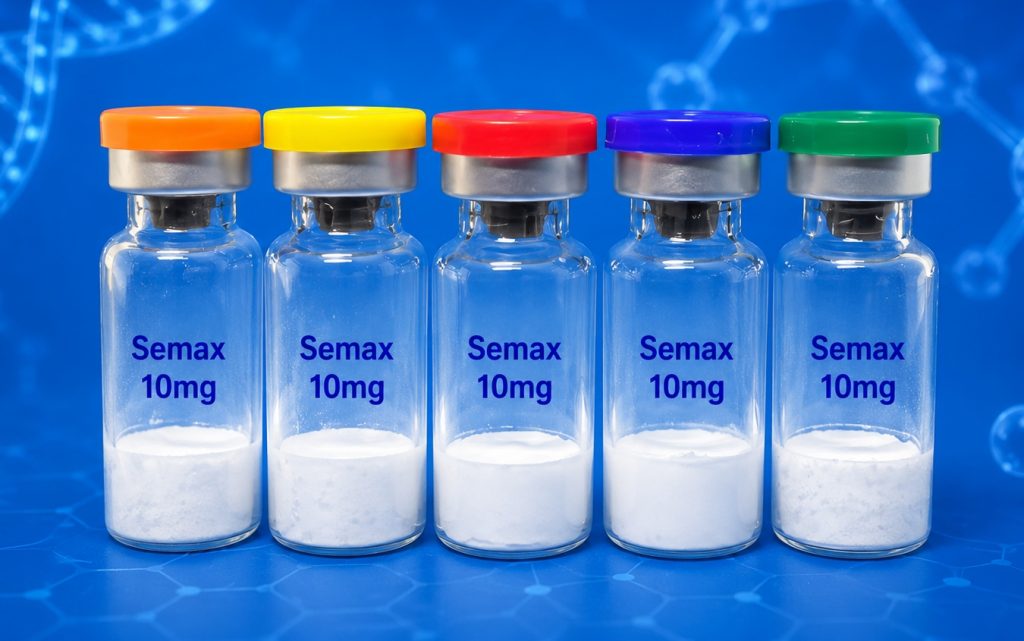
Semax Comes From ACTH Research—But It Is Not ACTH
At first glance, Semax peptide has an unusual scientific background.
Semax is a synthetic seven-amino-acid peptide related to a fragment of adrenocorticotropic hormone (ACTH).
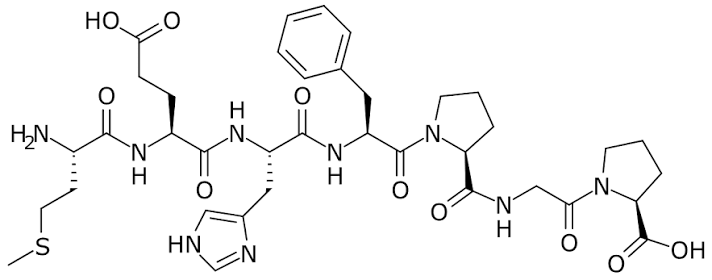
Its sequence is:
Met–Glu–His–Phe–Pro–Gly–Pro
The molecule combines an ACTH-derived sequence with a C-terminal Pro-Gly-Pro (PGP) region.
Yet Semax research is generally associated not with conventional endocrine ACTH activity, but with neurobiological signaling.
That creates an interesting question:
How did an ACTH-derived peptide become a research molecule associated with BDNF and neuroprotection?
Semax at a Glance
Key reference information for Semax research peptide includes:
- Product Name: Semax
- Sequence: Met-Glu-His-Phe-Pro-Gly-Pro
- CAS Number: 80714-61-0
- Molecular Formula: C37H51N9O10S
- Molecular Weight: approximately 813.90 g/mol
- Peptide Length: 7 amino acids
- Classification: Synthetic ACTH-related heptapeptide
- Typical Research Form: Lyophilized peptide
These identifiers are particularly important when comparing Semax research materials and analytical documentation.
Why Does BDNF Appear So Often in Semax Research?
Search for Semax BDNF and the term appears repeatedly.
BDNF—brain-derived neurotrophic factor—is a signaling protein involved in neuronal survival, synaptic plasticity and other aspects of nervous-system biology.
Experimental studies in rats have reported changes in BDNF protein levels following Semax exposure.
Other animal research has examined changes involving BDNF and NGF gene expression in brain regions such as the hippocampus and frontal cortex.
This helps explain why Semax is frequently discussed in neurobiology and neuroplasticity research.
But there is an important distinction:
A change in BDNF observed in an animal model is not the same as demonstrated cognitive enhancement in humans.
Mechanistic evidence can help explain a biological pathway.
It should not automatically become a clinical claim.
Semax Research Goes Beyond BDNF
BDNF is only one part of the Semax research story.
Preclinical studies have also investigated Semax in experimental cerebral-ischemia models.
Research in these models has reported changes involving inflammatory gene expression and proteins associated with cellular stress, inflammation and recovery—including pathways involving CREB, MMP-9 and JNK.
Transcriptomic studies have also investigated how Semax may influence groups of genes involved in immune responses and neurotransmission.
This makes Semax neuroprotection research more complex than the common online description of the peptide as simply a “focus enhancer.”
The scientific question is not whether Semax is a universal cognitive enhancer.
It is:
Which molecular pathways change under specific experimental conditions, and what do those changes actually mean?

What Do Online Semax Reviews Actually Show?
Searches for Semax reviews reveal very different experiences.
Some users describe perceived improvements in focus, mental clarity, motivation or brain fog.
Others report almost no noticeable effect.
Negative discussions include experiences such as headaches, nausea, fatigue, increased anxiety and brain fog.
This inconsistency should encourage scientific caution.
Online experiences rarely provide enough information to verify:
- Peptide identity
- Material purity
- Product formulation
- Storage conditions
- Actual peptide content
- Other compounds being used
- Individual biological variables
For that reason, online Semax reviews cannot establish efficacy or safety.
Anecdotal experiences can generate hypotheses. Controlled research is needed to test them.
Why “98% HPLC” Does Not Answer Every Semax Question
Researchers sourcing research grade Semax often encounter a headline purity specification.
Purity matters—but it answers only one analytical question.
HPLC Purity
HPLC can provide information about chromatographic purity and detectable related components.
A high Semax HPLC result can therefore be useful quality information.
But chromatographic purity does not independently establish every aspect of molecular identity.
Molecular Identity
The expected Semax peptide contains the sequence:
Met-Glu-His-Phe-Pro-Gly-Pro
Identity analysis provides complementary evidence that the material corresponds to the intended research peptide.
Actual Peptide Content
Purity percentage and peptide quantity are also different concepts.
A highly pure material does not automatically establish the exact amount of peptide contained in a particular vial.
Researchers should therefore understand what each analytical measurement actually reports.
Batch-Specific COA
A useful Semax COA should correspond to the production lot actually supplied.
Ideally, laboratories should be able to connect:
Product → Lot Number → Identity → Purity → Applicable Specification
That traceability becomes especially important when experiments are repeated across different production batches.

SUNONE Semax Research Peptide
SUNONE supplies Semax research peptide for qualified laboratory, analytical and biopharmaceutical research applications.
SUNONE Semax is supplied as ≥98% HPLC lyophilized research material, with applicable product specifications and batch analytical documentation available according to product requirements.
Researchers, biotechnology companies, distributors and qualified B2B customers can review product specifications here:
View SUNONE Semax Research Peptide
When comparing a Semax supplier or Semax manufacturer, laboratories should evaluate molecular identity, chromatographic purity, batch documentation, storage requirements and manufacturing traceability together rather than relying on a product name or a single purity percentage.
Final Thoughts
Semax is a useful example of how peptide research can evolve beyond the biological role of the molecule from which a sequence was originally derived.
Its ACTH-related structure led to a seven-amino-acid research peptide now investigated across BDNF signaling, gene expression, inflammatory pathways and experimental neurobiology.
But that research should be interpreted at the level at which it was performed.
Animal BDNF findings are not automatically human cognitive outcomes.
Online focus reports are not controlled clinical evidence.
And a purity percentage is not the same thing as complete molecular verification.
For laboratories studying Semax peptide, the strongest research starts by keeping molecular identity, analytical quality and biological evidence separate—and verifying each one independently.
Disclaimer
This article is provided solely for scientific, educational and laboratory research information. It does not constitute medical advice and does not claim that Semax improves cognition or prevents, diagnoses, treats or cures stroke, neurological disorders, cognitive impairment or any other disease.
SUNONE Semax products are intended for qualified laboratory research and manufacturing applications only. They are not intended for personal use, self-administration, human or veterinary consumption, diagnostic use or therapeutic use unless separately registered and authorized under applicable laws and regulations.
Leave a Reply