
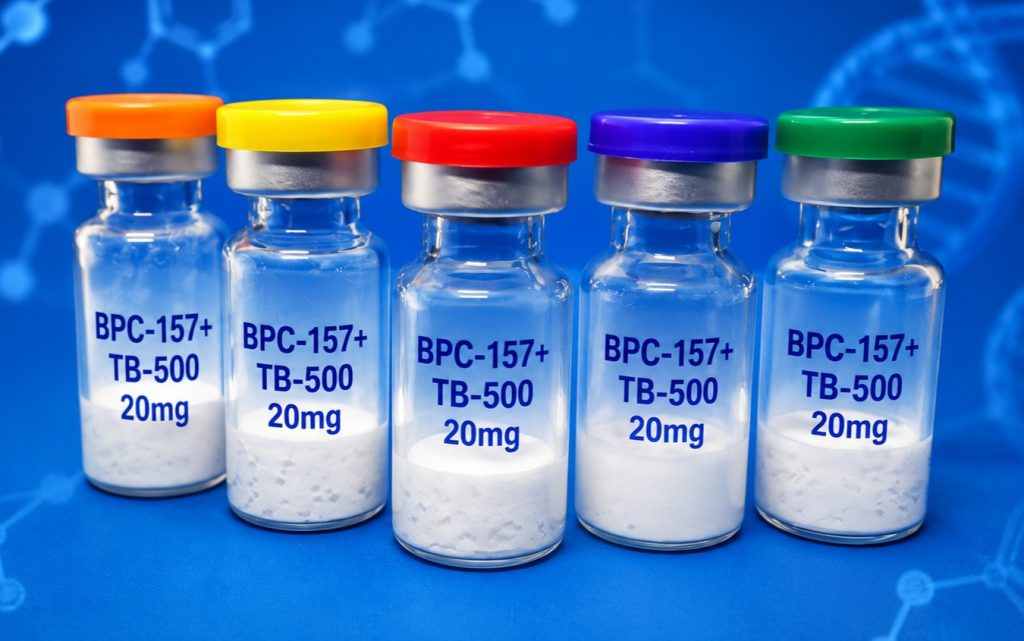
What Is a BPC-157 + TB-500 Research Blend?
BPC-157 + TB-500 is a multi-component peptide research formulation combining two peptides frequently studied in tissue-related biological models.
BPC-157 has been investigated primarily in preclinical models involving inflammatory signaling, vascular responses and tissue remodeling.
TB-500 is a synthetic fragment related to thymosin beta-4 research and is commonly studied in connection with actin-associated signaling, cell migration and regenerative biology.
Combining the two creates a useful laboratory model for researchers interested in complementary tissue-related pathways.
SUNONE BPC-157 + TB-500 Product Page:
Why Is BPC-157 + TB-500 Studied?
Research involving a BPC-157 TB-500 blend may focus on biological processes such as:
- tissue remodeling;
- cellular migration;
- inflammatory signaling;
- angiogenesis-related pathways;
- actin-associated biology;
- extracellular matrix responses;
- regenerative research models.
However, an important distinction is often missing from consumer-oriented articles: most published evidence examines BPC-157 and thymosin-related compounds separately, rather than a standardized BPC-157 + TB-500 combination.
This means that evidence for each individual peptide should not automatically be interpreted as evidence for a specific blended formulation.
What Does the Current Research Say?
Current BPC-157 literature remains heavily weighted toward preclinical research.
Animal and laboratory studies have generated interest in tendon, ligament, muscle, bone and inflammatory models, but robust human safety and efficacy evidence remains limited.
TB-500 research has an additional evidence challenge.
Many publications discussed online actually involve full-length thymosin beta-4, while TB-500 represents a related peptide fragment. These materials are not interchangeable, and research findings involving full-length TB4 should not automatically be attributed to TB-500.
For professional research, accurate molecular identification is therefore essential.
What Do BPC-157 + TB-500 Reviews Say?
Online BPC-157 + TB-500 reviews are highly mixed.
Positive anecdotal reports commonly describe perceived improvements in recovery, discomfort, mobility or exercise-related soreness.
Negative reports include:
- little or no noticeable effect;
- fatigue or unusual drowsiness;
- headaches or head pressure;
- gastrointestinal discomfort;
- sleep changes;
- anxiety or overstimulation;
- skin or other unexpected reactions.
These experiences are uncontrolled personal reports. In many cases, users also combine multiple compounds, supplements or training interventions, which makes it impossible to determine cause and effect.
Online reviews therefore should not be used as evidence of clinical efficacy or safety.
Why Multi-Component Identity Matters
A BPC-157 + TB-500 research blend is not a single chemical entity.
It should therefore not be represented by one CAS number, molecular formula or molecular weight.
For laboratory researchers, the important specifications include:
- identity of each peptide component;
- amount of each component;
- blend ratio;
- individual peptide purity;
- chemical or salt form;
- lot-specific analytical documentation.
This is especially important when comparing experiments across different suppliers or research batches.
What Should Researchers Check When Choosing a BPC-157 + TB-500 Supplier?
When evaluating a BPC-157 TB-500 supplier, researchers should look beyond marketing claims.
Batch-Specific COA
A Certificate of Analysis should identify the individual peptide components and their relevant specifications.
Purity Documentation
Analytical data should support the stated purity and help characterize peptide-related impurities.
Component Ratio
The amount and ratio of BPC-157 and TB-500 should be clearly documented.
Identity Verification
Researchers should confirm that the TB-500-related component is correctly identified rather than assuming that it is equivalent to full-length thymosin beta-4.
Storage and Traceability
Storage conditions, lot numbers and supporting SDS/specification documents should be available for every research batch.
SUNONE supplies BPC-157 + TB-500 Research Blend as ≥99.6% Research Grade lyophilized material for qualified laboratory and manufacturing applications.
BPC-157 + TB-500 Research: Look Beyond the “Wolverine Stack”
Many online pages describe BPC-157 + TB-500 using labels such as the “Wolverine Stack.”
That language may attract consumer searches, but it provides little scientific value.
For biotechnology researchers, the more useful questions concern peptide identity, tissue-related signaling, differences between TB-500 and full-length thymosin beta-4, evidence quality, impurity profiles and batch consistency.
This approach provides a stronger scientific framework for BPC-157 + TB-500 research than relying on anecdotal recovery claims.
SUNONE BPC-157 + TB-500 research peptide is for qualified labrtorynt, diagnois, druc tor mmatct or veteimant, use.research only, Not for human consumption, clinical treame.
Leave a Reply