
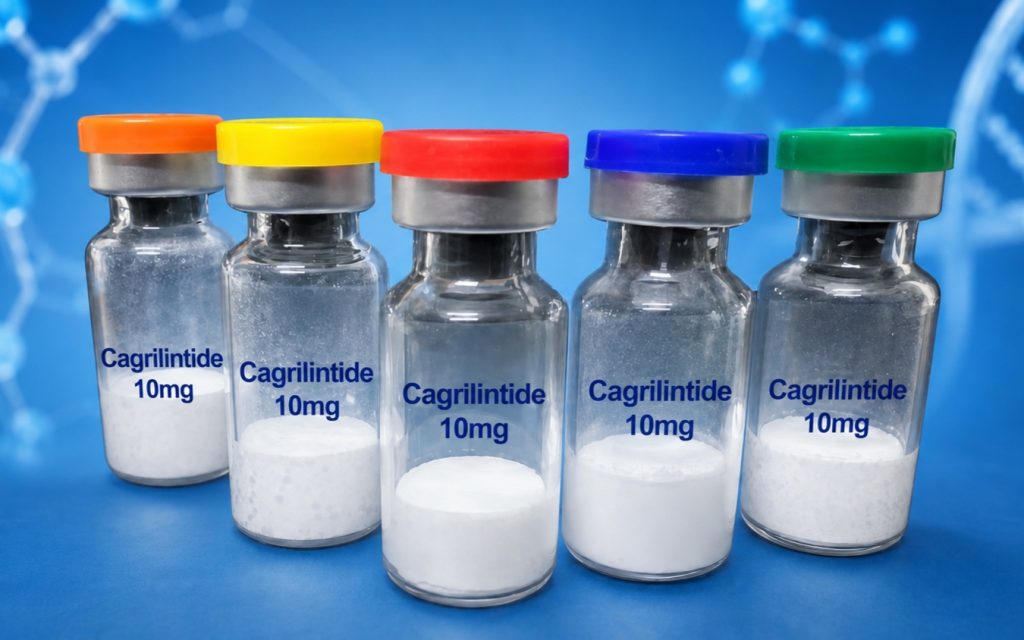
What Is Cagrilintide?
Cagrilintide is an investigational long-acting amylin analogue developed for research into appetite, satiety, metabolic regulation and calcitonin-family receptor signaling.
This distinction matters because Cagrilintide is often discussed online alongside GLP-1 peptides even though it represents a different biological pathway.
SUNONE supplies research-grade Cagrilintide for qualified laboratory and manufacturing applications.
SUNONE Cagrilintide Product Page:
Cagrilintide vs. GLP-1: What Is the Difference?
One of the most useful ways to understand Cagrilintide research is to look at what it is not.
Semaglutide and related GLP-1 compounds primarily act through the GLP-1 receptor.
Cagrilintide instead belongs to the amylin / calcitonin receptor family.
Research has shown that Cagrilintide can engage several amylin receptor subtypes as well as the calcitonin receptor, creating a receptor-signaling profile distinct from conventional GLP-1 receptor agonists.
This makes Cagrilintide particularly interesting for laboratories investigating complementary metabolic pathways rather than another version of GLP-1 biology.
Why Is Amylin Biology Important?
Natural amylin is a pancreatic peptide hormone involved in physiological pathways associated with satiety and energy regulation.
Cagrilintide was engineered as a longer-acting analogue, allowing researchers to investigate questions involving:
- amylin receptor signaling;
- calcitonin-family receptors;
- appetite and satiety pathways;
- energy-balance research;
- metabolic signaling;
- peptide pharmacology;
- combination incretin-amylin research.
Recent structural studies have also helped clarify how Cagrilintide interacts with individual amylin receptor subtypes.
What Does Current Cagrilintide Research Show?
Cagrilintide has progressed beyond early laboratory research into late-stage clinical development.
Phase 2 research established proof of concept for Cagrilintide as a long-acting amylin analogue.
More recently, the Phase 3 REDEFINE programme included a standalone Cagrilintide arm alongside semaglutide and the combined CagriSema intervention.
These studies support continued scientific interest in amylin-based metabolic pharmacology.
However, clinical-trial material manufactured under pharmaceutical development conditions should not be considered equivalent to a research-grade peptide supplied for laboratory applications.
What Do Cagrilintide Reviews Say?
Current online Cagrilintide reviews are highly mixed.
Positive anecdotal discussions frequently mention:
- strong appetite suppression;
- reduced interest in food;
- reduced sweet cravings;
- increased feelings of fullness.
Negative reports commonly mention:
- fatigue;
- brain fog;
- nausea;
- dizziness or light-headedness;
- gastrointestinal discomfort;
- little or no noticeable response.
The variation is notable: some users describe extremely strong effects, while others report almost none.
These testimonials are uncontrolled, frequently involve multiple compounds and cannot establish clinical safety, efficacy or material quality.
Why Cagrilintide and CagriSema Should Not Be Confused
Another common Google search problem is the tendency to use Cagrilintide and CagriSema interchangeably.
They are not the same intervention.
Cagrilintide is the long-acting amylin analogue.
CagriSema combines Cagrilintide with semaglutide, a GLP-1 receptor agonist.
Clinical results involving the combination therefore should not automatically be presented as results produced by Cagrilintide alone.
This distinction is important for accurate scientific communication and SEO content.
What Should Researchers Check When Choosing a Cagrilintide Supplier?
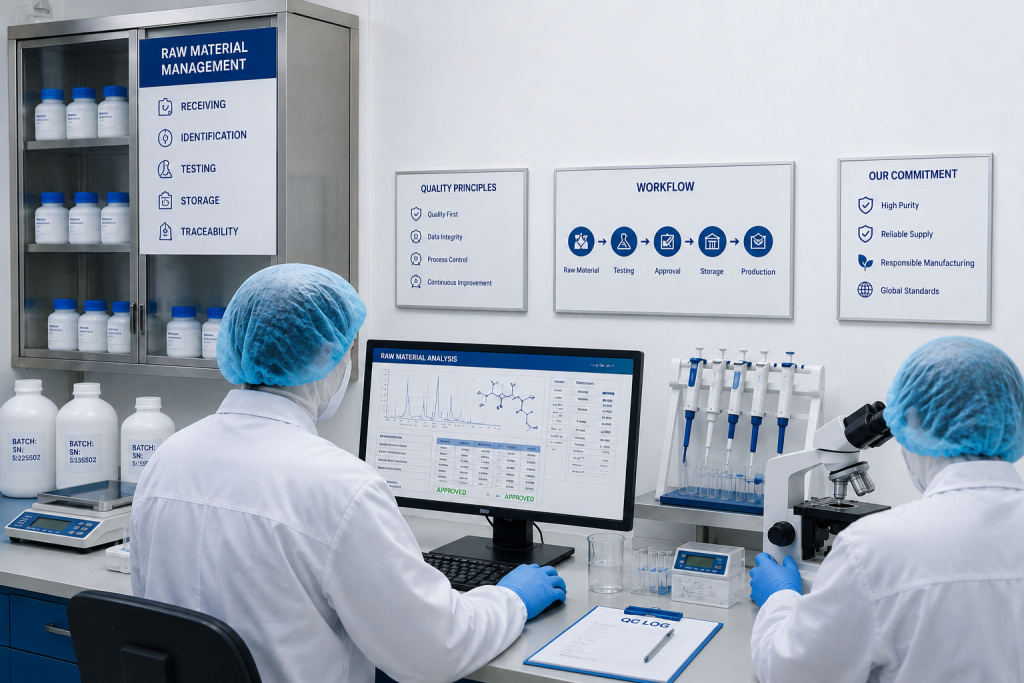
For professional research, Cagrilintide supplier selection should focus on analytical evidence rather than consumer claims.
Researchers should review:
- molecular identity;
- peptide purity;
- batch-specific HPLC data;
- applicable identity characterization;
- Certificate of Analysis;
- chemical or salt form;
- batch traceability;
- storage documentation.
SUNONE supplies Cagrilintide, CAS 1415456-99-3, as ≥99.6% Research Grade lyophilized material for qualified B2B laboratory and manufacturing customers.
Cagrilintide Research: Look Beyond the GLP-1 Comparison
The most interesting scientific feature of Cagrilintide is not simply that it is being developed in the same metabolic field as GLP-1 drugs.
It represents a different receptor system.
For researchers, the key questions involve how long-acting amylin analogues engage AMY receptors, how receptor subtype signaling differs from GLP-1 biology, and how complementary peptide pathways may be studied separately or together.
This receptor-focused perspective provides a more scientifically useful framework for Cagrilintide research than treating every metabolic peptide as another GLP-1 compound.
SUNONE Cagrilintide research peptide is for qualified labrtorynt, diagnois, druc tor mmatct or veteimant, use.research only, Not for human consumption, clinical treame.
Leave a Reply