
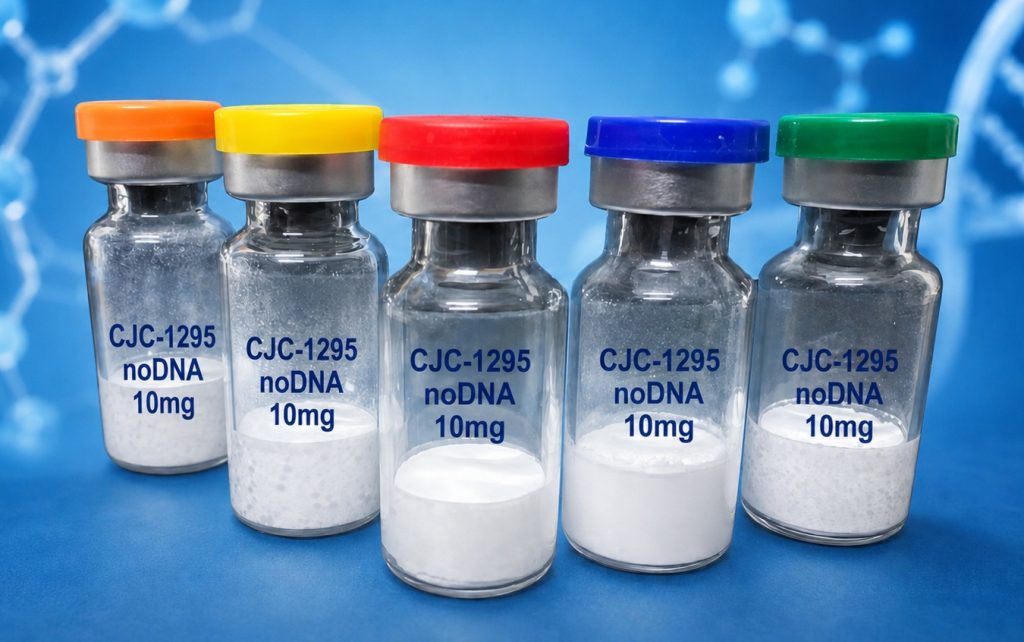
What Is CJC-1295 No DAC?
CJC-1295 No DAC, also known as CJC-1295 Without DAC, Modified GRF 1-29 or Mod GRF 1-29, is a synthetic peptide related to growth hormone-releasing hormone (GHRH).
Unlike CJC-1295 with DAC, the No DAC form does not contain the Drug Affinity Complex modification associated with prolonged albumin binding.
This difference makes CJC-1295 No DAC relevant to laboratories studying peptide structure, GHRH receptor biology and how molecular modifications influence peptide behavior.
For research specifications, visit:
Why Is Modified GRF 1-29 Studied?
Modified GRF 1-29 is based on the biologically active region of GHRH and incorporates structural modifications intended to improve peptide stability compared with native GRF fragments.
Research applications may include:
- GHRH receptor-related signaling;
- peptide stability studies;
- structure-activity relationships;
- GH-axis laboratory models;
- biochemical characterization;
- analytical method development;
- comparative peptide research.
For biotechnology laboratories, this makes CJC-1295 No DAC especially useful as a research material for examining the relationship between peptide sequence, stability and receptor-associated signaling.
CJC-1295 No DAC vs. CJC-1295 With DAC
This distinction is one of the most important points in CJC-1295 research.
CJC-1295 with DAC contains a Drug Affinity Complex designed to extend biological persistence through albumin association.
CJC-1295 No DAC / Modified GRF 1-29 does not contain that modification.
Because of this structural difference, published results from long-acting CJC-1295 studies should not automatically be treated as direct evidence for CJC-1295 No DAC.
Accurate naming is therefore important for both experimental design and scientific communication.
What Do CJC-1295 No DAC Reviews Say?

Online CJC-1295 No DAC reviews are mixed.
Some users describe perceived changes in recovery, training performance, sleep or body composition.
However, many reports involve CJC-1295 No DAC together with Ipamorelin or other compounds, making it difficult to determine which material contributed to the reported effect.
Negative anecdotal experiences include:
- headaches;
- dizziness;
- flushing;
- injection-site irritation;
- red welts or skin reactions;
- possible histamine-related reactions;
- little or no noticeable effect.
These reports are uncontrolled personal experiences and should not be considered evidence of clinical safety or efficacy.
For laboratory research, analytical documentation and controlled experimental results are far more useful than online testimonials.
What Should Researchers Check When Choosing a CJC-1295 No DAC Supplier?
When evaluating a CJC-1295 No DAC supplier, molecular identity is especially important because the terms CJC-1295, Modified GRF 1-29 and CJC-1295 with DAC are often used inconsistently online.
Correct Molecular Identity
Documentation should clearly state whether the material is CJC-1295 No DAC / Modified GRF 1-29 or the DAC-modified version.
HPLC Purity
Batch-specific chromatography helps laboratories evaluate peptide purity and related impurities.
Mass Spectrometry
MS data can provide additional confirmation of expected molecular identity.
Certificate of Analysis
A batch-specific CJC-1295 No DAC COA improves traceability and allows researchers to review analytical specifications.
Storage and Documentation
Relevant SDS, specification sheets and batch-specific storage conditions should be available.
SUNONE supplies CJC-1295 No DAC / Modified GRF 1-29 as ≥99% HPLC lyophilized research material with COA, HPLC and MS documentation available according to batch specification.
Why Accurate Naming Matters in CJC-1295 Research
One unusual problem with CJC-1295 search results is terminology.
Some websites use “CJC-1295” for the DAC-modified molecule, while others use the same name for Modified GRF 1-29 without DAC.
For professional laboratories, this ambiguity can create unnecessary confusion when comparing scientific publications, supplier specifications and analytical standards.
A better research approach is to verify the exact molecular identity, sequence specification, presence or absence of DAC, HPLC purity and mass data before comparing experimental results.
SUNONE CJC-1295 No DAC research peptide is for qualified labrtorynt, diagnois, druc tor mmatct or veteimant, use.research only, Not for human consumption, clinical treame.
Leave a Reply