
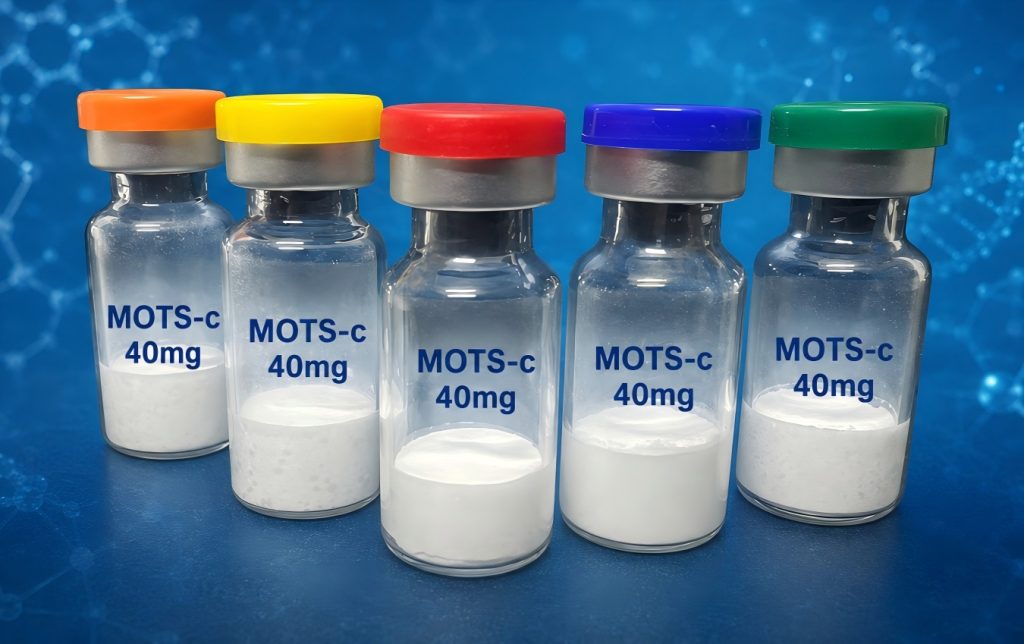
What Is MOTS-c?
MOTS-c is a mitochondrial-derived peptide encoded within a short open reading frame of mitochondrial 12S rRNA.
That origin makes MOTS-c scientifically unusual.
Most peptides discussed in metabolic research are encoded by nuclear DNA. MOTS-c is associated with the mitochondrial genome and has therefore become an important research target for studying communication between mitochondria, cellular metabolism and nuclear gene regulation.
SUNONE supplies Research Grade MOTS-c, CAS 1627580-64-6, for qualified laboratory, analytical and manufacturing research.
SUNONE MOTS-c Product Page:
Why Is MOTS-c Studied?
Current MOTS-c research includes areas such as:
- mitochondrial signaling;
- cellular energy metabolism;
- metabolic adaptation;
- glucose utilization;
- AMPK-associated pathways;
- cellular stress responses;
- skeletal-muscle metabolism;
- mitochondrial-to-nuclear communication.
One particularly interesting feature is that MOTS-c has been reported to translocate to the nucleus during metabolic stress, linking mitochondrial signaling with changes in nuclear gene expression.
This makes MOTS-c more than a generic “energy peptide.”
It is a model for studying how mitochondrial signals may influence whole-cell metabolic adaptation.
MOTS-c and Exercise: What Does the Evidence Actually Show?
Google searches frequently associate MOTS-c with exercise and endurance.
The evidence requires careful interpretation.
Human research has shown that exercise can increase endogenous MOTS-c levels in skeletal muscle and circulation.
Experimental studies have also reported improved physical capacity following MOTS-c treatment—but much of this intervention evidence comes from animal models.
Therefore:
Human exercise-induced MOTS-c ≠ proven human performance benefit from externally supplied MOTS-c.
That distinction is essential when interpreting MOTS-c research.

What Do MOTS-c Reviews Say?
Current online MOTS-c reviews are highly mixed.
Positive anecdotal reports sometimes mention:
- increased perceived energy;
- improved endurance;
- better workout experience;
- improved sense of metabolic wellbeing.
Negative reports include:
- unexpected fatigue;
- reduced workout performance;
- body or joint aches;
- injection-site reactions;
- no noticeable effect.
Some 2026 discussions contain both extremes: one person may describe significantly more exercise energy while another reports pronounced fatigue from what is described as the same peptide.
These experiences are not controlled studies.
Many reviewers also combine MOTS-c with compounds such as SS-31, NAD+, retatrutide or other peptides, making causal interpretation impossible.
Why “Mitochondrial Peptide” Does Not Mean Proven Anti-Aging Therapy
Another common search phrase is “MOTS-c anti-aging peptide.”
MOTS-c is indeed studied in aging biology.
Animal studies have investigated age-related physical decline, metabolic homeostasis and stress adaptation. Human observational research has also investigated relationships between circulating MOTS-c and metabolic conditions.
However, these findings do not establish MOTS-c as a clinically proven anti-aging treatment.
Research into a biological pathway should be separated from claims of demonstrated therapeutic benefit.

What Should Researchers Check When Choosing a MOTS-c Supplier?
For professional MOTS-c research, analytical quality is more useful than marketing language.
Researchers should consider:
Molecular Identity
The material should correspond to the expected sequence-defined MOTS-c peptide.
HPLC Purity
Batch-specific chromatographic data can help characterize purity and related peptide species.
Chemical Form
Termini, salt form and related molecular characteristics should match the applicable specification.
Certificate of Analysis
A batch-specific MOTS-c COA improves traceability and reproducibility.
Storage Documentation
Storage conditions should be confirmed from the applicable COA, SDS and product specification.
SUNONE currently lists MOTS-c, CAS 1627580-64-6, as Research Grade lyophilized peptide for B2B research and manufacturing applications.
MOTS-c Research: Study the Signal, Not the Hype
The phrase “energy peptide” is attractive for marketing, but it does not capture the most interesting biology of MOTS-c.
For researchers, the more important questions involve:
How does a mitochondrial-encoded peptide participate in cellular stress adaptation? How does exercise affect endogenous MOTS-c? How does MOTS-c influence mitochondrial-to-nuclear communication and metabolic signaling?
Those questions place MOTS-c in a much more scientifically meaningful context.
For laboratories sourcing research-grade MOTS-c, molecular identity, purity, batch traceability and analytical documentation should take priority over anecdotal claims about energy, performance or anti-aging effects.
SUNONE MOTS-c research peptide is for qualified labrtorynt, diagnois, druc tor mmatct or veteimant, use.research only, Not for human consumption, clinical treame.
Leave a Reply