
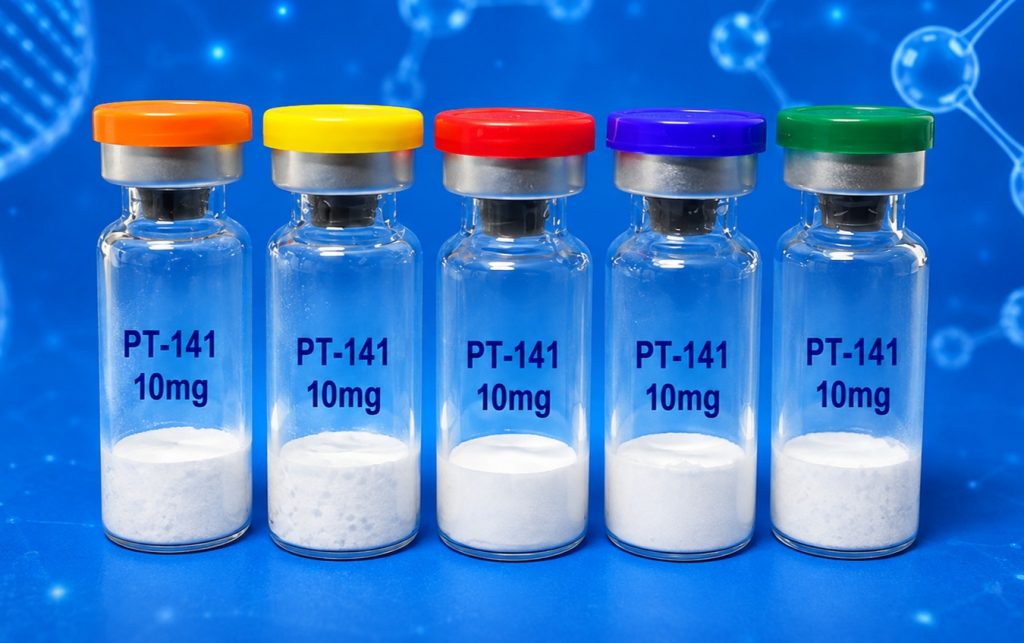
What Is PT-141 Bremelanotide?
PT-141, also known as Bremelanotide, is a synthetic cyclic heptapeptide belonging to the melanocortin research field.
Unlike compounds primarily studied through peripheral vascular pathways, PT-141 has attracted research interest because of its interaction with melanocortin receptors, including receptor pathways associated with central nervous system signaling.
This makes PT-141 relevant to laboratories studying peptide–receptor interactions, melanocortin biology and neuroendocrine signaling.
For analytical specifications, visit the SUNONE PT-141 Bremelanotide product page:
Why Is PT-141 Studied?
PT-141 research primarily focuses on melanocortin receptor signaling.
Relevant research areas include:
- MC4R-associated signaling;
- melanocortin receptor pharmacology;
- neuroendocrine pathways;
- peptide–receptor interactions;
- central signaling mechanisms;
- cyclic peptide structure–activity relationships;
- peptide characterization and analytical development.
The molecular mechanism is particularly interesting because Bremelanotide does not simply follow the same biological pathway as conventional PDE5-related compounds.
This distinction has made PT-141 peptide research valuable for understanding how melanocortin signaling can influence complex neurobiological responses.
What Do PT-141 Reviews Say?
Online PT-141 reviews contain both strongly positive and negative experiences.
Some users of Bremelanotide-containing products report noticeable subjective changes in sexual desire or physiological responsiveness.
Other users describe little benefit or unwanted experiences such as:
- nausea;
- flushing;
- headaches;
- temporary discomfort;
- delayed or inconsistent subjective effects;
- changes in pigmentation.
Controlled clinical research with pharmaceutical Bremelanotide has also reported nausea, flushing and headache among commonly observed adverse effects.
However, consumer reviews and clinical experiences with approved pharmaceutical products do not evaluate SUNONE research-grade PT-141.
They should therefore not be used as evidence of clinical safety or efficacy for research material.

PT-141 Research Peptide vs. Pharmaceutical Bremelanotide
This distinction is essential.
Bremelanotide is also the active pharmaceutical ingredient in an FDA-approved prescription product for a specific clinical indication and patient population.
A research-grade PT-141 peptide, however, is supplied for laboratory, analytical and manufacturing research.
Clinical data from an approved pharmaceutical formulation should not be used to claim that research-grade PT-141 is approved, therapeutically equivalent or appropriate for personal use.
For researchers, the relevant questions are instead related to:
- molecular identity;
- peptide purity;
- mass confirmation;
- batch traceability;
- analytical documentation.
What Should Researchers Check When Sourcing PT-141?
When evaluating a PT-141 supplier, laboratories should prioritize analytical quality over promotional claims.
Peptide Identity
Testing should support the expected Bremelanotide molecular identity.
HPLC Purity
Batch-specific HPLC data provides information about peptide purity and related impurities.
Mass Spectrometry
MS characterization can provide additional confirmation of expected molecular mass.
Certificate of Analysis
A lot-specific PT-141 COA improves traceability and allows researchers to review analytical results for an individual batch.
Storage and Documentation
Research materials should include relevant SDS, specifications and batch-specific storage information.
SUNONE supplies PT-141 Bremelanotide, CAS 189691-06-3, as ≥98% HPLC lyophilized material with supporting analytical documentation for qualified B2B research and manufacturing customers.
PT-141 Research: Look Beyond the “Libido Peptide” Label
Much of the online discussion reduces PT-141 to a simple “libido peptide.”
For biotechnology researchers, however, Bremelanotide is also an interesting model for studying melanocortin receptor pharmacology, MC4R-associated signaling, cyclic peptide design and central neuroendocrine pathways.
This scientific perspective is more useful than repeating consumer-oriented benefit claims.
For professional research, verified molecular identity, HPLC purity, mass confirmation, batch-specific COA and transparent documentation should remain central when sourcing PT-141.
SUNONE PT-141 research peptide is for qualified labrtorynt, diagnois, druc tor mmatct or veteimant, use.research only, Not for human consumption, clinical treame.
Leave a Reply