
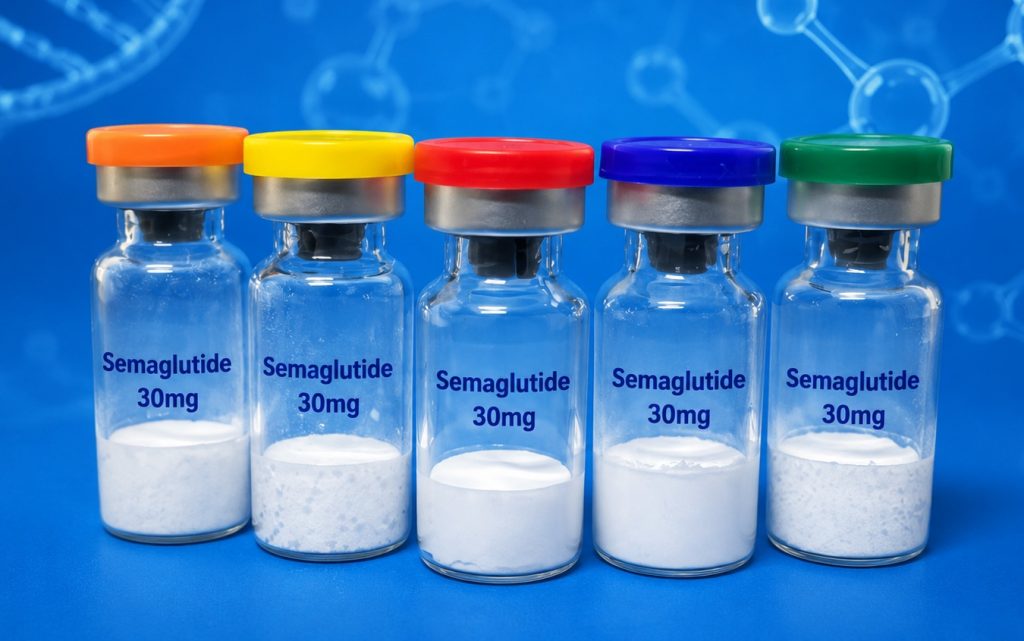
What Is Semaglutide?
Semaglutide is a synthetic GLP-1 analogue designed to interact with the glucagon-like peptide-1 receptor.
Its molecular structure contains modifications that increase stability and prolong biological persistence compared with native GLP-1, making Semaglutide an important research compound for laboratories investigating incretin biology and peptide engineering.
SUNONE supplies research-grade Semaglutide for qualified laboratory and manufacturing applications.
Why Is Semaglutide Important in GLP-1 Research?
Semaglutide research extends beyond the popular topic of body-weight management.
Laboratory research commonly investigates Semaglutide in relation to:
- GLP-1 receptor signaling;
- incretin-related pathways;
- glucose metabolism;
- endocrine signaling;
- appetite-related signaling;
- energy homeostasis;
- peptide stability;
- structure–activity relationships.
One scientifically important feature is its molecular engineering.
Semaglutide includes structural modifications that promote albumin association and improve resistance to enzymatic degradation. These features make it valuable for studying how peptide modification can affect stability, receptor activity and biological persistence.
What Do Semaglutide Reviews Say?
Online Semaglutide reviews include both strongly positive and negative experiences.
Among patients using approved prescription products containing Semaglutide, positive reviews frequently mention perceived improvements in appetite regulation, body-weight management or glucose-related outcomes.
Negative reviews commonly describe experiences such as:
- nausea;
- vomiting;
- diarrhea or constipation;
- abdominal discomfort;
- fatigue;
- dizziness;
- limited perceived benefit;
- discontinuation because of gastrointestinal effects.
These reviews relate to regulated pharmaceutical products and do not evaluate SUNONE research-grade Semaglutide.
Consumer testimonials should therefore be treated as contextual information rather than scientific evidence regarding laboratory material.

Research-Grade Semaglutide vs. Pharmaceutical Semaglutide
This distinction is particularly important.
Approved medicines containing Semaglutide are regulated pharmaceutical products manufactured for specific clinical indications.
A research-grade Semaglutide peptide, by contrast, is supplied for laboratory, analytical or manufacturing research.
Clinical outcomes reported for prescription Semaglutide products should therefore not be used to claim that a research peptide is approved, clinically equivalent or suitable for personal use.
For laboratories, the relevant questions are instead:
- Is the molecular identity correct?
- Is purity supported by analytical data?
- Is the material traceable to a specific batch?
- Are COA and SDS documents available?
- Are storage conditions clearly defined?
What Should Researchers Check When Choosing a Semaglutide Supplier?
When evaluating a Semaglutide supplier, analytical transparency should be more important than promotional claims.
HPLC Purity
Batch-specific chromatographic data can help evaluate peptide purity and related impurities.
Molecular Identity
Analytical testing should support the expected Semaglutide identity and molecular mass.
Certificate of Analysis
A lot-specific Semaglutide COA improves batch traceability and allows researchers to review analytical specifications.
Chemical Form
Researchers should verify the exact peptide form, termini, counterion or salt state against batch documentation.
Storage Documentation
Storage requirements should be supported by the applicable COA, SDS and specification sheet.
SUNONE supplies Semaglutide, CAS 910463-68-2, as ≥99.2% HPLC-certified lyophilized research material for qualified B2B customers.
Semaglutide Research: Beyond the Weight-Loss Keyword
Google searches for Semaglutide are dominated by weight-loss and consumer-health content.
For biotechnology researchers, however, Semaglutide is also an important example of GLP-1 receptor pharmacology, peptide acylation, albumin binding, metabolic signaling and long-acting peptide engineering.
This molecular perspective provides a more useful research framework than simply repeating consumer benefit claims.
For professional laboratories, verified identity, HPLC purity, batch-specific COA and transparent analytical documentation remain central when sourcing research-grade Semaglutide.
SUNONE Semaglutide research peptide is for qualified labrtorynt, diagnois, druc tor mmatct or veteimant, use.research only, Not for human consumption, clinical treame.
Leave a Reply