
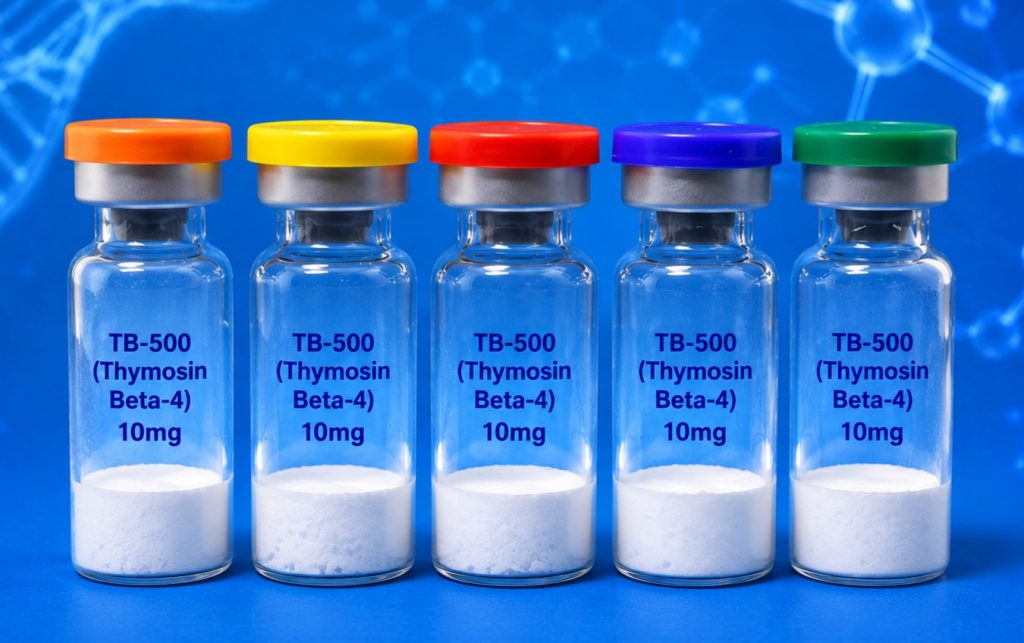
What Is TB-500?
TB-500, also known as Thymosin Beta-4 Fragment 17–23, is a synthetic N-terminally acetylated heptapeptide with the sequence Ac-LKKTETQ.
It corresponds to amino-acid residues 17–23 of the 43-amino-acid protein Thymosin β4.
This distinction matters: TB-500 is not the same molecule as full-length Thymosin β4.
SUNONE supplies research-grade TB-500 for qualified laboratory and manufacturing applications.
View SUNONE TB-500:
Why Is TB-500 Studied?
The LKKTETQ region of Thymosin β4 is associated with its actin-binding domain, making TB-500 relevant to laboratory research involving:
- actin-associated biology;
- cytoskeletal dynamics;
- cell migration models;
- angiogenesis-related pathways;
- peptide metabolism;
- structure–activity relationships;
- HPLC and mass-spectrometry analysis.
Earlier experimental research found that short peptides containing the LKKTETQ region could influence cell migration and angiogenesis-related activity.
However, an important evidence gap remains.
Much of the published tissue-repair literature relates to full-length Thymosin β4 rather than the isolated TB-500 fragment. Researchers should therefore avoid assuming that every biological effect reported for Thymosin β4 automatically applies to TB-500.
What Do TB-500 Reviews Say?
Online TB-500 reviews contain both positive and negative experiences.
Some users describe perceived improvements in recovery, mobility or discomfort after injuries.
Other users report little noticeable improvement or question whether the perceived benefit can be separated from rehabilitation, rest or other products used at the same time.
Negative anecdotal discussions also include reports of:
- brain fog;
- emotional changes;
- fatigue or general discomfort;
- nausea;
- sleep or nervous-system-related complaints.
Many online reports involve TB-500 together with BPC-157 or other compounds, making it difficult to attribute an outcome to TB-500 itself.
Online testimonials should therefore be treated as anecdotal sentiment rather than evidence of safety or efficacy.

TB-500 vs. Thymosin Beta-4: Why the Difference Matters
This is one of the most important considerations in TB-500 research.
Full-length Thymosin β4 contains 43 amino acids, while SUNONE TB-500 is the shorter Ac-LKKTETQ fragment.
Scientific literature on Thymosin β4 has explored pathways associated with cell migration, angiogenesis, inflammation and wound biology. However, recent evidence reviews show that direct research on the exact TB-500 fragment remains substantially more limited.
For laboratories, clearly identifying the molecule being studied can prevent inappropriate extrapolation from one peptide to another.
What Should Researchers Check When Sourcing TB-500?
When evaluating a TB-500 supplier, laboratories should focus on chemical identity and analytical characterization.
Correct peptide identity
Documentation should confirm that the material is the intended Ac-LKKTETQ fragment rather than full-length Thymosin β4.
HPLC purity
Batch-specific chromatography provides important information regarding peptide purity.
Certificate of Analysis
A lot-specific TB-500 COA supports identity, purity and material traceability.
Impurity characterization
Peptide-related impurities, aggregation and analytical characterization are important considerations for research materials.
Clear documentation
Researchers should have access to relevant specifications, SDS and batch documentation.
SUNONE supplies TB-500 / Thymosin β4 Fragment 17–23, CAS 885340-08-9, as ≥99.1% HPLC lyophilized research material.
Final Thoughts
TB-500 is an interesting research peptide because the Ac-LKKTETQ sequence connects it to the actin-binding region of Thymosin β4.
At the same time, one of the most important lessons from current research is that evidence for full-length Thymosin β4 should not automatically be presented as direct evidence for TB-500.
For professional laboratories, accurate molecular identity, HPLC purity, batch-specific COA and transparent analytical documentation are more useful than broad online claims about recovery or tissue repair.
SUNONE TB-500 research peptide is for qualified labrtorynt, diagnois, druc tor mmatct or veteimant, use.research only, Not for human consumption, clinical treame.
Leave a Reply