
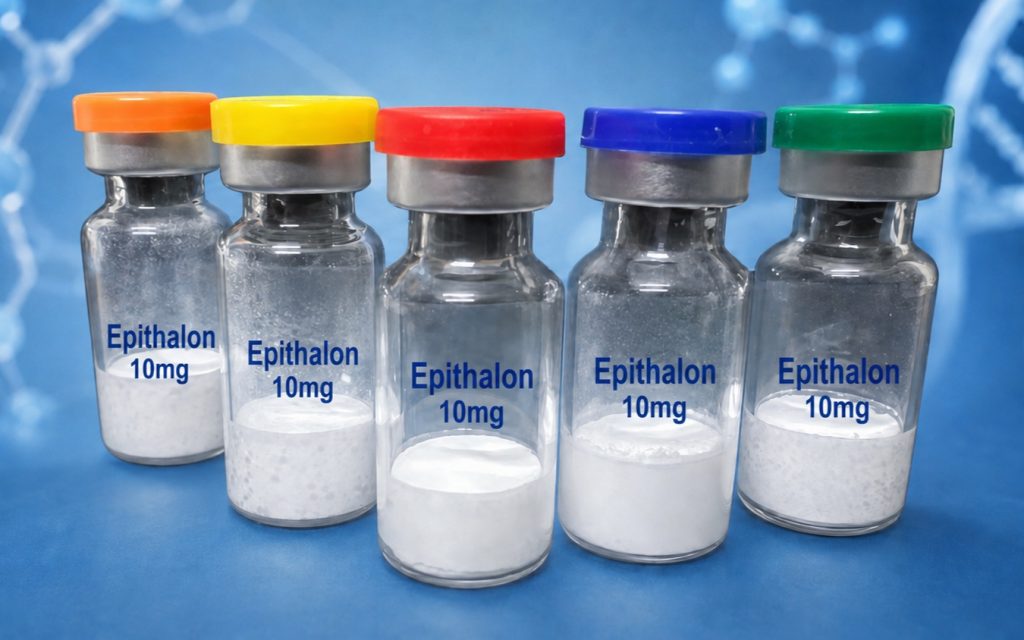
What Is Epithalon?
Epithalon, also commonly spelled Epitalon, is a synthetic tetrapeptide composed of four amino acids:
Ala-Glu-Asp-Gly (AEDG)
Its very short peptide sequence has made Epithalon an interesting research model in cellular biology, aging-related pathways, telomere biology and peptide signaling.
SUNONE supplies Epithalon, CAS 307297-39-8, as ≥99% HPLC Research Grade lyophilized peptide for qualified laboratory, analytical and manufacturing research.
SUNONE Epithalon Product Page:
Why Is Epithalon Studied in Telomere Research?
One of the most widely discussed areas of Epithalon research is telomere biology.
Telomeres are repetitive DNA structures located at chromosome ends. Their maintenance is closely connected with cellular replication and senescence research.
Earlier laboratory studies proposed that Epitalon may influence telomerase-related pathways.
Importantly, a 2025 independent cell study reported that Epitalon increased telomere length in normal human cell lines alongside increased hTERT expression and telomerase activity.
This strengthens the laboratory evidence that Epitalon can interact with telomere-maintenance pathways.
However, it does not mean that Epithalon has been clinically proven to reverse human aging or extend human lifespan.
Telomere Lengthening Is Not the Same as “Anti-Aging”
Google search results frequently use phrases such as:
“Epitalon anti-aging peptide”
“Epithalon longevity peptide”
“Epitalon telomere peptide”
These phrases can oversimplify the science.
A longer telomere in a cultured cell does not automatically translate into improved healthspan or lifespan in humans.
Aging involves many interconnected processes, including:
- genomic instability;
- mitochondrial dysfunction;
- cellular senescence;
- altered nutrient sensing;
- epigenetic changes;
- chronic inflammation;
- impaired tissue repair.
Telomere biology is only one part of that much larger system.

Why the 2025 Epitalon Study Is Interesting
The 2025 research is especially relevant because it quantified several molecular endpoints, including telomere length, hTERT expression and telomerase activity.
It also produced an important caution.
Epitalon was studied not only in normal cells but also in breast cancer cell lines, where telomere extension was observed through mechanisms involving alternative lengthening of telomeres.
That does not establish that Epitalon causes cancer.
But it does show why telomere-related research should be discussed carefully rather than reduced to a simple claim that “longer telomeres are always better.”
For researchers, mechanism matters.
What Do Epithalon Reviews Say?
Current Epithalon reviews are highly mixed.
Positive anecdotal discussions commonly mention:
- improved perceived sleep quality;
- easier sleep onset;
- deeper sleep;
- changes in circadian rhythm;
- feeling more rested.
Negative or neutral discussions include:
- almost no noticeable effect;
- sleep improvement that was difficult to distinguish from normal variation;
- fatigue;
- disrupted sleep in some users;
- skepticism about longevity claims.
Online reviews have an additional limitation: the identity, purity and storage history of the peptide being discussed are usually unknown.
Many users also combine Epitalon with other peptides or supplements.
For this reason, online testimonials should be treated as anecdotal sentiment, not clinical evidence.
Epithalon vs. Epithalamin: Why Naming Matters
Another source of confusion in online Epithalon content is the difference between Epithalon and Epithalamin.
Epithalon / Epitalon is the defined synthetic tetrapeptide AEDG.
Epithalamin historically refers to a more complex pineal-derived peptide preparation.
They should not automatically be treated as the same research material.
When reviewing historical literature, laboratories should therefore determine which preparation was actually studied before transferring conclusions to synthetic AEDG.

What Should Researchers Check When Choosing an Epithalon Supplier?
For professional Epithalon research, product identity should come before longevity marketing claims.
Researchers should consider:
Peptide sequence
The expected sequence is Ala-Glu-Asp-Gly, or AEDG.
CAS identity
SUNONE identifies its Epithalon research material as CAS 307297-39-8.
HPLC purity
Batch-specific chromatography helps characterize the principal peptide and related impurities.
Identity analysis
Mass or other identity analysis may provide additional support for the expected molecular material.
Certificate of Analysis
A batch-specific Epithalon COA improves traceability between experiments.
SUNONE supplies ≥99% HPLC Research Grade Epithalon / Epitalon with analytical documentation available according to batch specification.
Epithalon Research: Focus on the Mechanism, Not the Longevity Headline
The most interesting question about Epithalon is not simply:
“Does Epitalon make people live longer?”
The current evidence does not justify such a conclusion.
A better research question is:
“How does the AEDG tetrapeptide influence telomerase, telomere-maintenance pathways and cellular signaling under defined experimental conditions?”
That approach separates measurable molecular research from broad anti-aging marketing.
For laboratories sourcing research-grade Epithalon, sequence identity, HPLC purity, batch documentation and experimental reproducibility should matter more than longevity testimonials.
SUNONE Epithalon research peptide is for qualified labrtorynt, diagnois, druc tor mmatct or veteimant, use.research only, Not for human consumption, clinical treame.
Leave a Reply