
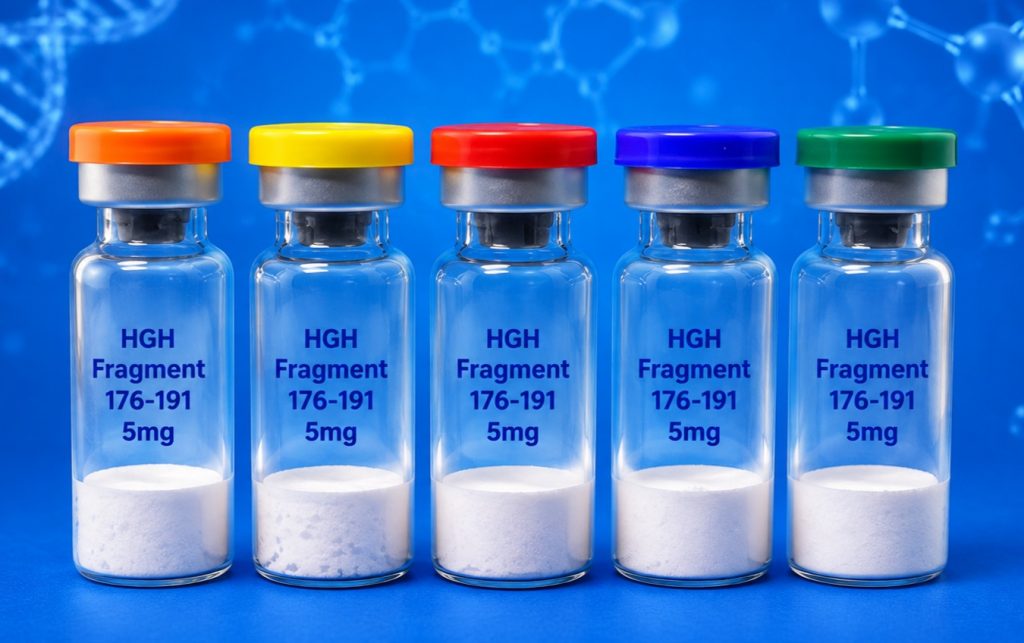
What Is HGH Fragment 176-191?
HGH Fragment 176-191 is a synthetic peptide corresponding to the C-terminal region of human growth hormone.
Full-length human growth hormone contains 191 amino acids. HGH Fragment 176-191 represents only a small section of that much larger protein.
That difference is fundamental.
SUNONE supplies HGH Fragment 176-191, CAS 66004-57-7, as a lyophilized Research Grade peptide for qualified laboratory, analytical and biochemical research.
SUNONE HGH Fragment 176-191:
HGH Fragment 176-191 Is Not Full-Length HGH
One of the most common search misconceptions is treating HGH Fragment 176-191 as a smaller version of HGH with the same biological profile.
It is not.
Full-length human growth hormone is a 191-amino-acid protein involved in complex growth-hormone receptor and IGF-related signaling.
HGH Fragment 176-191 contains only the C-terminal peptide region.
Removing most of the parent protein creates a fundamentally different research molecule.
Therefore, findings involving full-length HGH should not automatically be attributed to HGH Fragment 176-191.
HGH Fragment 176-191 vs AOD-9604
These two research peptides are also frequently confused.
They originate from closely related regions of human growth hormone, but they are not automatically identical materials.
HGH Fragment 176-191 refers to the native C-terminal fragment.
AOD-9604 is a modified synthetic analog derived from this region, with a structural change involving an N-terminal tyrosine.
That small molecular difference matters because AOD-9604 developed its own pharmaceutical research history.
AOD-9604 reached human clinical development.
HGH Fragment 176-191 does not have an equivalent independent human clinical evidence base under the same molecular identity.
Therefore:
AOD-9604 clinical data should not automatically be presented as HGH Fragment 176-191 clinical data.

What Does the Original HGH Fragment Research Show?
Early research examined the C-terminal region of growth hormone in metabolic models.
Animal studies suggested that peptides derived from this region could affect lipid-related metabolic processes.
However, the terminology matters.
For example, an early study reported antilipogenic activity, meaning reduced lipid accumulation, while failing to show significant direct lipolysis based on glycerol release in the tested model.
These are different biological endpoints.
This makes the evidence more nuanced than the common marketing statement:
“HGH Fragment 176-191 directly burns fat.”
A more accurate research framework is:
C-terminal GH fragment → lipid-metabolism experiments → animal evidence → limited direct human evidence.
What Do HGH Fragment 176-191 Reviews Say?
Current online HGH Fragment 176-191 reviews are highly mixed.
Positive anecdotal reports sometimes mention:
- changes in waist appearance;
- perceived reduction in body fat;
- improved definition;
- changes in body measurements.
Negative or neutral reviews commonly report:
- no noticeable change;
- unclear results;
- results that could not be separated from diet or training;
- skepticism about whether the material produced any effect.
A major problem is confounding.
Online users frequently discuss HGH Fragment alongside:
- dietary changes;
- cardiovascular exercise;
- GLP-1 compounds;
- hormone therapy;
- other research peptides.
This makes it impossible to establish causality from user reviews.
Online reviews should therefore be considered anecdotal search sentiment, not scientific evidence.

Why Peptide Identity Matters
A supplier name alone cannot prove molecular identity.
For HGH Fragment 176-191 research, laboratories should confirm that the supplied material corresponds to the intended peptide rather than AOD-9604, full-length somatropin, or another GH-related sequence.
Important sourcing considerations include:
Sequence Identity
The material should correspond to the intended HGH Fragment 176-191 sequence.
Molecular Mass
Analytical results should be consistent with the expected peptide specification.
HPLC Purity
A batch-specific chromatogram can help characterize peptide purity and related impurities.
Batch-Specific COA
A current HGH Fragment 176-191 COA supports lot-to-lot traceability.
Clear Product Naming
Researchers should distinguish:
HGH Fragment 176-191 ≠ AOD-9604 ≠ HGH 191AA.
Using these names interchangeably can lead to incorrect literature interpretation.
SUNONE currently lists:
Product: HGH Fragment 176-191
Synonyms: Somatotropin (176-191), HGH (176-191), GH Fragment 176-191
CAS: 66004-57-7
Formula: C78H123N23O22S2
Molecular Weight: 1799.1 g/mol
Purity: ≥98% HPLC, subject to batch-specific COA
Form: Lyophilized Research Grade material
HGH Fragment Research: Follow the Molecule, Not the Name
A common Google search is:
“Does HGH Fragment 176-191 work for fat loss?”
For laboratory research, a better first question is:
“Which molecular entity produced the published result?”
That creates a stronger scientific framework:
Full-length HGH → C-terminal region → HGH Fragment 176-191 → modified analog AOD-9604 → different evidence bases.
For laboratories evaluating a HGH Fragment 176-191 supplier, molecular identity, sequence verification, HPLC purity and batch-specific documentation should take priority over generalized “fat-burning peptide” claims.
SUNONE HGH Fragment 176-191 research peptide is for qualified labrtorynt, diagnois, druc tor mmatct or veteimant, use.research only, Not for human consumption, clinical treame.
Leave a Reply