
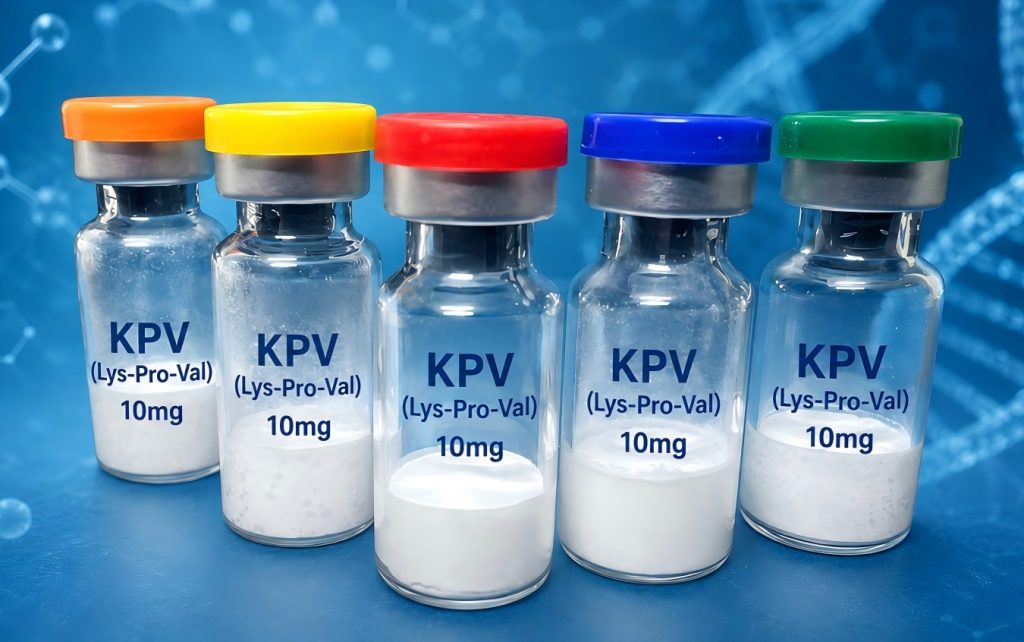
What Is KPV Peptide?
KPV, short for Lys-Pro-Val, is a three-amino-acid peptide corresponding to residues 11–13 at the C-terminal region of α-melanocyte-stimulating hormone (α-MSH).
Despite its extremely short sequence, KPV has attracted research interest in inflammatory signaling, intestinal epithelial biology and peptide transport.
SUNONE supplies KPV, CAS 67727-97-3, as ≥99.1% Research Grade material for qualified laboratory, analytical and manufacturing applications.
SUNONE KPV Product Page:
Why Is KPV Different From Full-Length α-MSH?
α-MSH is a 13-amino-acid peptide involved in melanocortin signaling.
KPV contains only its final three amino acids:
Lys-Pro-Val
Yet laboratory studies indicate that this short fragment can retain important biological activity associated with inflammatory pathways.
Interestingly, research suggests that KPV does not simply behave as a miniature version of α-MSH.
Its effects may occur partly independently of classical melanocortin receptor signaling.
That makes KPV useful for studying how very short peptide sequences can preserve selected biological functions while losing others.
What Is the Connection Between KPV and PepT1?
One of the most interesting areas of KPV research involves the peptide transporter PepT1.
PepT1 normally transports dipeptides and tripeptides across intestinal epithelial cells.
Research has shown that KPV can be transported through PepT1 in intestinal epithelial and immune-cell models.
This is important because PepT1 expression can change during intestinal inflammation.
Experimental studies reported that KPV uptake was associated with changes in:
- NF-κB activation;
- MAP kinase signaling;
- inflammatory cytokine production;
- intestinal epithelial inflammatory responses.
This creates a more specific research model than simply calling KPV an “anti-inflammatory peptide.”
KPV and NF-κB Signaling
NF-κB is a major transcriptional regulator involved in cellular inflammatory responses.
Laboratory studies have reported that KPV can inhibit NF-κB-associated signaling in experimental systems.
KPV has also been studied in relation to MAPK pathways and inflammatory cytokines.
However, most of this evidence comes from:
- cultured cells;
- animal models;
- mechanistic laboratory experiments.
It should not be interpreted as proof that KPV is a clinically established treatment for human inflammatory disease.
Why Is KPV Studied in Intestinal Research?
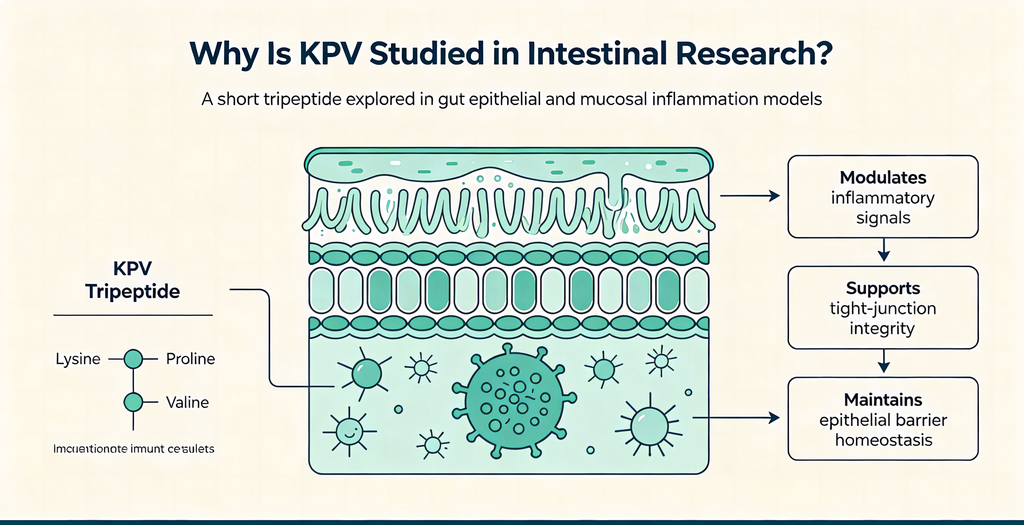
KPV has received particular attention in experimental intestinal-inflammation models.
In a published Gastroenterology study, researchers reported that KPV was transported through PepT1 and reduced inflammatory signaling in intestinal epithelial and immune cells.
Animal experiments also reported reduced inflammatory changes in chemically induced colitis models.
Additional mouse research found KPV-related effects in experimental inflammatory bowel disease models.
These findings make KPV peptide research relevant to:
- epithelial biology;
- intestinal peptide transport;
- inflammatory signaling;
- PepT1 research;
- cytokine regulation;
- peptide–transporter interactions.
But preclinical intestinal research should not be confused with demonstrated clinical efficacy in patients with IBD, Crohn’s disease or ulcerative colitis.
What Do KPV Reviews Say?
Current online KPV reviews are highly mixed.
Positive anecdotal reports sometimes mention:
- improved skin appearance;
- reduced perceived redness;
- reduced subjective inflammation;
- gastrointestinal improvements;
- better recovery experience.
Negative or neutral reviews include:
- no noticeable change;
- fatigue;
- facial redness;
- dry or irritated skin;
- new bumps or skin sensitivity.
The major problem with online reviews is verification.
Most reviewers cannot establish:
- actual peptide identity;
- HPLC purity;
- impurity profile;
- storage history;
- whether other compounds affected the result.
Therefore, online KPV reviews should be treated as anecdotal observations rather than scientific evidence.
Why a Three-Amino-Acid Peptide Still Requires Quality Control
Because KPV contains only three amino acids, it may appear analytically simple.
But “short peptide” does not mean “quality is automatic.”
Researchers should still evaluate:
Molecular Identity
The material should correspond to the expected Lys-Pro-Val structure.
Purity
Batch-specific analytical data should support the stated KPV purity.
Related Impurities
Short peptides can still contain synthesis-related or degradation-related impurities.
Certificate of Analysis
A batch-specific KPV COA improves traceability between experiments.
Supporting Documentation
SDS and product specifications should correspond to the supplied material.
SUNONE currently identifies its KPV research material as:
CAS: 67727-97-3
Sequence: Lys-Pro-Val
Molecular Weight: 342.43 g/mol
Grade: ≥99.1% Research Grade
KPV Research: Study the Transporter, Not Just the Claim
Google search results often reduce KPV to one phrase:
“anti-inflammatory peptide.”
For biotechnology researchers, the more interesting questions are:
How can a three-amino-acid fragment of α-MSH retain biological activity?
Can PepT1-mediated transport influence its cellular effects?
How does KPV affect NF-κB and MAPK signaling in defined experimental systems?
These questions create a clearer research framework:
α-MSH fragment → KPV → PepT1 transport → NF-κB/MAPK signaling → epithelial biology → analytical identity.
For laboratories evaluating a KPV supplier, molecular identity, purity, batch traceability and analytical documentation should matter more than broad therapeutic marketing claims.
SUNONE KPV research peptide is for qualified labrtorynt, diagnois, druc tor mmatct or veteimant, use.research only, Not for human consumption, clinical treame.
Leave a Reply