
What Is Liraglutide?
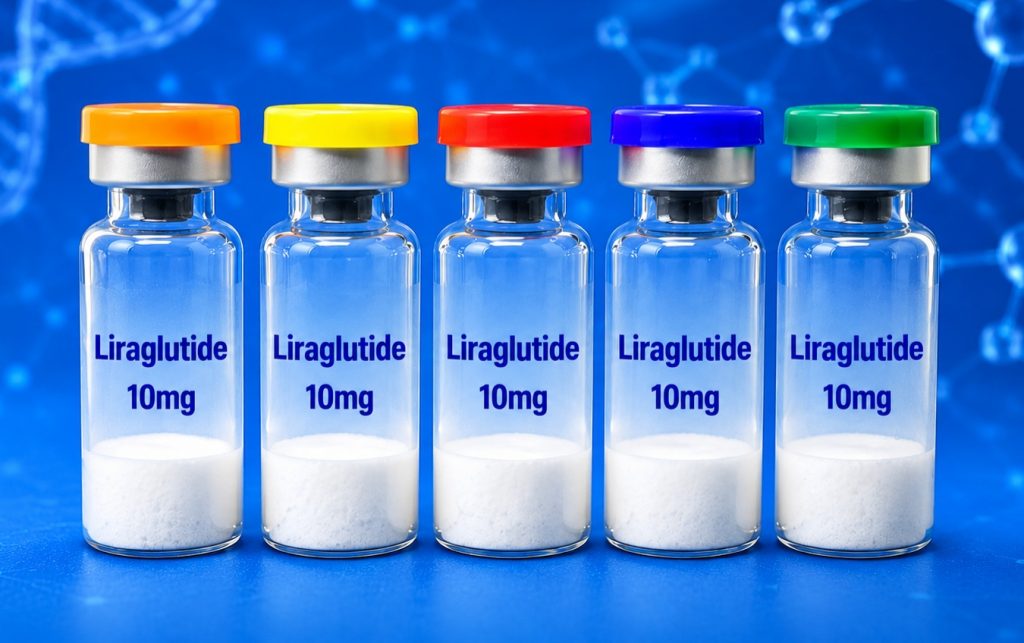
Liraglutide, also known as NN2211, is a long-acting acylated analogue of human glucagon-like peptide-1, or GLP-1.
SUNONE supplies Liraglutide, CAS 204656-20-2, as a research-grade peptide for qualified laboratory, analytical-development and biopharmaceutical-manufacturing applications.
SUNONE Liraglutide Product Page:
Why Is Liraglutide More Than a GLP-1 Analogue?
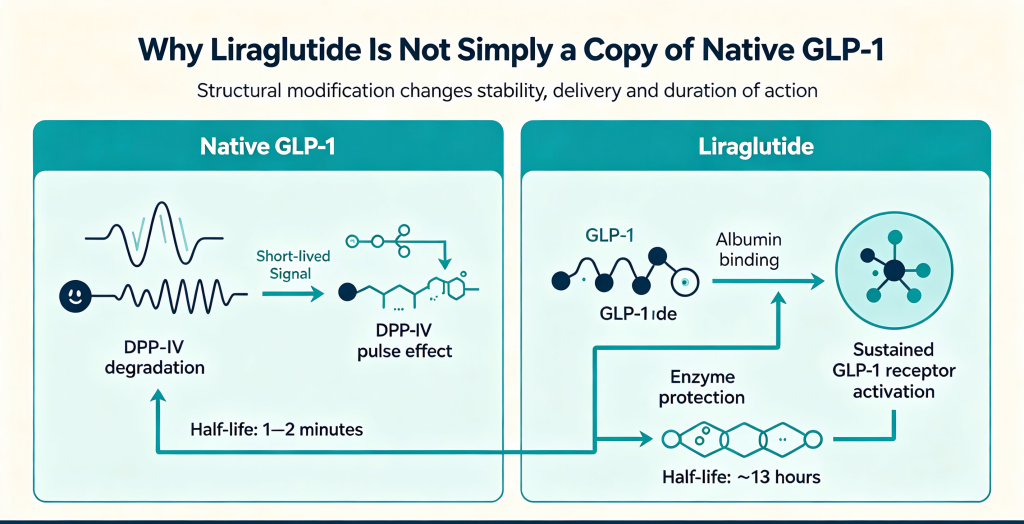
Native GLP-1 is rapidly degraded in biological systems.
Liraglutide was engineered to remain active for substantially longer.
A major part of this design is a C16 fatty-acid side chain attached to the peptide through a spacer.
This structural modification promotes reversible interaction with albumin.
For researchers, Liraglutide therefore represents more than a GLP-1 receptor agonist. It is also a useful model for studying:
- peptide acylation;
- albumin binding;
- long-acting peptide engineering;
- resistance to enzymatic degradation;
- GLP-1 receptor signaling;
- structure–activity relationships.
Why Does Albumin Binding Matter?
Albumin is one of the most abundant proteins in plasma.
By reversibly associating with albumin, an acylated peptide may be protected from rapid clearance and enzymatic degradation.
For Liraglutide, this contributes to its prolonged pharmacological profile compared with native GLP-1.
This makes Liraglutide albumin binding an important research topic for laboratories interested in designing longer-acting peptide molecules.
The key question is not simply:
“Does the peptide activate GLP-1 receptors?”
It is also:
“How does molecular engineering change peptide stability and persistence?”
Liraglutide vs Native GLP-1
Liraglutide retains high sequence similarity to human GLP-1 but contains targeted structural changes.
These modifications alter several characteristics, including:
- metabolic stability;
- protein binding;
- self-association;
- duration of receptor exposure.
This illustrates an important principle in peptide engineering:
small structural changes can produce large pharmacokinetic differences.
For biotechnology research, Liraglutide is therefore useful for studying the relationship between peptide sequence, lipid conjugation and biological behavior.

What Do Liraglutide Reviews Say?
Current Liraglutide reviews are generally positive but highly variable.
Positive reviews of approved pharmaceutical products frequently mention:
- reduced appetite;
- reduced food cravings;
- improved portion control;
- perceived weight change;
- improved glucose-related outcomes.
Negative reviews commonly mention:
- nausea;
- constipation;
- diarrhea;
- vomiting;
- fatigue;
- gastrointestinal discomfort.
Some users also report that appetite suppression becomes less noticeable over time.
These reviews relate primarily to approved prescription products such as Saxenda or Victoza.
They should not be treated as evidence regarding SUNONE Research Grade Liraglutide.
Research-Grade Liraglutide vs Pharmaceutical Liraglutide
This distinction is essential.
Approved prescription Liraglutide products are finished pharmaceutical formulations manufactured under regulated drug-production standards.
SUNONE Liraglutide is supplied as a research and analytical material.
Clinical outcomes from approved pharmaceutical products therefore do not establish:
- pharmaceutical equivalence;
- clinical efficacy;
- clinical safety;
- formulation equivalence;
- suitability for human administration
of research-grade material.
What Should Researchers Check When Choosing a Liraglutide Supplier?
A professional Liraglutide supplier should provide more than a product name.
Researchers should consider:
Molecular Identity
The material should correspond to the expected Liraglutide structure.
Acylated Peptide Identity
Because fatty-acid conjugation is central to Liraglutide design, analytical characterization should support the intended acylated molecule.
HPLC Purity
Batch-specific chromatographic analysis can help characterize purity and related peptide impurities.
Certificate of Analysis
A batch-specific Liraglutide COA improves traceability and experimental reproducibility.
Supporting Documentation
SDS and specification documentation should match the actual production lot.
SUNONE currently lists Liraglutide, CAS 204656-20-2, for research, analytical development and biopharmaceutical manufacturing.
Liraglutide Research: Study the Engineering, Not Just the Outcome
Google searches often reduce Liraglutide to weight-loss or appetite-control keywords.
For researchers, a more valuable question is:
How did C16 fatty-acid acylation transform a rapidly degraded endogenous peptide into a longer-acting GLP-1 analogue?
That question creates a clearer scientific framework:
GLP-1 sequence → C16 acylation → albumin binding → metabolic stability → receptor signaling → analytical characterization.
For laboratories evaluating research-grade Liraglutide, molecular identity, acylation state, purity and batch-specific documentation should come before consumer-effect claims.
SUNONE Liraglutide research peptide is for qualified labrtorynt, diagnois, druc tor mmatct or veteimant, use.research only, Not for human consumption, clinical treame.
Leave a Reply