
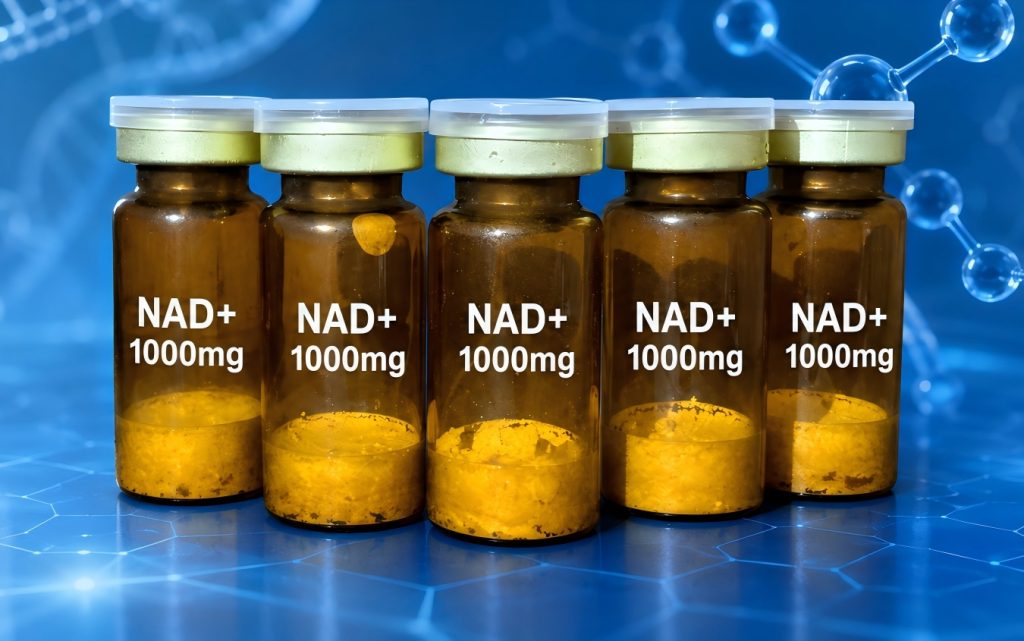
What Is NAD+?
NAD+, or Nicotinamide Adenine Dinucleotide, is an essential cellular cofactor involved in hundreds of biochemical reactions.
It is particularly important in:
- cellular redox reactions;
- mitochondrial metabolism;
- ATP-related energy pathways;
- DNA-repair-associated signaling;
- sirtuin biology;
- cellular stress responses.
SUNONE supplies NAD+, CAS 53-84-9, as ≥99.7% Research Grade material for qualified laboratory, analytical and manufacturing applications.
SUNONE NAD+ Product Page:
Is NAD+ the Same as NMN or NR?
No.
This is one of the most important distinctions in NAD+ research.
NAD+ is the cellular cofactor itself.
NMN, or nicotinamide mononucleotide, is a metabolic precursor that can contribute to NAD+ biosynthesis.
NR, or nicotinamide riboside, is another NAD+ precursor.
The relationship can be simplified as:
precursors → NAD+ biosynthetic pathways → cellular NAD+ pools
However, this does not mean that NAD+, NMN and NR are analytically or biologically interchangeable research materials.
Why Does the Difference Matter?
A major problem in online NAD+ content is that evidence from one molecule is often transferred to another.
For example, many human trials have evaluated oral NR or NMN and measured changes in blood or cellular NAD-related metabolites.
Those studies may tell researchers something about NAD+ metabolism.
They do not automatically establish the same effects for direct NAD+ material.
For biotechnology research, the identity of the molecule being studied matters.
NAD+ Is a Redox Cofactor, Not Just an “Energy Molecule”
NAD+ is often marketed as a “cellular energy booster.”
That description is incomplete.
One of its fundamental functions is participation in redox reactions through the reversible relationship between:
NAD+ ↔ NADH
In this system, NAD+ can accept electrons, while NADH carries reducing equivalents to other metabolic reactions.
This makes NAD+/NADH biology relevant to:
- glycolysis;
- the TCA cycle;
- mitochondrial respiration;
- redox balance;
- metabolic flux.
NAD+ is also consumed by signaling enzymes including sirtuins, PARPs and CD38-related pathways.
For research purposes, this makes NAD+ both a metabolic cofactor and signaling substrate.
Does NAD+ Always Decline With Age?
The answer is more complicated than many commercial pages suggest.
Age-associated changes in NAD+ metabolism have been reported in preclinical research, but human evidence varies substantially by:
- tissue;
- study population;
- analytical method;
- age range;
- metabolic condition.
Recent reviews have emphasized that a universal age-related decline across every human tissue has not been conclusively established.
This matters because the phrase:
“NAD+ always declines with age”
is too broad for evidence-based scientific content.
What Does Current Human Research Show?
Human clinical research is strongest for several NAD+ precursors, especially NR and NMN.
These compounds can increase certain NAD-related biomarkers in human studies.
However, improvements in broader outcomes such as:
- metabolic function;
- exercise performance;
- vascular outcomes;
- fatigue;
- healthy-aging measures
have been inconsistent.
A 2026 systematic review found clear evidence of biological target engagement but heterogeneous clinical outcomes.
It also found no eligible clinical-outcomes trials testing intravenous or intramuscular NAD+ itself for anti-aging or wellness purposes.
Therefore:
raising a biomarker is not the same as proving a clinical benefit.

What Do NAD+ Reviews Say?
Current online NAD+ reviews are mixed.
Positive anecdotal discussions sometimes report:
- increased perceived energy;
- better exercise sessions;
- improved recovery;
- improved subjective wellbeing.
Negative or neutral experiences include:
- fatigue;
- brain fog;
- no noticeable benefit;
- temporary redness or discomfort;
- unexpectedly strong subjective reactions.
Some users specifically report becoming more tired despite expecting an energy increase.
These reports should be interpreted cautiously.
Online reviews usually cannot verify:
- actual NAD+ identity;
- purity;
- storage history;
- contaminant profile;
- concurrent compounds;
- health-related confounding factors.
Therefore, NAD+ reviews are anecdotal sentiment rather than controlled evidence.
Why NAD+ Research Requires Identity Control
The terms NAD+, NADH, NR, NMN and nicotinamide frequently appear together.
They are not interchangeable analytical standards.
Researchers evaluating a NAD+ supplier should consider:
Chemical Identity
The supplied material should correspond to the intended Nicotinamide Adenine Dinucleotide specification.
Purity
Batch-specific analytical documentation should support the stated NAD+ purity.
Oxidation State
NAD+ is the oxidized form and should not be confused with NADH, its reduced counterpart.
Batch-Specific COA
A lot-specific NAD+ COA improves traceability between experiments.
Storage and Stability
Cofactor stability can influence analytical results, making appropriate storage documentation important.
SUNONE currently identifies its research material as:
Product: NAD+
CAS: 53-84-9
Synonyms: Nicotinamide Adenine Dinucleotide, beta-NAD, Coenzyme I, DPN+
Grade: ≥99.7% Research Grade
NAD+ Research: Study the Molecule Before the Marketing Claim
A common consumer question is:
“Does NAD+ increase energy and slow aging?”
For biotechnology researchers, a more useful set of questions is:
Which NAD-related molecule is actually being studied?
Is the experiment using NAD+, NMN, NR or NADH?
Is the endpoint a biomarker change or a meaningful functional outcome?
That creates a clearer scientific framework:
NR/NMN precursors → NAD+ biosynthesis → NAD+/NADH redox biology → cellular metabolism → signaling enzymes → analytical identity.
For laboratories evaluating research-grade NAD+, molecular identity, oxidation state, purity, batch traceability and experimental context should take priority over broad “anti-aging” claims.
SUNONE NAD+ research peptide is for qualified labrtorynt, diagnois, druc tor mmatct or veteimant, use.research only, Not for human consumption, clinical treame.
Leave a Reply