
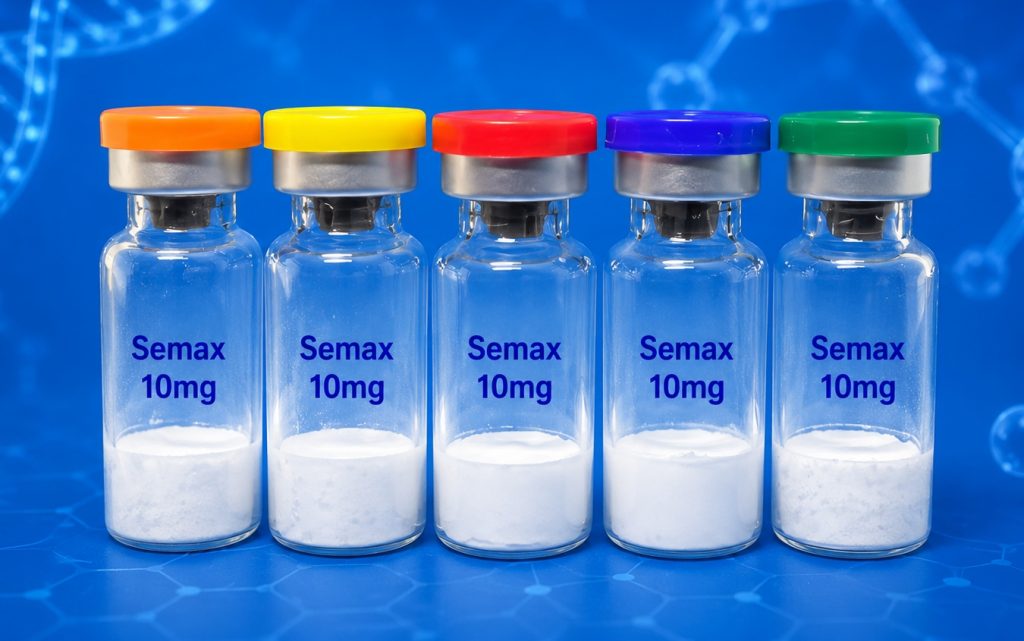
What Is Semax?
Semax is a synthetic seven-amino-acid peptide derived from the ACTH(4–7) region and extended with a C-terminal Pro-Gly-Pro (PGP) sequence.
Rather than viewing Semax simply as a “nootropic peptide,” researchers can examine it as a defined ACTH-derived signaling molecule used in experimental neuroscience and peptide-biology models.
SUNONE supplies Semax, CAS 80714-61-0, as ≥98% HPLC lyophilized Research Grade material for qualified laboratory, analytical and manufacturing applications.
SUNONE Semax Product Page:
Is Semax the Same as ACTH?
No.
Semax contains a short sequence derived from ACTH, but it is not full-length adrenocorticotropic hormone.
Its structure combines an ACTH(4–7)-derived sequence with a Pro-Gly-Pro tail.
That distinction is important because biological findings associated with full-length ACTH should not automatically be transferred to Semax.
For research purposes, Semax should be treated as its own sequence-defined peptide entity.
Why Is BDNF Frequently Mentioned in Semax Research?
Brain-derived neurotrophic factor (BDNF) is one of the most frequently discussed targets in Semax literature.
Animal studies have reported changes in:
- BDNF gene expression;
- BDNF protein levels;
- TrkB receptor signaling;
- NGF expression;
- neurotrophin receptor transcription.
However, the relationship is more complicated than the marketing phrase “Semax increases BDNF.”
Published experiments show that neurotrophin responses can vary according to:
- brain region;
- experimental model;
- time after exposure;
- ischemic versus non-ischemic conditions.
This makes Semax BDNF research a question of signaling dynamics rather than a simple on/off effect.

Why Does TrkB Matter?
BDNF performs many of its biological functions through the TrkB receptor.
Experimental Semax research has reported increased BDNF alongside changes in TrkB expression and phosphorylation in rat hippocampal models.
This creates a useful mechanistic research pathway:
Semax → BDNF regulation → TrkB signaling → downstream neuronal responses
But these animal findings should not automatically be interpreted as proven cognitive enhancement in humans.
The PGP Tail Is More Than a Structural Detail
Semax is often described only by its ACTH origin.
However, its Pro-Gly-Pro sequence is also scientifically relevant.
Research comparing Semax with PGP has found partially overlapping changes in neurotrophin and receptor transcription in experimental cerebral-ischemia models.
This suggests that peptide-fragment design may influence the resulting biological response.
For researchers, Semax therefore provides an interesting model for studying:
- peptide sequence engineering;
- structure–activity relationships;
- neurotrophin signaling;
- gene-expression regulation;
- neuroprotection-related pathways.
What Do Semax Reviews Say?

Current online Semax reviews are highly inconsistent.
Positive anecdotal reviews sometimes mention:
- improved focus;
- greater mental clarity;
- reduced subjective brain fog;
- improved verbal fluency;
- increased work productivity.
Negative or neutral experiences include:
- no noticeable effect;
- fatigue;
- drowsiness;
- brain fog;
- reduced concentration;
- anxiety or overstimulation.
These reviews should be interpreted cautiously.
Online users may be discussing Semax analogues, modified compounds or products of uncertain identity. Many also combine multiple supplements, medications or research compounds.
Therefore, Semax reviews are anecdotal sentiment rather than controlled scientific evidence.
Semax vs Modified Semax Analogues
Another important search issue is product identity.
Terms such as:
- Semax;
- N-Acetyl Semax;
- N-Acetyl Semax Amidate
may appear together in online discussions.
They should not automatically be considered the same molecular material.
Structural modifications can alter molecular mass, stability, analytical behavior and potentially biological properties.
Research involving a modified Semax analogue therefore should not be automatically attributed to standard Semax.
What Should Researchers Check When Choosing a Semax Supplier?
A professional Semax supplier should provide more than the product name.
Researchers should consider:
Molecular Identity
The material should correspond to the intended Semax structure.
HPLC Purity
Chromatographic analysis helps characterize the principal peptide and related impurities.
Sequence Verification
Sequence identity is particularly important when standard Semax and modified Semax analogues coexist in the market.
Batch-Specific COA
A lot-specific Semax COA improves traceability between research experiments.
Supporting Documentation
Applicable SDS and specification information should correspond to the actual production batch.
SUNONE currently supplies Semax, CAS 80714-61-0, as ≥98% HPLC Research Grade lyophilized peptide.
Semax Research: Study the Signaling Network, Not Just the “Focus” Claim
Many search results reduce Semax to:
“Does Semax improve focus?”
For biotechnology research, better questions include:
How does an ACTH-derived heptapeptide affect neurotrophin signaling?
What role does the PGP sequence play?
Why do BDNF and Trk receptor responses change across different brain regions and experimental conditions?
This creates a stronger scientific framework:
ACTH(4–7) fragment → PGP sequence → BDNF/NGF regulation → Trk signaling → gene-expression response → analytical identity.
For laboratories evaluating research-grade Semax, sequence identity, purity, batch traceability and experimental context are more useful than generalized nootropic claims.
SUNONE Semax research peptide is for qualified labrtorynt, diagnois, druc tor mmatct or veteimant, use.research only, Not for human consumption, clinical treame.
Leave a Reply