
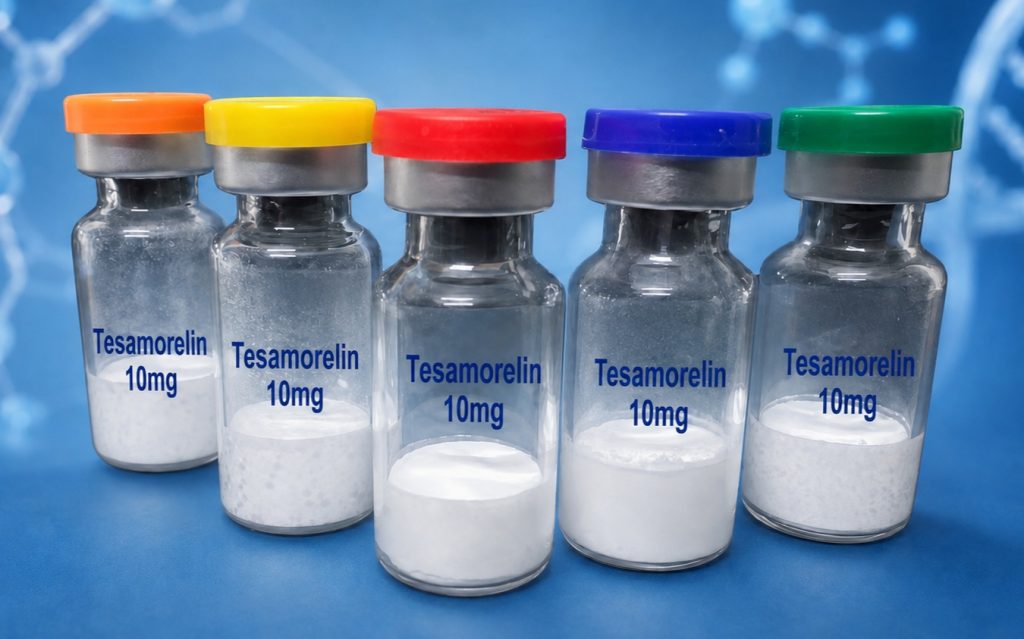
What Is Tesamorelin?
Tesamorelin, also known as TH9507 or TH-9507, is a synthetic analogue of human growth hormone-releasing hormone, or GHRH.
SUNONE supplies Tesamorelin, CAS 218949-48-5, as ≥99% HPLC Research Grade lyophilized peptide for qualified laboratory, analytical and manufacturing research.
SUNONE Tesamorelin Product Page:
Tesamorelin Is a GHRH Analog — Not a Ghrelin Peptide
This distinction is easy to miss in online peptide content.
Tesamorelin acts through the GHRH receptor, also called the growth hormone-releasing factor receptor.
Ghrelin and many growth hormone secretagogues act through a different receptor:
GHS-R — the growth hormone secretagogue receptor.
Although both pathways can influence growth hormone release, they are not the same signaling system.
For researchers, this matters because compounds such as:
- Tesamorelin;
- CJC-1295;
- Ipamorelin;
- ghrelin-related secretagogues
should not automatically be grouped together simply because they influence the GH axis.
How Does Tesamorelin Affect the GH Axis?
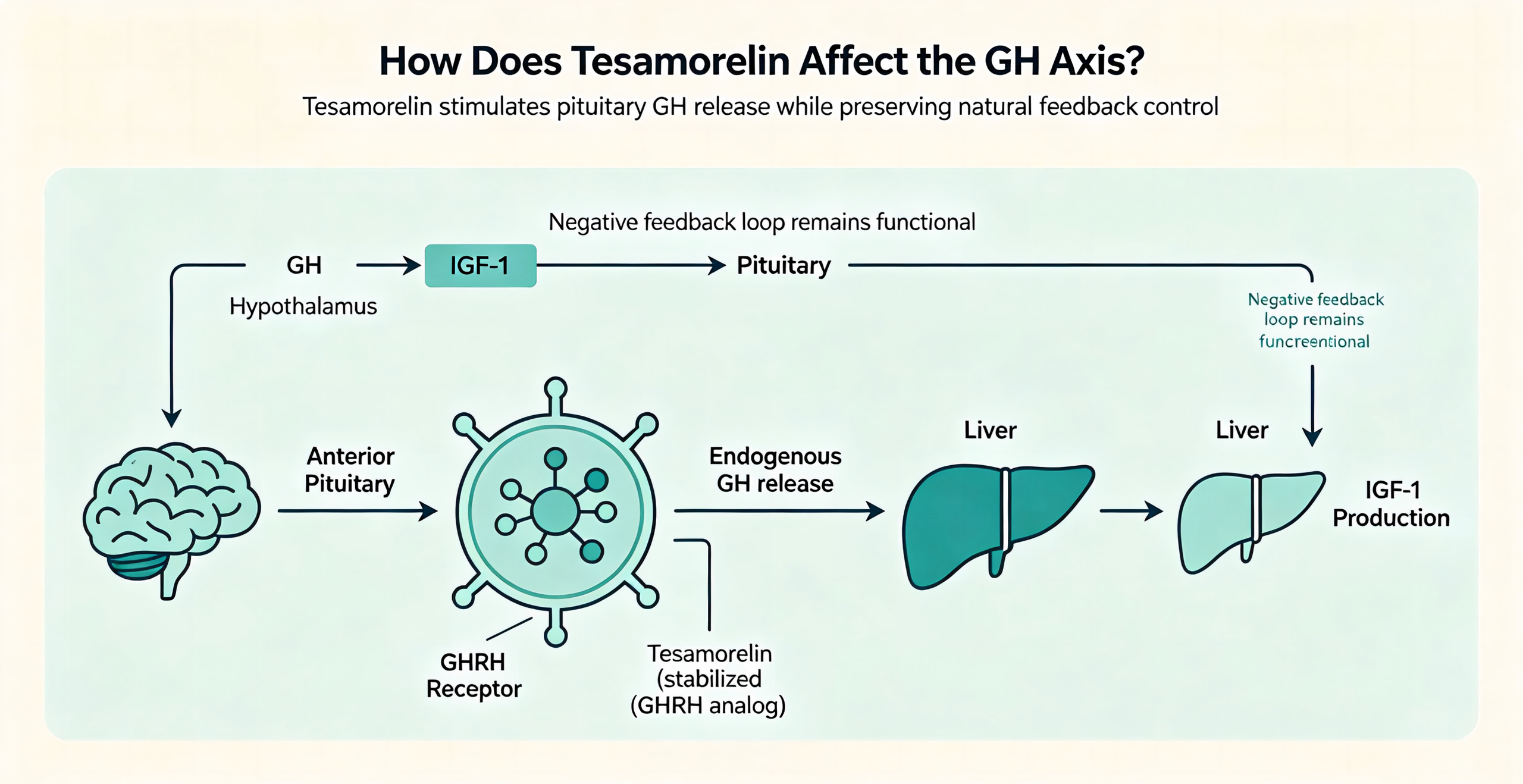
Tesamorelin binds to GHRH receptors on pituitary somatotroph cells.
This stimulates the synthesis and pulsatile release of endogenous growth hormone.
GH then contributes to downstream signaling that includes IGF-1 production and metabolic responses.
This creates a research pathway of:
Tesamorelin → GHRH receptor → pituitary GH release → IGF-1-related signaling
rather than:
ghrelin → GHS-R → secretagogue signaling.
The distinction is especially useful in experimental designs comparing different ways of modulating the GH axis.
GHRH Receptor vs GHS-R: Why Researchers Should Care
The two receptors belong to different signaling systems and have different endogenous ligands.
GHRH receptor:
Activated by hypothalamic GHRH and GHRH analogues such as Tesamorelin.
GHS-R:
Activated by ghrelin and recognized by growth hormone secretagogue peptides and related ligands.
This means that similar downstream outcomes do not imply identical receptor pharmacology.
For peptide research, receptor identity affects:
- mechanism interpretation;
- experimental controls;
- comparison of analogues;
- receptor-expression models;
- downstream signaling analysis.
What Does Human Tesamorelin Evidence Actually Show?
Tesamorelin is unusual among research peptides because a regulated pharmaceutical form has an established clinical indication.
The current U.S. EGRIFTA WR label states that pharmaceutical Tesamorelin is indicated to reduce excess abdominal fat in HIV-infected adults with lipodystrophy.
However, the label also specifically states that it is not indicated for weight-loss management, and long-term cardiovascular safety has not been established.
Therefore, Tesamorelin should not be described simply as a general-purpose “fat-loss peptide.”
Clinical evidence involving EGRIFTA WR also does not establish pharmaceutical equivalence to SUNONE Research Grade Tesamorelin.
What Do Tesamorelin Reviews Say?

Current pharmaceutical Tesamorelin reviews are mixed.
Positive reviews commonly mention:
- perceived reduction in abdominal fat;
- changes in waist appearance;
- improved energy;
- body-composition changes.
Negative or neutral experiences include:
- fatigue;
- muscle or joint discomfort;
- headaches;
- water retention;
- carpal-tunnel-like symptoms;
- little or no noticeable effect.
Drugs.com currently reports an average rating of 6.7/10 from 23 Tesamorelin reviews, with 48% positive and 13% negative experiences.
These reviews relate primarily to prescription Tesamorelin and should not be treated as evidence regarding SUNONE research material.
Why “Tesamorelin vs Ipamorelin” Is a Mechanism Question
Tesamorelin and Ipamorelin are frequently compared in search results.
But mechanistically, they belong to different categories.
Tesamorelin: GHRH receptor pathway.
Ipamorelin: growth hormone secretagogue/GHS-R pathway.
This makes the comparison scientifically more useful when framed as:
GHRH receptor signaling vs GHS-R signaling
rather than simply asking which compound “releases more GH.”
The same principle applies when comparing Tesamorelin with other GH-axis peptides.
What Should Researchers Check When Choosing a Tesamorelin Supplier?
Researchers evaluating a Tesamorelin supplier should look beyond product naming.
Important quality considerations include:
Molecular Identity
The supplied material should correspond to the intended Tesamorelin structure.
Peptide Purity
Batch-specific HPLC data should support the stated purity.
Molecular Mass
Analytical data should be consistent with the expected Tesamorelin molecular specification.
Batch-Specific COA
A lot-specific Tesamorelin COA supports experimental traceability.
Supporting Documentation
SDS and specification documentation should correspond to the actual supplied batch.
SUNONE currently lists:
Product: Tesamorelin / TH9507
CAS: 218949-48-5
Molecular Weight: 5135.9 g/mol
Grade: ≥99% HPLC, Research Grade
Form: Lyophilized
Tesamorelin Research: Follow the Receptor Pathway
Many search results group every growth-hormone-related peptide into the same category.
A better research framework is:
Tesamorelin → GHRH receptor → pituitary somatotroph → pulsatile GH → IGF-1 signaling
versus:
ghrelin or GHRP → GHS-R → secretagogue signaling → GH-axis response.
Understanding this distinction can improve experimental design, literature interpretation and peptide selection.
For laboratories evaluating research-grade Tesamorelin, receptor mechanism, molecular identity, HPLC purity and batch-specific analytical documentation should take priority over broad body-composition marketing claims.
SUNONE Tesamorelin research peptide is for qualified labrtorynt, diagnois, druc tor mmatct or veteimant, use.research only, Not for human consumption, clinical treame.
Leave a Reply