
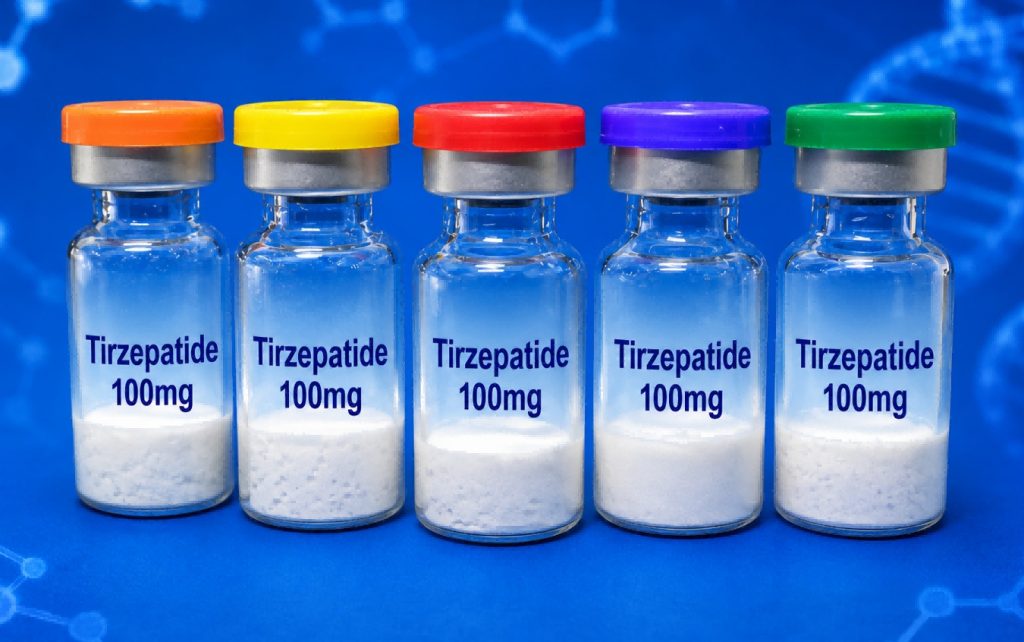
What Is Tirzepatide?
Tirzepatide, also known as LY3298176, is a modified peptide investigated for its ability to activate both the GIP receptor and GLP-1 receptor.
This dual-receptor profile is widely discussed, but receptor pharmacology is only part of the molecule’s scientific design.
Tirzepatide also contains structural modifications intended to influence peptide stability, molecular behavior and albumin association.
SUNONE supplies research-grade Tirzepatide, CAS 2023788-19-2, for qualified laboratory, analytical and manufacturing applications.
SUNONE Tirzepatide Product Page:
Tirzepatide Is More Than a GIP/GLP-1 Dual Agonist
Many Tirzepatide articles focus almost entirely on:
GIP + GLP-1 = dual incretin signaling.
That is scientifically important, but incomplete.
Tirzepatide is a modified peptide whose design also includes a long-chain fatty-acid component.
According to pharmaceutical characterization of Tirzepatide, the molecule contains a C20 fatty diacid attached through a linker.
This modification supports interaction with albumin.
For researchers, that creates another important relationship:
peptide sequence → lipid modification → albumin association → altered molecular persistence.
Why Does Albumin Binding Matter?
Albumin is the most abundant circulating protein in human plasma and can interact with many fatty-acid-modified molecules.
Attaching a lipid chain to a peptide can increase reversible association with albumin.
In peptide-engineering research, this strategy may help:
- reduce rapid clearance;
- influence proteolytic exposure;
- change distribution;
- extend molecular persistence;
- modify pharmacokinetic behavior.
Tirzepatide is therefore an important example of how peptide pharmacology and molecular engineering can work together.

What Makes Tirzepatide Structurally Different?
Tirzepatide is based on a GIP-related peptide sequence but includes several engineered features.
These include:
- modified amino-acid positions;
- non-standard amino-acid residues;
- a C-terminal amide;
- a fatty-diacid-containing side chain;
- a linker connecting the lipid component to the peptide.
These features matter because two molecules may both be described as “GIP/GLP-1 agonists” while having very different:
- molecular weights;
- receptor activity profiles;
- albumin-binding behavior;
- stability;
- analytical fingerprints.
For research laboratories, the commercial category is therefore not enough to establish molecular identity.
GIP and GLP-1 Still Matter
Tirzepatide selectively interacts with both the GIP receptor and GLP-1 receptor.
These receptor systems are involved in incretin biology and metabolic signaling.
Research areas include:
- glucose-dependent signaling;
- pancreatic endocrine biology;
- appetite-related pathways;
- energy homeostasis;
- insulin and glucagon regulation;
- multi-receptor peptide pharmacology.
However, clinical outcomes observed with regulated pharmaceutical Tirzepatide should not automatically be attributed to all materials sold under the name “Tirzepatide.”
Material identity and formulation matter.
What Do Tirzepatide Reviews Say?

Current Tirzepatide reviews are predominantly positive but highly variable.
Frequently reported positive experiences include:
- reduced appetite;
- less food-related craving;
- earlier satiety;
- perceived weight changes;
- improved subjective metabolic control.
Negative or neutral reviews commonly mention:
- nausea;
- constipation;
- diarrhea;
- vomiting;
- fatigue;
- stomach discomfort;
- headache;
- little or inconsistent appetite suppression.
Some recent users report substantial appetite suppression with relatively few unwanted effects, while others describe nausea and fatigue without the expected subjective appetite response.
These reviews should not be treated as scientific proof.
Most relate to approved pharmaceutical Tirzepatide or compounded products, not SUNONE Research Grade Tirzepatide.
Pharmaceutical Tirzepatide vs Research-Grade Tirzepatide
Approved Mounjaro and Zepbound are regulated finished pharmaceutical products.
SUNONE Tirzepatide is supplied as Research Grade material.
Clinical trials and pharmaceutical reviews therefore do not establish the:
- clinical efficacy;
- clinical safety;
- pharmaceutical equivalence;
- formulation equivalence;
- suitability for human administration
of SUNONE research material.
For laboratory research, the relevant question is whether the supplied material has the intended molecular and analytical characteristics.
What Should Researchers Check When Choosing a Tirzepatide Supplier?
A professional Tirzepatide supplier should provide more than a purity claim.
Molecular Identity
Analytical data should correspond to the intended Tirzepatide molecule.
HPLC Purity
A batch-specific chromatogram can help characterize the principal component and peptide-related impurities.
Molecular-Mass Verification
Mass-related analytical data can support identification of the intended modified peptide.
Chemical Form
Researchers should confirm the form described in the actual batch documentation rather than assuming all Tirzepatide materials are identical.
Batch-Specific COA
A lot-specific Tirzepatide COA supports traceability and reproducibility.
SUNONE currently lists:
Product: Tirzepatide
Synonym: LY3298176
CAS: 2023788-19-2
Formula: C225H348N48O68
Molecular Weight: approximately 4813 g/mol
Grade: GMP Research Grade
Form: Lyophilized
Tirzepatide Research: Follow the Molecular Design
The most common search description is:
“Tirzepatide is a dual GIP/GLP-1 agonist.”
That is correct, but researchers can go further.
A more useful molecular framework is:
GIP-derived peptide → engineered amino acids → C20 fatty diacid → albumin binding → prolonged molecular behavior → dual GIP/GLP-1 receptor signaling.
This perspective connects peptide chemistry with receptor biology.
For laboratories evaluating research-grade Tirzepatide, molecular identity, lipid modification, analytical purity and batch traceability are more meaningful than generalized consumer claims.
SUNONE Tirzepatide research peptide is for qualified labrtorynt, diagnois, druc tor mmatct or veteimant, use.research only, Not for human consumption, clinical treame.
Leave a Reply