
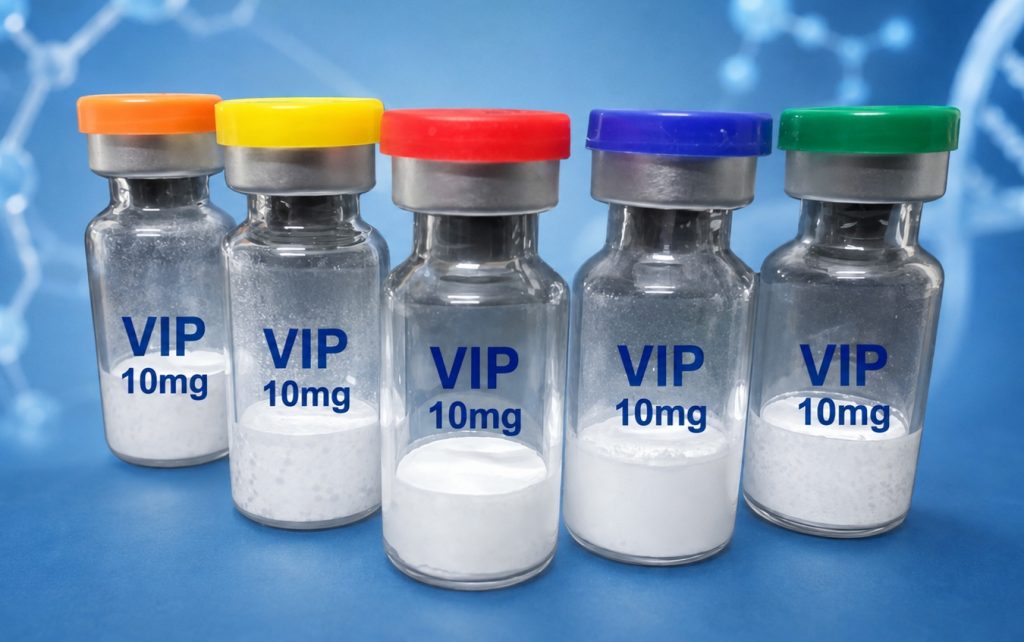
What Is Vasoactive Intestinal Peptide?
Vasoactive Intestinal Peptide (VIP), also known as Vasoactive Intestinal Polypeptide or Aviptadil, is a naturally occurring 28-amino-acid neuropeptide studied across neurological, gastrointestinal, endocrine, immune and receptor-signaling systems.
SUNONE supplies VIP, CAS 37221-79-7, as ≥99% HPLC Research Grade lyophilized peptide for qualified laboratory, analytical and manufacturing research.
SUNONE VIP Product Page:
Why Is VIP Studied Through VPAC1 and VPAC2?
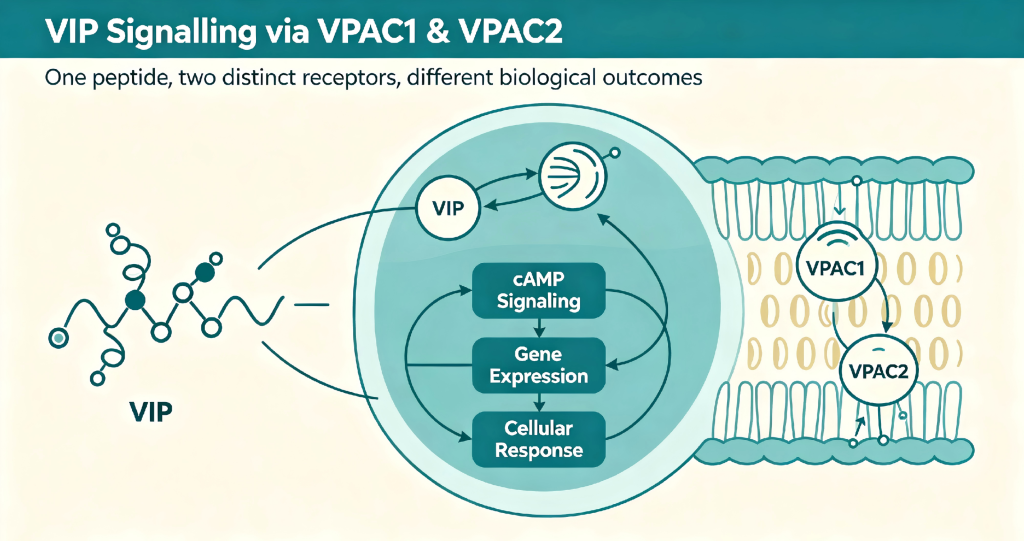
The scientific value of VIP peptide research is closely connected to its receptors.
VIP interacts primarily with two major receptors:
- VPAC1
- VPAC2
These receptors belong to the class B family of G-protein-coupled receptors and are involved in signaling pathways associated with adenylate cyclase, cAMP and protein kinase A.
This makes VIP useful for studying:
- peptide–receptor interactions;
- neuropeptide signaling;
- GPCR biology;
- cellular communication;
- immune signaling;
- gastrointestinal physiology;
- endocrine regulation.
For researchers, the receptor profile is more informative than simply describing VIP as a “vasodilator peptide.”
VPAC1 vs. VPAC2: Why the Difference Matters
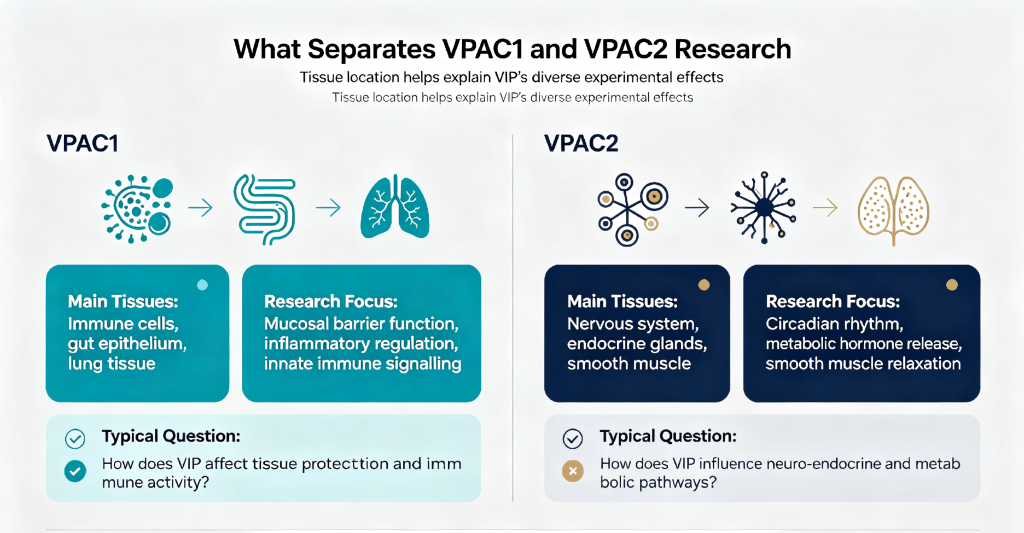
Although VIP can activate both VPAC1 and VPAC2, the two receptors do not have identical tissue distribution or biological roles.
VPAC1 is widely expressed in several epithelial, immune and gastrointestinal systems.
VPAC2 is also found across multiple tissues and has received particular research interest in endocrine and metabolic signaling.
For example, VPAC2-related research has investigated glucose-dependent insulin secretion and pancreatic beta-cell biology.
This means that a laboratory studying VIP receptor signaling should consider not only the peptide itself but also:
which receptor is expressed, receptor density, downstream signaling and the experimental cell or tissue system.
Is VIP the Same as Aviptadil?
The term Aviptadil is commonly used for the synthetic form of human VIP in pharmaceutical and clinical research contexts.
However, the name alone does not establish that every material marketed as “VIP” or “Aviptadil” is pharmaceutically equivalent.
Clinical-trial Aviptadil has been investigated in respiratory and critical-care settings.
Those studies provide useful information about VIP pharmacology, but they should not be automatically transferred to unrelated research-grade peptide materials.
SUNONE VIP is supplied as a research-grade laboratory material, not as an approved pharmaceutical drug product.
What Does Human VIP Research Show?
Human studies confirm that VIP has measurable physiological activity.
Historical research showed that VIP could influence airway tone and vascular responses.
More recent Aviptadil studies have explored respiratory failure and ARDS-related applications.
However, clinical results have been mixed, and the current evidence does not justify describing VIP as a broadly proven respiratory therapy.
Human studies have also reported adverse effects including:
- flushing;
- warm sensations;
- heart palpitations;
- diarrhea;
- hypotension;
- fatigue.
These findings demonstrate why receptor pharmacology and clinical efficacy should be treated as separate questions.
What Do VIP Peptide Reviews Say?
Online VIP peptide reviews are relatively limited compared with more commercially popular peptides.
Positive anecdotal discussions sometimes mention:
- increased perceived energy;
- improved sense of wellbeing;
- improved cognitive clarity;
- reduced subjective fatigue.
Negative or mixed experiences include:
- anxiety;
- excessive stimulation;
- disrupted sleep;
- fatigue;
- no clear effect;
- poor tolerability.
These experiences should be interpreted very cautiously.
Many online users combine VIP with Vilon, BPC-157, growth-hormone-related peptides or other compounds.
The identity and purity of the material are also usually unknown.
Therefore, online VIP reviews are anecdotal sentiment rather than controlled evidence.

Why Short Peptide Half-Life Matters in VIP Research
Native VIP is rapidly degraded in biological systems.
This short persistence has been one of the major challenges in translating VIP biology into pharmaceutical development.
For researchers, that creates interesting questions involving:
- peptide stability;
- receptor activation kinetics;
- enzymatic degradation;
- formulation research;
- peptide analog development;
- VPAC-selective agonist design.
This is one reason modern VIP research often extends beyond the native peptide itself to modified analogues and receptor-selective compounds.
What Should Researchers Check When Choosing a VIP Peptide Supplier?
A professional VIP peptide supplier should provide more than a product name.
Researchers should consider:
Peptide Sequence
Human VIP is a defined 28-amino-acid peptide.
Molecular Identity
The supplied material should correspond to the expected VIP molecular specification.
HPLC Purity
Batch-specific chromatographic analysis helps characterize purity and peptide-related impurities.
Certificate of Analysis
A batch-specific VIP peptide COA improves experimental traceability.
Storage and Handling Documentation
Applicable SDS and product specifications should be reviewed before laboratory use.
SUNONE currently supplies Vasoactive Intestinal Peptide, CAS 37221-79-7, as ≥99% HPLC Research Grade lyophilized peptide.
VIP Research: Receptor Biology Before Therapeutic Claims
The most useful question for biotechnology researchers is not:
“What condition does VIP treat?”
A better starting point is:
“Which VIP receptor is involved, and what downstream signaling pathway is being measured?”
That shift changes VIP from a broad therapeutic marketing term into a clearly defined research subject involving:
VIP → VPAC1/VPAC2 → GPCR signaling → cAMP pathways → cellular response → analytical characterization.
For professional VIP research, receptor biology, molecular identity, HPLC purity and batch-specific documentation should take priority over anecdotal therapeutic claims.
SUNONE VIP research peptide is for qualified labrtorynt, diagnois, druc tor mmatct or veteimant, use.research only, Not for human consumption, clinical treame.
Leave a Reply