
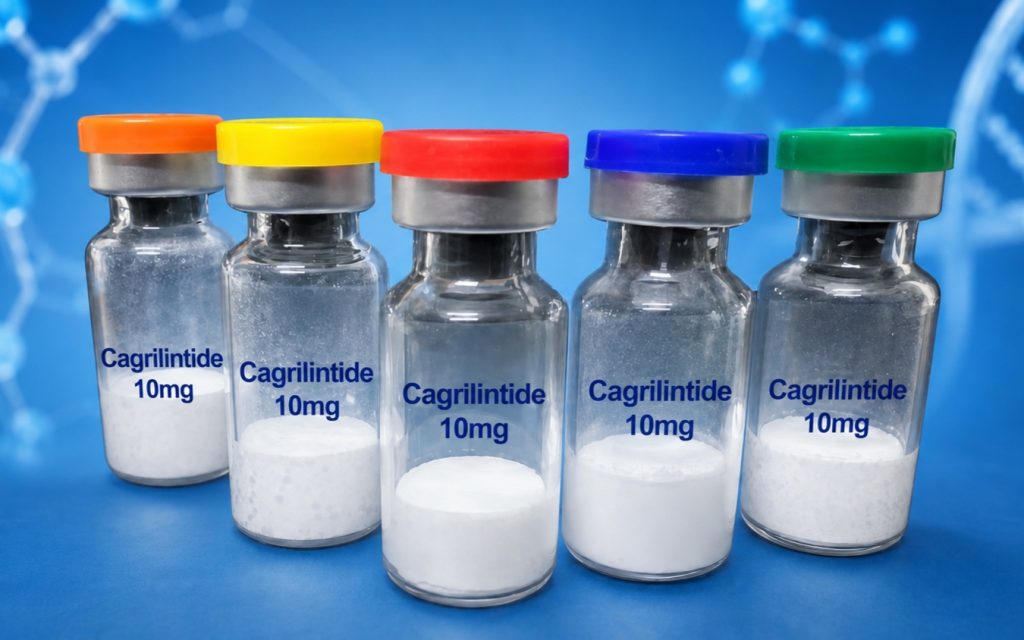
What Is Cagrilintide?
Cagrilintide is a long-acting amylin analogue being investigated in metabolic, appetite and weight-management research.
Unlike GLP-1 receptor agonists, Cagrilintide primarily targets amylin-related receptor biology, including amylin and calcitonin receptor systems.
SUNONE supplies research-grade Cagrilintide, CAS 1415456-99-3, for qualified laboratory, analytical and manufacturing applications.
SUNONE Cagrilintide Product Page:
Cagrilintide Is Not the Same as CagriSema
One of the biggest sources of confusion in current Cagrilintide search results is the term CagriSema.
CagriSema is not another name for Cagrilintide.
It is a fixed-dose combination containing:
Cagrilintide + Semaglutide
These molecules act through different but complementary biological pathways.
Cagrilintide is an amylin analogue, while Semaglutide is a GLP-1 receptor agonist.
Therefore:
CagriSema evidence ≠ Cagrilintide monotherapy evidence.
Why Do the Trial Results Matter?
The distinction becomes clear in the REDEFINE 1 Phase 3 program.
Reported results showed approximately:
CagriSema: 22.7%–23% average body-weight reduction
versus approximately:
Cagrilintide alone: 11.8% average body-weight reduction
under analyses assuming participants remained on treatment.
The important point for researchers is not the percentage itself.
It is that the combination and the individual peptide produced different outcomes.
Google articles that simply state “Cagrilintide caused 23% weight loss” can therefore create a misleading interpretation of the evidence.
What Does Cagrilintide Target?
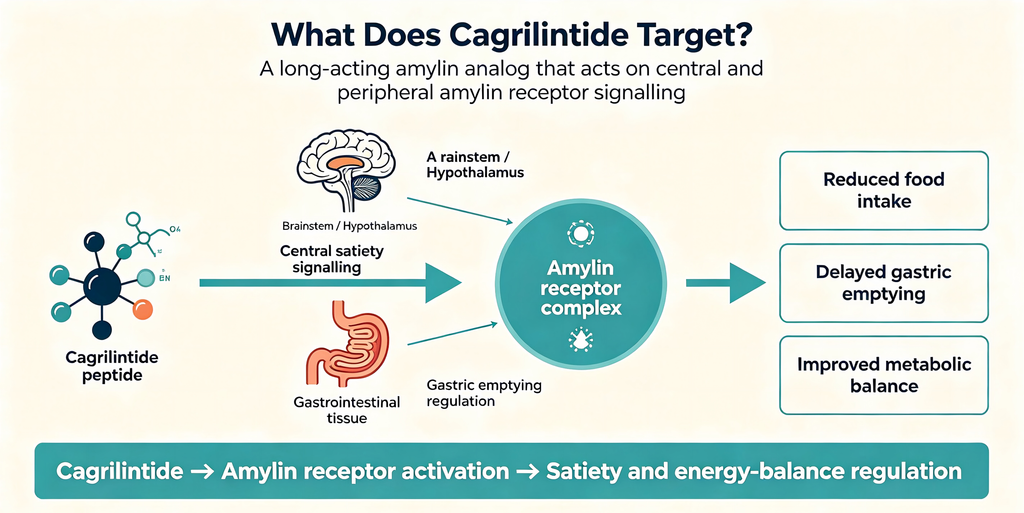
Cagrilintide is structurally designed as a long-acting amylin analogue.
Recent structural research has examined its interaction with:
- AMY1 receptors;
- AMY2 receptors;
- AMY3 receptors;
- the calcitonin receptor.
Research published in 2025 showed an amylin-like binding mode while also identifying distinct receptor conformational dynamics.
This reinforces the idea that Cagrilintide should be studied through amylin and calcitonin-family receptor pharmacology, rather than being grouped automatically with GLP-1 peptides.
Is Cagrilintide an Approved Drug?
Cagrilintide remains an investigational molecule.
Novo Nordisk has advanced Cagrilintide monotherapy into the RENEW Phase 3 program.
CagriSema, meanwhile, followed a separate regulatory pathway and was submitted to the U.S. FDA for approval in late 2025.
This distinction is important:
Cagrilintide alone and CagriSema are separate development programs.
Research-grade Cagrilintide should also not be represented as an approved pharmaceutical product.
What Do Cagrilintide Reviews Say?
Current online Cagrilintide reviews are mixed.
Positive anecdotal comments often mention:
- stronger appetite suppression;
- increased fullness;
- reduced food-related thoughts;
- renewed appetite control after perceived plateaus with other compounds.
Negative or neutral reports include:
- fatigue;
- nausea;
- lightheadedness;
- very low appetite;
- feeling generally unwell;
- little or no noticeable effect.
Interestingly, recent users describe very different responses—some call the appetite effect extremely strong, while others report almost no effect.
This variability is one reason online reviews cannot establish peptide quality or clinical effectiveness.
Cagrilintide reviews are anecdotal search sentiment, not controlled scientific evidence.
Why Combination Reviews Can Be Misleading
Many online discussions involve Cagrilintide together with:
- Semaglutide;
- Tirzepatide;
- Retatrutide;
- other experimental compounds.
That creates a major interpretation problem.
If several compounds are being used together, researchers cannot reliably determine which molecule produced a particular subjective outcome.
The same principle applies to clinical evidence:
combination data should not automatically be attributed to a single component.
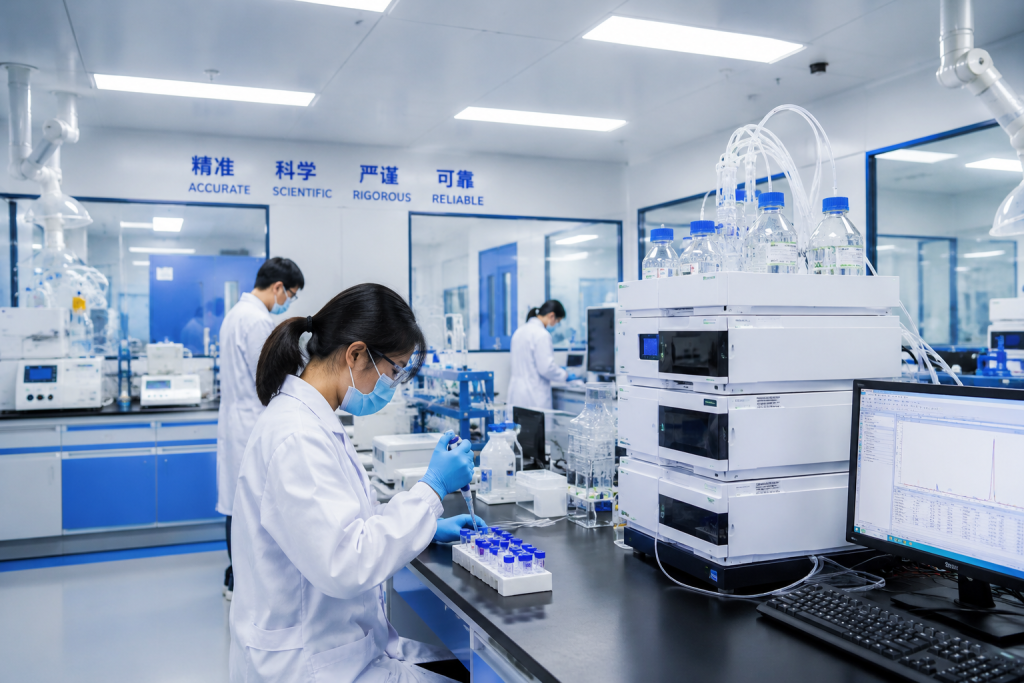
What Should Researchers Check When Choosing a Cagrilintide Supplier?
For professional Cagrilintide research, laboratories should evaluate analytical documentation rather than relying on online reviews.
Important considerations include:
Molecular Identity
The supplied material should correspond to the intended Cagrilintide molecular entity.
HPLC Purity
Batch-specific chromatography should support the reported purity.
Molecular-Mass Characterization
Analytical data should be consistent with the expected Cagrilintide molecule.
Batch-Specific COA
A current Cagrilintide COA supports lot-level traceability and research reproducibility.
SUNONE currently lists:
Product: Cagrilintide
CAS: 1415456-99-3
Formula: C194H312N54O59S2
Molecular Weight: 4409 g/mol
Purity: ≥99.6%
Form: Lyophilized Powder
Grade: Research Grade
Final Thoughts
A common Google search question is:
“How effective is Cagrilintide?”
For scientific research, a better question is:
“Was the reported result produced by Cagrilintide alone or by CagriSema?”
That distinction creates a clearer evidence framework:
Cagrilintide → amylin receptor biology → monotherapy evidence
versus
Cagrilintide + Semaglutide → CagriSema → combination evidence.
For laboratories comparing a research-grade Cagrilintide supplier, molecular identity, purity, batch-specific analytical documentation and accurate interpretation of the clinical evidence should take priority over headline claims.
SUNONE research peptide is for qualified labrtorynt, diagnois, druc tor mmatct or veteimant, use.research only, Not for human consumption, clinical treame.
Leave a Reply