
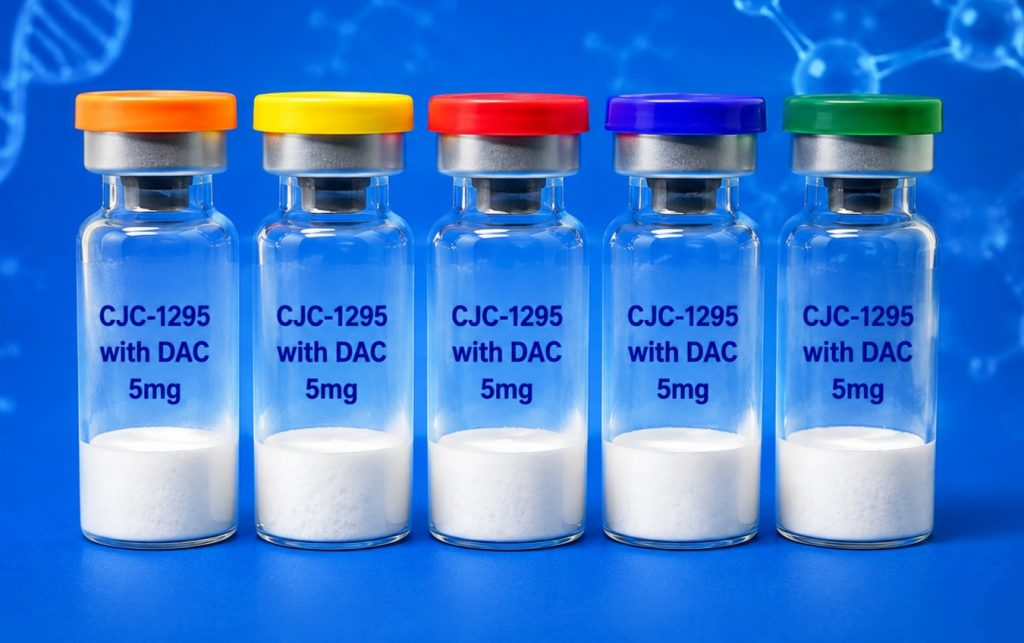
What Is CJC-1295 with DAC?
CJC-1295 with DAC is a synthetic long-acting analogue of growth hormone-releasing hormone, or GHRH.
What makes this molecule particularly interesting is the Drug Affinity Complex (DAC) modification.
Rather than treating DAC as a minor naming detail, researchers should recognize that it substantially changes the pharmacokinetic behavior of the peptide.
SUNONE supplies research-grade CJC-1295 with DAC, CAS 446262-90-4, for qualified laboratory, analytical and manufacturing applications.
SUNONE CJC-1295 with DAC Product Page:
What Does DAC Actually Do?
Native GHRH has a relatively short duration of action.
CJC-1295 was designed to overcome this limitation.
The DAC modification enables the peptide to interact with endogenous serum albumin, substantially prolonging its circulating persistence.
Published human research reported an estimated CJC-1295 half-life of approximately 5.8–8.1 days, along with prolonged changes in GH and IGF-1 signaling.
This creates a useful mechanistic chain:
CJC-1295 → DAC modification → albumin binding → prolonged exposure → extended GHRH-receptor signaling.
For researchers, that means DAC chemistry is central to understanding the molecule.
Why CJC-1295 with DAC Is Not the Same as “CJC-1295 No DAC”
Google search results frequently use several names interchangeably:
- CJC-1295
- CJC-1295 with DAC
- CJC-1295 No DAC
- Modified GRF 1-29
This can create confusion.
CJC-1295 with DAC is the long-acting DAC-containing peptide studied in classic human pharmacokinetic research.
By contrast, products sold as CJC-1295 No DAC are commonly described as Modified GRF 1-29 and do not contain the Drug Affinity Complex modification.
Therefore:
evidence for CJC-1295 with DAC should not automatically be transferred to CJC-1295 No DAC.
The molecular modification changes the pharmacokinetic context.
What Did Human Research Actually Show?
One randomized, placebo-controlled study investigated CJC-1295 in healthy adults.
Researchers reported prolonged increases in circulating GH and IGF-1 after exposure to the long-acting peptide.
A later study also found that pulsatile GH secretion remained detectable during prolonged stimulation by CJC-1295.
These studies are scientifically important because they demonstrate that the peptide can modify the GH/IGF-1 axis under controlled research conditions.
However, the evidence base remains limited and relatively old.
It should not be converted into broad claims about muscle building, anti-aging, athletic performance or clinical effectiveness.

Why Albumin Binding Matters for Peptide Research
Albumin binding can change several experimental variables.
These may include:
- apparent peptide persistence;
- exposure duration;
- pharmacokinetic profile;
- receptor-stimulation duration;
- interpretation of sampling time points.
For researchers comparing GHRH-related peptides, these differences matter.
A short-acting GHRH analogue and an albumin-binding CJC-1295 molecule may activate related biology while producing very different exposure profiles.
This is why molecular identity should be established before comparing study results.
What Do CJC-1295 Reviews Say?
Current online CJC-1295 reviews are mixed.
Positive anecdotal comments sometimes mention:
- improved perceived sleep;
- better perceived recovery;
- joint comfort;
- changes in appetite or body composition.
Negative or neutral comments include:
- fatigue;
- increased hunger;
- headache or pressure sensations;
- hand numbness;
- no meaningful perceived benefit.
Some online discussions also involve CJC-1295 together with Ipamorelin or other compounds.
That makes attribution even more difficult.
CJC-1295 reviews should therefore be treated as anecdotal search sentiment, not controlled scientific evidence.
What Does FDA Say About CJC-1295?
Current FDA information highlights important uncertainties around compounded CJC-1295 materials.
FDA has noted potential concerns involving:
- peptide-related impurities;
- API characterization;
- aggregation;
- immunogenicity.
The agency has also identified serious adverse events associated with CJC-1295, including increased heart rate and a systemic vasodilatory reaction, while noting that available clinical data remain limited.
This is another reason research-grade material should not be presented as an established therapeutic product.

Why HPLC Purity Is Not the Only Quality Question
A specification such as ≥98% HPLC purity is useful, but it does not answer every analytical question.
For a modified peptide such as CJC-1295 with DAC, laboratories may also need to consider:
- molecular identity;
- DAC-related structural integrity;
- molecular mass;
- peptide-related impurities;
- aggregation;
- batch consistency;
- applicable analytical methods.
The more useful sourcing question is therefore not only:
“What is the purity?”
but also:
“What analytical evidence confirms the intended DAC-containing CJC-1295 molecule?”
What Should Researchers Check When Choosing a CJC-1295 Supplier?
When evaluating a CJC-1295 with DAC supplier, researchers should look for clear product identity and batch-level analytical documentation.
SUNONE currently lists:
Product: CJC-1295 with DAC
Synonyms: CJC-1295 DAC, DAC:GRF, CJC-1295
CAS: 446262-90-4
Formula: C165H269N47O46
Molecular Weight: 3647.2 g/mol
Purity: ≥98% HPLC
Form: Lyophilized Solid
Grade: Research Grade
Storage: -20°C
Available analytical documentation may include COA, HPLC and MS data according to batch specification.
Final Thoughts
For CJC-1295 research, the word “DAC” should never be treated as an unimportant suffix.
It represents a structural feature that fundamentally affects the peptide’s interaction with albumin and its pharmacokinetic behavior.
A stronger research framework is:
CJC-1295 identity → DAC chemistry → albumin binding → prolonged exposure → GHRH signaling → analytical characterization.
For laboratories comparing a research-grade CJC-1295 supplier, correct molecular identity and batch-specific analytical evidence should take priority over broad claims based on the name “CJC-1295” alone.
SUNONE research peptide is for qualified labrtorynt, diagnois, druc tor mmatct or veteimant, use.research only, Not for human consumption, clinical treame.
Leave a Reply