
What Is GHK-Cu?
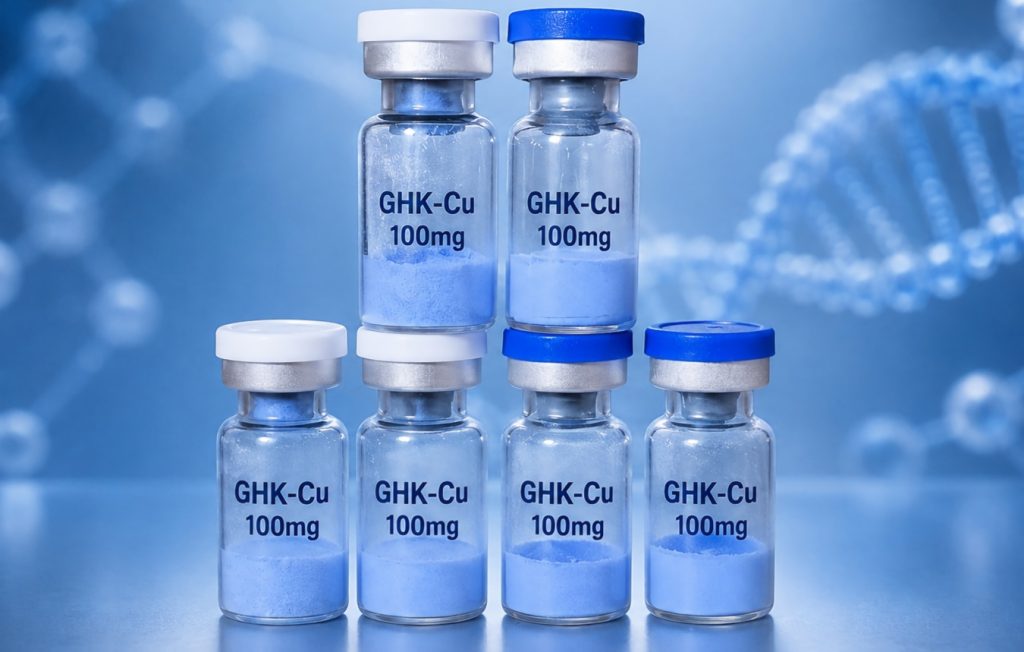
GHK-Cu, also known as Copper Tripeptide-1, is a copper-binding complex formed from the tripeptide Gly-His-Lys and copper ions.
It is widely investigated in research involving:
- extracellular matrix biology;
- collagen-related pathways;
- tissue remodeling;
- skin biology;
- copper-dependent cellular signaling.
SUNONE supplies research-grade GHK-Cu, CAS 300801-03-0, for qualified laboratory, analytical and manufacturing research.
SUNONE GHK-Cu Product Page:
GHK-Cu Is More Than a Three-Amino-Acid Peptide
A common description of GHK-Cu is simply:
“a copper peptide.”
That description is correct, but analytically incomplete.
The molecule contains two important components:
GHK peptide + coordinated copper
This means researchers should distinguish between:
GHK peptide identity
and
GHK-Cu copper-complex identity.
A highly pure peptide sequence does not automatically answer every question about copper coordination or the chemical form of the finished complex.
For GHK-Cu research, peptide purity and copper-complex characterization should therefore be considered together.
Why Does Copper Binding Matter?
GHK has a strong affinity for copper and forms the biologically studied GHK-Cu complex.
Copper coordination changes the molecular entity being investigated.
Experimental literature has associated GHK-Cu with processes involving:
- extracellular matrix synthesis;
- collagen-related signaling;
- cellular remodeling;
- antioxidant pathways;
- inflammatory signaling;
- angiogenesis and cellular proliferation.
This creates a useful research framework:
GHK sequence → copper binding → GHK-Cu complex → cellular signaling and matrix biology.
Researchers should avoid assuming that evidence generated using GHK alone automatically applies identically to GHK-Cu.
What Does the Current Evidence Say?
GHK-Cu has a substantial preclinical research history, but the human evidence base is much smaller.
A recent systematic review evaluating GHK-Cu in aesthetic and regenerative research identified 20 eligible studies, of which 18 were preclinical and only 2 were randomized controlled clinical trials.
Preclinical studies reported effects involving collagen, extracellular matrix synthesis, angiogenesis and inflammatory pathways.
However, the review also emphasized important limitations:
- relatively few controlled human studies;
- different formulations;
- inconsistent research methods;
- different delivery systems;
- limited standardized clinical protocols.
Therefore:
promising biological evidence ≠ established broad clinical effectiveness.

What About GHK-Cu Skin Research?
GHK-Cu is commonly discussed in connection with skin and cosmetic peptide research.
However, skin delivery is itself a research question.
GHK-Cu is relatively hydrophilic, while the stratum corneum creates a substantial lipophilic barrier.
Recent reviews have therefore examined formulation approaches such as liposomes and other delivery systems.
This matters because:
the biological activity of a peptide does not automatically prove that every formulation delivers an equivalent amount to the same biological site.
Formulation, permeability and molecular identity should be separated when interpreting GHK-Cu research.
What Do GHK-Cu Reviews Say?
Current online GHK-Cu reviews are mixed.
Positive anecdotal comments frequently mention:
- improved perceived skin appearance;
- smoother-looking skin;
- changes in hair appearance;
- faster perceived nail growth;
- improved overall skin quality.
Negative or neutral comments include:
- no noticeable change;
- skin irritation or rash;
- burning or discomfort;
- acne or breakouts;
- fatigue;
- brain fog;
- uncertainty about whether results justify continued use.
These experiences vary widely.
They may involve different products, formulations, routes, additional compounds and uncontrolled variables.
Therefore:
GHK-Cu reviews are anecdotal search sentiment—not controlled scientific evidence.
Why HPLC Purity Is Not the Entire GHK-Cu Quality Story
A common supplier specification is:
“GHK-Cu ≥99% purity.”
HPLC purity is useful, but GHK-Cu is a metal-peptide complex.
Researchers may also need to evaluate:
- molecular identity;
- copper-complex form;
- expected molecular mass;
- related peptide impurities;
- batch consistency;
- analytical method;
- storage documentation;
- batch-specific COA.
This means:
high HPLC purity ≠ complete characterization of every quality attribute.
For copper peptides in particular, researchers should confirm that the analytical documentation relates to the intended GHK-Cu complex, not merely a generic peptide specification.
What Should Researchers Check When Choosing a GHK-Cu Supplier?
When comparing a research-grade GHK-Cu supplier, laboratories should look beyond marketing descriptions.
Molecular Identity
The supplied material should correspond to the intended GHK-Cu / Copper Tripeptide-1 entity.
Copper-Complex Form
The applicable documentation should clearly identify the copper-peptide material being supplied.
HPLC Purity
Batch-specific chromatography should support the stated peptide purity.
Analytical Characterization
Mass-related or other appropriate analytical data can help support molecular identity.
Batch-Specific COA
The GHK-Cu COA should correspond to the actual lot supplied.
SUNONE currently lists:
Product: GHK-Cu
Synonyms: Copper Tripeptide-1, Copper Tripeptide 1, Gly-His-Lys Copper Complex, GHK Copper
CAS: 300801-03-0
Formula: C28H48CuN12O8
Molecular Weight: 744.3 g/mol
Form: Lyophilized Powder
Grade: Research Grade
Storage: 2–8°C
Because online catalog specifications can be updated, final purity, copper-complex form and analytical requirements should always be verified against the applicable batch-specific COA.
Final Thoughts
A common Google search is:
“What does GHK-Cu do?”
For laboratory researchers, a more useful question is:
“What exact GHK-Cu molecular complex produced the reported result, and how was that material characterized?”
A stronger research-quality framework is:
GHK identity → copper complex → HPLC purity → analytical characterization → batch-specific COA → reproducible research.
For laboratories comparing a GHK-Cu supplier, clear molecular identity and batch-specific analytical evidence should take priority over broad cosmetic or anti-aging claims.
SUNONE research peptide is for qualified labrtorynt, diagnois, druc tor mmatct or veteimant, use.research only, Not for human consumption, clinical treame.
Leave a Reply