
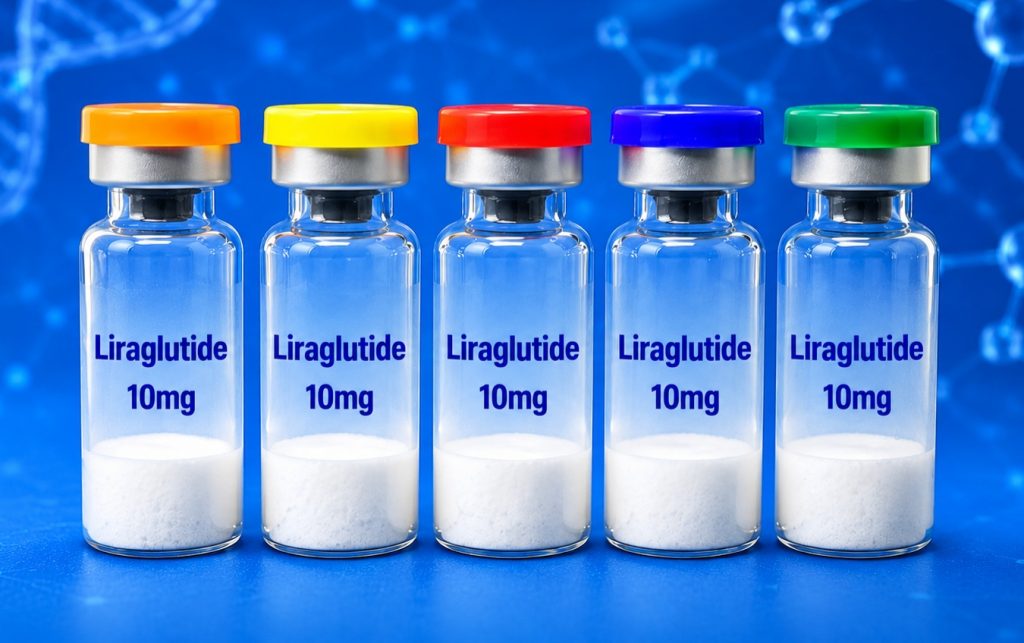
What Is Liraglutide?
Liraglutide is a long-acting acylated GLP-1 analogue used extensively in metabolic and peptide research.
Its molecular design includes a modified GLP-1 sequence and a C16 fatty-acid side chain, creating a structurally more complex research molecule than a short linear peptide.
SUNONE supplies research-grade Liraglutide, CAS 204656-20-2, for qualified laboratory, analytical and manufacturing applications.
SUNONE Liraglutide Product Page:
Why Liraglutide Stability Matters
Researchers often focus on one specification:
HPLC purity.
That is important, but Liraglutide quality also depends on whether the intended peptide remains chemically intact during manufacturing, storage and analytical handling.
Recent stability studies show that Liraglutide can generate multiple degradation products under:
- oxidative stress;
- hydrolytic stress;
- thermal stress;
- light exposure.
This creates a more useful quality framework:
Liraglutide identity → purity → stability → degradation profile → reproducible research.
What Can Happen When Liraglutide Degrades?
Liraglutide is a modified therapeutic peptide, so several chemical changes may affect its analytical profile.
Research has identified degradation pathways involving changes produced by oxidation, hydrolysis, heat and photolytic stress.
Recent LC-HRMS studies have separated numerous Liraglutide-related degradation products and characterized their molecular changes.
For researchers, this means:
a high main-peak percentage does not automatically describe every degradation pathway.
Why HPLC and LC-MS Are Complementary
HPLC is useful for examining chromatographic purity and separating the main peptide peak from detectable related substances.
LC-MS or MS can add molecular-mass and structural information that helps characterize the intended peptide and degradation products.
For complex peptides such as Liraglutide, these methods answer different questions.
A simple model is:
HPLC → How clean is the chromatographic profile?
MS / LC-MS → What molecular species are present?
Using both types of analytical information can provide a stronger basis for research-grade peptide evaluation.
Liraglutide Research Grade vs Pharmaceutical Liraglutide
Liraglutide is also the active pharmaceutical ingredient associated with regulated medicines such as Victoza and Saxenda.
However, approved finished medicines contain defined formulations, excipients, manufacturing controls and regulatory release specifications.
SUNONE Liraglutide is supplied as Research Grade material.
Therefore:
pharmaceutical Liraglutide evidence ≠ pharmaceutical equivalence of research-grade Liraglutide.
Clinical outcomes from approved medicines should not automatically be attributed to laboratory raw material.
What Do Liraglutide Reviews Say?
Current online Liraglutide reviews are generally positive but highly variable.
Positive experiences frequently mention:
- reduced appetite;
- improved fullness;
- reduced food cravings;
- weight-related changes;
- improved perceived glucose control.
Negative experiences include:
- nausea;
- constipation;
- diarrhea;
- fatigue;
- headache;
- heartburn;
- appetite suppression that feels too strong;
- limited effect in some users.
These reviews mainly concern prescription pharmaceutical products.
They should therefore be treated as anecdotal search sentiment, not evidence about SUNONE Research Grade Liraglutide.
Why Reviews Cannot Confirm Peptide Quality
A user reporting a strong effect does not prove:
- peptide identity;
- purity;
- correct molecular mass;
- acceptable degradation levels;
- formulation equivalence.
Likewise, a user reporting little effect does not prove that a peptide material is analytically poor.
For laboratories, analytical documentation should carry more weight than subjective reviews.
What Should Researchers Check When Choosing a Liraglutide Supplier?
When evaluating a research-grade Liraglutide supplier, several quality factors are useful.
Molecular Identity
The supplied material should correspond to the intended Liraglutide molecular entity.
HPLC Purity
Batch-specific chromatography should support the stated purity.
Mass Characterization
MS or LC-MS data can help support molecular identity.
Degradation Profile
For stability-sensitive peptide research, researchers should consider whether relevant degradation products are monitored or characterized.
Batch-Specific COA
A current Liraglutide COA helps support traceability and experimental reproducibility.
SUNONE currently lists:
Product: Liraglutide
Synonyms: Liraglutide, NN2211, GLP-1 analog
CAS: 204656-20-2
Formula: C172H265N43O51
Molecular Weight: 3751.2 g/mol
Purity: ≥98% HPLC
Form: Lyophilized
Grade: Research Grade
Final Thoughts
A common sourcing question is:
“What is the purity of Liraglutide?”
A better analytical question is:
“What evidence supports the identity, purity and stability of this specific Liraglutide batch?”
For laboratories comparing a Liraglutide supplier, a stronger quality framework is:
molecular identity → HPLC purity → LC-MS characterization → degradation profile → batch-specific COA.
This approach provides more useful information than relying on a single headline purity percentage.
SUNONE research peptide is for qualified labrtorynt, diagnois, druc tor mmatct or veteimant, use.research only, Not for human consumption, clinical treame.
Leave a Reply