
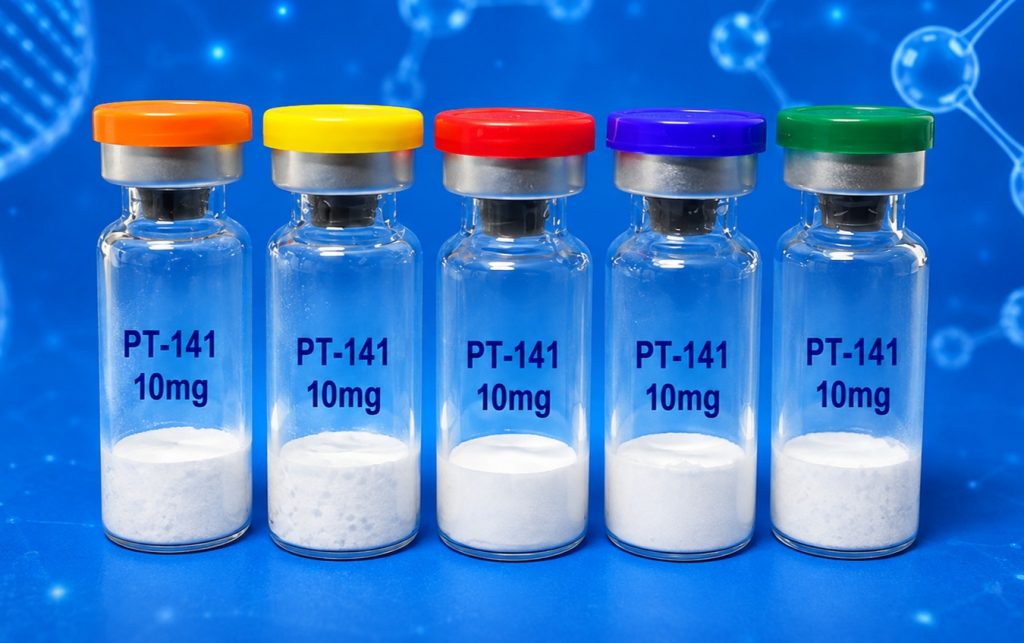
What Is PT-141?
PT-141, also known as Bremelanotide, is a synthetic cyclic heptapeptide and melanocortin receptor agonist.
Unlike peptides studied mainly for metabolic or growth-hormone pathways, PT-141 is associated with melanocortin receptor signaling, particularly MC1R and MC4R-related biology.
SUNONE supplies research-grade PT-141 / Bremelanotide for qualified laboratory, analytical and manufacturing applications.
SUNONE PT-141 Product Page:
PT-141 and Bremelanotide Acetate: Why the Name Is Not Enough
A common search mistake is assuming that:
PT-141 = Bremelanotide = Bremelanotide acetate = Vyleesi
in every chemical and product context.
These terms are closely related, but researchers should distinguish the active peptide from its salt form.
SUNONE currently lists PT-141 / Bremelanotide with:
CAS 189691-06-3
Formula C50H68N14O10
Molecular Weight 1025.16 g/mol
By contrast, FDA substance records identify Bremelanotide acetate as a defined acetate salt with a different registry identity and molecular composition.
For analytical work, that difference matters.
Why Does Salt Form Matter in Peptide Research?
A peptide salt and its parent molecular entity may share the same active peptide moiety, but they are not analytically identical substances.
Salt form can affect properties such as:
- molecular weight;
- elemental composition;
- mass-balance calculations;
- counterion content;
- formulation behavior;
- analytical reporting.
This creates an important sourcing question:
Is the material the parent Bremelanotide peptide, Bremelanotide acetate, or another defined form?
A purity value alone cannot answer that question.

What Is Vyleesi?
Vyleesi is an FDA-approved prescription product containing Bremelanotide in acetate form.
Its regulatory identity, formulation, manufacturing controls and clinical evidence belong to that specific pharmaceutical product.
SUNONE Research Grade PT-141 is a different product category.
Therefore:
Vyleesi clinical evidence does not establish pharmaceutical equivalence for SUNONE PT-141.
This distinction is especially important when writing scientific or procurement content.
What Receptors Does Bremelanotide Activate?
Current pharmaceutical labeling describes Bremelanotide as a nonselective melanocortin receptor agonist.
Its receptor activity includes:
- MC1R;
- MC4R;
- MC3R;
- MC5R;
- MC2R.
At clinically relevant pharmaceutical exposure, MC1R and MC4R are considered particularly relevant.
MC4R is expressed in multiple regions of the central nervous system, while MC1R is strongly associated with melanocyte signaling and pigmentation biology.
This explains why PT-141 research should be understood through the wider melanocortin receptor system, rather than being reduced to a single commercial claim.
What Do PT-141 Reviews Say?
Current PT-141 reviews are mixed but generally trend positive.
Positive anecdotal comments frequently describe:
- stronger subjective desire;
- increased arousal;
- noticeable changes in sexual interest;
- longer-lasting subjective effects.
Negative or neutral comments include:
- nausea;
- vomiting;
- headache;
- flushing;
- gastrointestinal discomfort;
- little or no noticeable effect.
Some 2026 users describe very strong subjective responses, while others report only flushing or nausea with little perceived benefit.
This variation is important.
Online reviews may involve regulated Vyleesi, compounded preparations or research materials from unknown sources.
For that reason:
PT-141 reviews should be treated as anecdotal sentiment, not evidence of the safety or efficacy of research-grade material.

Why Product Identity Matters More Than User Experience
A strong subjective effect does not prove that a material has:
- the correct peptide sequence;
- the expected molecular mass;
- the intended salt form;
- acceptable purity;
- controlled impurity levels.
Likewise, no perceived effect does not automatically prove that the peptide is low quality.
For research applications, analytical documentation is more reliable than subjective reports.
What Should Researchers Check When Choosing a PT-141 Supplier?
A professional PT-141 supplier should provide clear identity information.
Peptide Identity
The material should correspond to the intended Bremelanotide peptide.
Chemical Form
Researchers should establish whether the product is:
Bremelanotide parent peptide
or
Bremelanotide acetate
rather than assuming that the terms are interchangeable.
HPLC Purity
Batch-specific HPLC data should support the stated purity.
Mass Spectrometry
MS data can help confirm the intended molecular identity.
Batch-Specific COA
A current PT-141 COA improves lot-level traceability and research reproducibility.
SUNONE currently lists:
Product: PT-141 (Bremelanotide)
Synonyms: Bremelanotide, PT-141, PT141
CAS: 189691-06-3
Formula: C50H68N14O10
Molecular Weight: 1025.16 g/mol
Purity: ≥98% HPLC
Form: Lyophilized Powder
Grade: Research Grade
PT-141 Research: Follow the Chemical Identity
A common Google search question is:
“Is PT-141 the same as Vyleesi?”
For biotechnology researchers, a better question is:
“Which molecular and salt form is actually being studied?”
That creates a more useful analytical framework:
PT-141 → Bremelanotide active peptide → chemical form → acetate salt or parent peptide → melanocortin receptor signaling → experimental interpretation.
For laboratories evaluating research-grade PT-141, molecular identity, salt form, HPLC purity, MS characterization and batch-specific documentation should take priority over generalized product claims.
SUNONE research peptide is for qualified labrtorynt, diagnois, druc tor mmatct or veteimant, use.research only, Not for human consumption, clinical treame.
Leave a Reply