
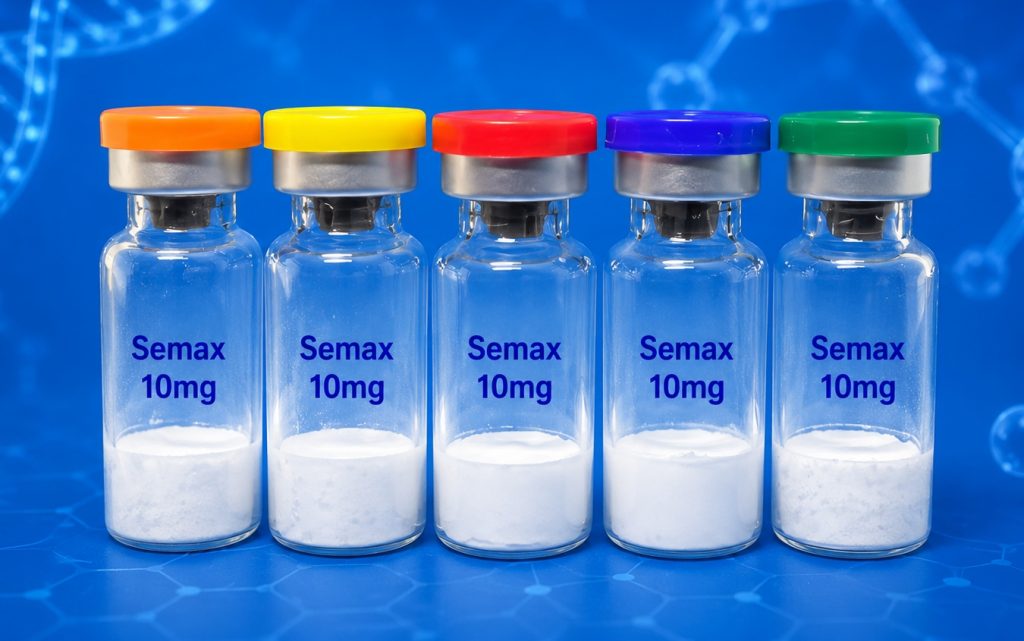
What Is Semax?
Semax is a synthetic heptapeptide with the amino-acid sequence:
Met-Glu-His-Phe-Pro-Gly-Pro (MEHFPGP).
It is commonly described as an ACTH-derived peptide because its first four amino acids correspond to the ACTH(4–7) fragment.
However, the more informative structural description is:
ACTH(4–7) + Pro-Gly-Pro = ACTH(4–7)PGP.
SUNONE supplies research-grade Semax, CAS 80714-61-0, for qualified laboratory, analytical and manufacturing research.
SUNONE Semax Product Page:
Why Does the PGP Tail Matter?
Many Semax articles focus only on the ACTH-derived portion of the molecule.
That leaves out an important structural feature.
The final three residues are:
Pro-Gly-Pro (PGP).
PGP was incorporated into the peptide in part to improve resistance to enzymatic degradation, but experimental research suggests it may also participate in biological signaling.
In animal models, both Semax and PGP have influenced the transcription of neurotrophins and neurotrophin receptors.
Their effects overlap—but they are not identical.
This creates a more useful research model:
ACTH(4–7) fragment + PGP tail → complete Semax molecule → biological response.
Semax Is More Than a “BDNF Peptide”
Semax is frequently marketed online using simplified phrases such as:
“BDNF peptide,”
“focus peptide,” or
“nootropic peptide.”
These descriptions are incomplete.
Preclinical studies have reported changes in BDNF, NGF and neurotrophin-receptor expression, particularly in rat brain and cerebral-ischemia models.
Other research has examined:
- neurotransmission-related genes;
- inflammatory signaling;
- CREB-associated pathways;
- neuronal survival mechanisms.
Importantly, much of this mechanistic evidence comes from animal or cellular research.
Changes in rat BDNF expression do not automatically prove cognitive enhancement in humans.

Why Semax Molecular Identity Matters
“Semax” can sometimes be used commercially without clearly identifying the exact chemical form.
Researchers should distinguish among:
- Semax free base;
- Semax acetate;
- modified Semax derivatives;
- analogs marketed under similar names.
These materials should not automatically be treated as analytically interchangeable.
In 2026, the U.S. FDA specifically highlighted naming and physicochemical-characterization concerns involving Semax-related bulk substances.
For research laboratories, this reinforces a simple rule:
Product name alone is not sufficient evidence of molecular identity.
What Do Semax Reviews Say?
Current online Semax reviews are strongly mixed.
Positive anecdotal reports include:
- greater mental clarity;
- improved perceived focus;
- better verbal fluency;
- improved memory;
- increased motivation.
Negative or neutral reports include:
- no noticeable effect;
- fatigue;
- sleepiness;
- afternoon energy decline;
- brain fog;
- disappointment compared with online expectations.
This wide variation matters.
Different online users may be discussing different chemical forms, products, formulations or additional compounds.
Therefore:
Semax reviews should be treated as anecdotal search sentiment—not controlled scientific evidence.

What Does the Evidence Actually Support?
Semax has an interesting preclinical research record.
Studies have investigated BDNF, NGF, gene expression, neuroprotection and cerebral-ischemia models.
However, the evidence hierarchy is uneven.
Much of the mechanistic literature comes from animal studies and research groups concentrated in a limited geographic and academic setting.
In 2026, FDA reviewers also concluded that the available evidence was insufficient to support the effectiveness of Semax-related bulk substances for the clinical uses they evaluated.
For research content, the most accurate position is:
Semax has biologically interesting experimental evidence, but that evidence should not be converted into broad clinical claims.
What Should Researchers Check When Choosing a Semax Supplier?
A professional Semax supplier should provide more than a purity percentage.
Sequence Identity
The intended Semax molecule should correspond to:
Met-Glu-His-Phe-Pro-Gly-Pro
Chemical Form
Researchers should determine whether the supplied material is the free base, acetate or another explicitly defined form.
HPLC Purity
Batch-specific HPLC documentation should support the stated purity.
Molecular-Mass Verification
Mass-related analytical data can help confirm peptide identity.
Batch-Specific COA
A current Semax COA helps support traceability and reproducibility.
SUNONE currently lists:
Product: Semax
Sequence: Met-Glu-His-Phe-Pro-Gly-Pro
CAS: 80714-61-0
Formula: C37H51N9O10S
Molecular Weight: 813.90 g/mol
Purity: ≥98% HPLC
Form: Lyophilized
Grade: Research Grade
Final Thoughts
A common Google question is:
“Does Semax improve focus?”
For laboratory research, a stronger question is:
“Which Semax molecular form produced the reported experimental result?”
That creates a clearer scientific framework:
ACTH(4–7) → PGP tail → ACTH(4–7)PGP → molecular identity → neurotrophin and signaling research → evidence interpretation.
For laboratories evaluating a research-grade Semax supplier, molecular identity, chemical form, HPLC purity and batch-specific analytical documentation should take priority over generalized “nootropic peptide” claims.
SUNONE research peptide is for qualified labrtorynt, diagnois, druc tor mmatct or veteimant, use.research only, Not for human consumption, clinical treame.
Leave a Reply