
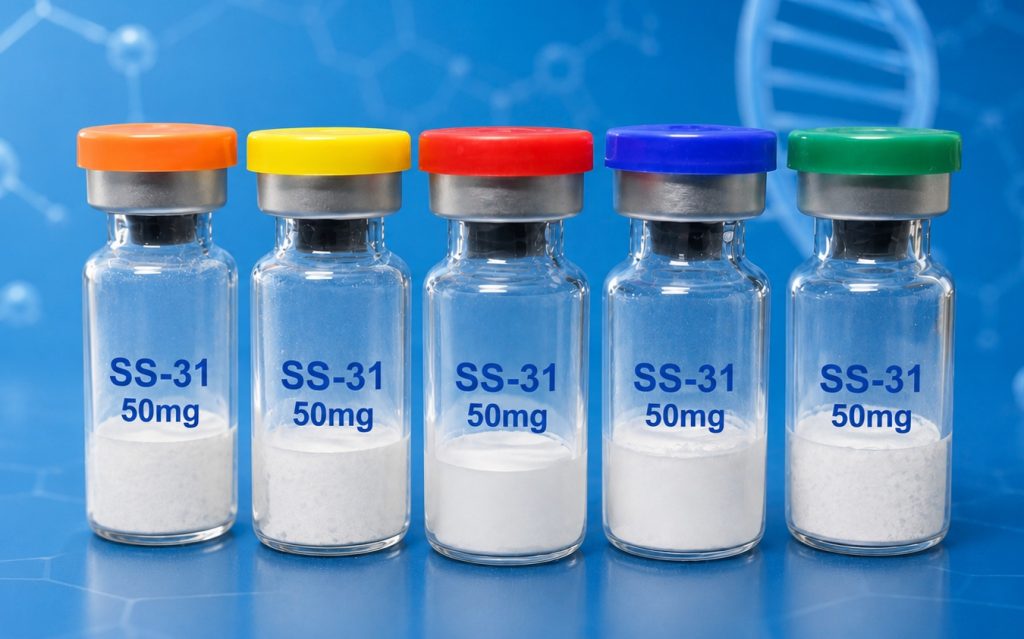
What Is SS-31?
SS-31, also known as Elamipretide, Bendavia and MTP-131, is a synthetic mitochondria-targeting tetrapeptide studied for its interaction with the inner mitochondrial membrane.
Rather than thinking of SS-31 simply as an “energy peptide,” researchers can view it as a molecular probe for studying cardiolipin-dependent mitochondrial biology.
SUNONE supplies SS-31, CAS 736992-21-5, as ≥99% HPLC lyophilized Research Grade material for qualified laboratory, analytical and manufacturing applications.
SUNONE SS-31 Product Page:
Why Is Cardiolipin Central to SS-31 Research?
Cardiolipin is a specialized phospholipid concentrated in the inner mitochondrial membrane.
It contributes to:
- mitochondrial cristae architecture;
- electron transport chain organization;
- membrane protein function;
- mitochondrial bioenergetics;
- cytochrome-c-related signaling.
SS-31 has been investigated for its ability to associate with cardiolipin and influence this membrane environment.
This creates a more precise research pathway than the broad phrase “boosts mitochondrial energy”:
SS-31 → cardiolipin interaction → inner mitochondrial membrane → cristae organization → bioenergetic function.
SS-31 Is Not Simply an Antioxidant
Earlier descriptions of Elamipretide often focused heavily on oxidative stress.
More recent research provides a broader picture.
Current mechanistic reviews describe potential SS-31 effects involving:
- cardiolipin-associated membrane organization;
- mitochondrial membrane electrostatics;
- respiratory-complex organization;
- cristae stability;
- ATP-related bioenergetics.
This means SS-31 research is increasingly about mitochondrial membrane architecture and function, rather than simple free-radical scavenging.

Why Is the Inner Mitochondrial Membrane Important?
The inner mitochondrial membrane contains much of the machinery required for oxidative phosphorylation.
Its structure and lipid environment influence how efficiently respiratory proteins operate.
For research purposes, this makes SS-31 especially interesting because it targets a specific mitochondrial compartment rather than functioning as a generic metabolic precursor.
This distinguishes SS-31 from compounds frequently grouped together under “mitochondrial support,” such as:
- NAD+;
- NR;
- NMN;
- MOTS-c.
These molecules have different structures, targets and evidence bases.
What Changed After the FDA Approval of Elamipretide?
In September 2025, the FDA granted accelerated approval to Forzinity (elamipretide) for improving muscle strength in adult and pediatric patients with Barth syndrome weighing at least 30 kg.
Barth syndrome is a rare mitochondrial disorder associated with abnormalities in cardiolipin metabolism.
This approval is scientifically important because it connects Elamipretide with a defined mitochondrial disease context.
However, it does not mean that every SS-31 material is an approved pharmaceutical product.
Forzinity and SUNONE Research Grade SS-31 are different product categories.
FDA-reviewed clinical results involving Forzinity should not be used to claim pharmaceutical equivalence, safety or efficacy for SUNONE research material.
What Do SS-31 Reviews Say?
Current online SS-31 reviews are highly mixed.
Positive anecdotal reports sometimes mention:
- increased perceived energy;
- improved stamina;
- better recovery;
- less subjective fatigue;
- improved ability to maintain activity.
Negative or neutral reports include:
- no noticeable effect;
- fatigue;
- temporary “poisoned” or unwell feelings;
- inconsistent results;
- uncertainty about whether any change was related to SS-31.
These reports should be treated cautiously.
Online discussions frequently involve products of uncertain identity, multiple research compounds, supplements, medications and uncontrolled variables.
Therefore, SS-31 reviews are anecdotal sentiment rather than controlled evidence.

What Does Pharmaceutical Safety Data Show?
Clinical safety data for FDA-approved Elamipretide are available in the Forzinity prescribing information.
In its Barth syndrome clinical program, commonly reported adverse reactions included local administration-site reactions such as:
- erythema;
- pain;
- induration;
- itching;
- bruising;
- urticaria.
These findings relate to the regulated Forzinity pharmaceutical formulation.
They should not be interpreted as safety data for SUNONE Research Grade SS-31.
SS-31 vs MOTS-c: Similar Topic, Different Biology
SS-31 and MOTS-c are often grouped together in mitochondrial peptide discussions.
They should not be treated as equivalent.
SS-31 / Elamipretide is studied primarily in relation to the inner mitochondrial membrane and cardiolipin-associated biology.
MOTS-c is a mitochondrial-derived peptide studied in metabolic signaling, stress responses and exercise-related pathways.
The comparison is therefore more scientifically useful when framed as:
mitochondrial membrane targeting vs mitochondrial-derived signaling.
What Should Researchers Check When Choosing an SS-31 Supplier?
Researchers evaluating an SS-31 supplier should look beyond general mitochondrial claims.
Molecular Identity
The supplied material should correspond to the intended SS-31 / Elamipretide peptide.
HPLC Purity
Batch-specific chromatographic data should support the stated purity.
Molecular-Mass Verification
Analytical data can support identification of the intended peptide.
Batch-Specific COA
A current SS-31 COA supports experimental traceability.
Storage Documentation
Peptide storage and handling conditions can influence analytical consistency.
SUNONE currently lists:
Product: SS-31 / Elamipretide
Synonyms: Bendavia, MTP-131, Szeto-Schiller Peptide 31
CAS: 736992-21-5
Formula: C32H49N9O5
Molecular Weight: 611.78 g/mol
Purity: ≥99% HPLC
Form: Lyophilized Research Grade peptide
SS-31 Research: Follow the Membrane, Not the Marketing Claim
A common search question is:
“Does SS-31 increase energy?”
For biotechnology research, a stronger question is:
“How does a mitochondria-targeting tetrapeptide interact with cardiolipin and influence inner-membrane organization?”
That creates a clearer scientific framework:
SS-31 → cardiolipin → inner mitochondrial membrane → cristae structure → respiratory organization → mitochondrial bioenergetics.
For laboratories evaluating research-grade SS-31, molecular identity, analytical purity, batch traceability and experimental context should take priority over broad “anti-aging” or “energy peptide” claims.
SUNONE research peptide is for qualified labrtorynt, diagnois, druc tor mmatct or veteimant, use.research only, Not for human consumption, clinical treame.
Leave a Reply