
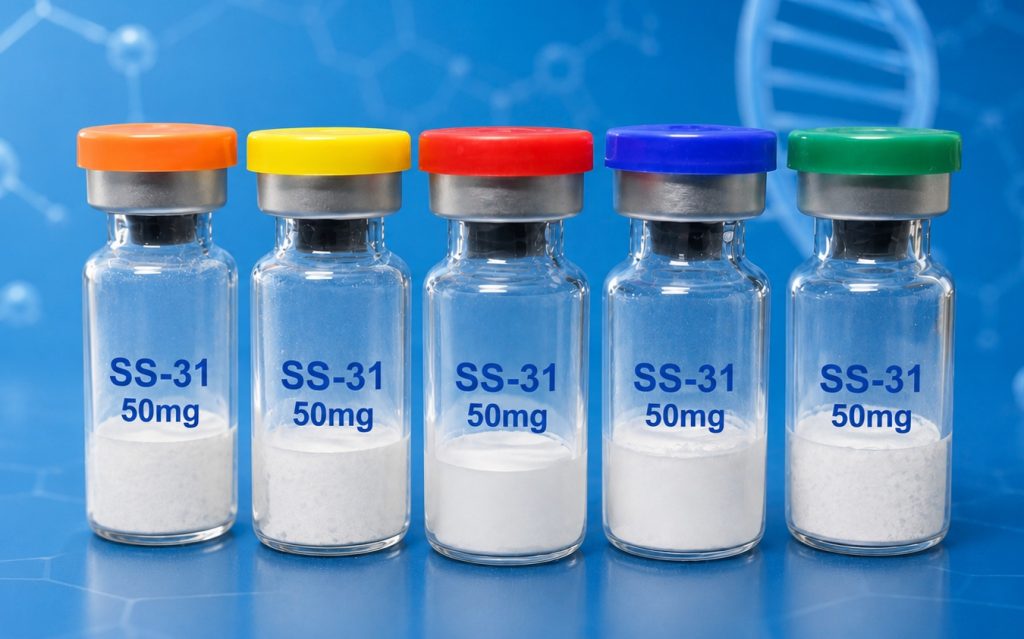
What Is SS-31?
SS-31, also known as Elamipretide, MTP-131 and Bendavia, is a synthetic mitochondria-targeting tetrapeptide studied for its interactions with the inner mitochondrial membrane.
A major area of SS-31 research involves cardiolipin, a phospholipid that plays an important structural and functional role in mitochondrial membranes.
SUNONE supplies research-grade SS-31, CAS 736992-21-5, for qualified laboratory, analytical and manufacturing research.
SUNONE SS-31 Product Page:
Why Has SS-31 Become More Important in 2026?
For many years, SS-31 was primarily discussed as an investigational mitochondrial peptide.
That changed in September 2025.
The U.S. FDA granted accelerated approval to Forzinity (elamipretide) for improving muscle strength in certain adult and pediatric patients with Barth syndrome weighing at least 30 kg.
This makes elamipretide especially important scientifically.
However, it also creates a new terminology problem.
Researchers may now encounter:
- SS-31
- Elamipretide
- MTP-131
- Bendavia
- Forzinity
in the same Google search results.
These names are related, but the products behind them should not automatically be treated as interchangeable.
Is SS-31 the Same as Forzinity?
At the active-molecule level, SS-31 is commonly used as a research name for elamipretide.
But product equivalence requires more than a shared active-molecule name.
Forzinity is an FDA-regulated finished pharmaceutical product with defined manufacturing, formulation, sterility, concentration, quality and regulatory specifications.
SUNONE SS-31 is supplied as Research Grade peptide material.
Therefore:
SS-31 molecular identity ≠ automatic pharmaceutical equivalence to Forzinity.
This distinction is essential for scientific writing, sourcing and experimental interpretation.
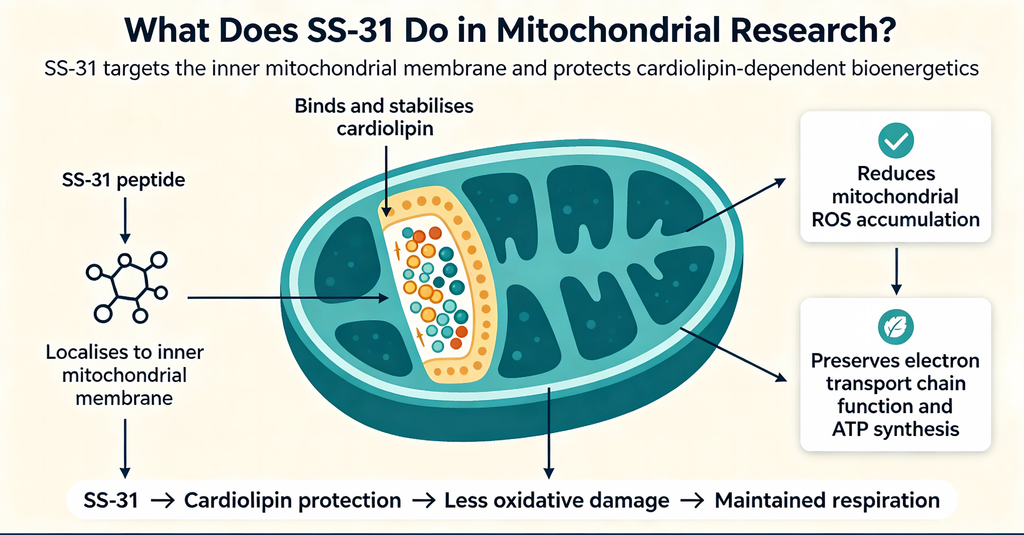
What Does SS-31 Do in Mitochondrial Research?
SS-31 has been extensively studied for its interaction with cardiolipin in the inner mitochondrial membrane.
Current mechanistic research suggests that this interaction may influence:
- mitochondrial cristae organization;
- oxidative phosphorylation;
- ATP-related bioenergetics;
- membrane electrostatic properties;
- cardiolipin-dependent protein organization;
- oxidative-stress-related pathways.
This means SS-31 is more accurately described as a mitochondria-targeting peptide than simply an “energy peptide.”
A useful research model is:
SS-31 → inner mitochondrial membrane → cardiolipin interaction → mitochondrial organization → bioenergetic response.
What Did FDA Approval Actually Establish?
FDA accelerated approval of Forzinity applies to a very specific context:
Barth syndrome patients weighing at least 30 kg.
It does not establish SS-31 as a general treatment for:
- aging;
- fatigue;
- athletic performance;
- longevity;
- brain fog;
- general mitochondrial enhancement.
Those broader claims are frequently discussed online but are not the indication established by the FDA approval.
This is an important distinction because Google results often combine approved-drug information with experimental “mitochondrial optimization” claims.
What Do SS-31 Reviews Say?
Current online SS-31 reviews are mixed.
Positive anecdotal reports sometimes mention:
- increased perceived energy;
- improved stamina;
- better recovery;
- improved daily drive;
- reduced subjective fatigue.
Negative or neutral reports include:
- no noticeable effect;
- fatigue;
- feeling generally unwell;
- disappointing results;
- concerns about cost;
- uncertainty about whether perceived effects justify continued use.
Some users report major subjective improvement, while others report no meaningful benefit at all.
This variability matters.
Online reviews may involve:
- unknown research materials;
- different formulations;
- multiple compounds;
- underlying diseases;
- different experimental circumstances.
Therefore:
SS-31 reviews should be treated as anecdotal search sentiment, not controlled scientific evidence.
What Are the Known Adverse Reactions With Pharmaceutical Elamipretide?
FDA documentation for regulated elamipretide has identified injection-site reactions as an important safety issue.
Reported reactions include:
- erythema;
- pain;
- induration;
- pruritus;
- bruising;
- urticaria.
FDA review documents also discuss hypersensitivity as a potential risk.
These data concern the regulated pharmaceutical product and its clinical-development program.
They should not be used to claim that SUNONE Research Grade SS-31 has established clinical safety.

Why Pharmaceutical Evidence Cannot Be Directly Transferred to Research-Grade SS-31
A finished pharmaceutical product is characterized by far more than the identity of its active peptide.
Important differences may include:
- formulation;
- concentration;
- excipients;
- sterility controls;
- impurity specifications;
- manufacturing process;
- container system;
- stability testing;
- regulatory release criteria.
Therefore:
Forzinity clinical data ≠ proof of SUNONE SS-31 clinical equivalence.
The FDA approval strengthens the scientific relevance of elamipretide biology, but it does not convert research-grade peptide material into an approved medicine.
What Should Researchers Check When Choosing an SS-31 Supplier?
For professional SS-31 research, laboratories should evaluate analytical quality rather than relying only on the product name.
Molecular Identity
The supplied peptide should correspond to the intended SS-31 / Elamipretide molecular entity.
HPLC Purity
Batch-specific chromatographic documentation should support the stated purity.
Molecular-Mass Confirmation
Analytical data should be consistent with the expected molecular specification.
Chemical Form
Researchers should verify the chemical form stated in the applicable batch documentation.
Batch-Specific COA
A current SS-31 COA supports lot-level traceability and experimental reproducibility.
SUNONE currently lists:
Product: SS-31
Synonyms: Elamipretide, Bendavia, MTP-131, Szeto-Schiller Peptide 31
CAS: 736992-21-5
Formula: C32H49N9O5
Molecular Weight: 611.78 g/mol
Purity: ≥99% HPLC
Form: Lyophilized Powder
Grade: Research Grade
Final Thoughts
A common Google search question is:
“Is SS-31 FDA approved?”
The more accurate answer requires product context.
Elamipretide is the active substance in FDA-approved Forzinity for a defined Barth syndrome indication.
But a research-grade SS-31 product should not automatically be described as an FDA-approved medicine.
For biotechnology researchers, a stronger framework is:
SS-31 molecular identity → mitochondrial mechanism → clinical elamipretide evidence → pharmaceutical formulation → research-grade material → analytical documentation.
For laboratories comparing a research-grade SS-31 supplier, molecular identity, HPLC purity, COA traceability and clear separation between research material and approved pharmaceutical evidence should remain central.
SUNONE research peptide is for qualified labrtorynt, diagnois, druc tor mmatct or veteimant, use.research only, Not for human consumption, clinical treame.
Leave a Reply