
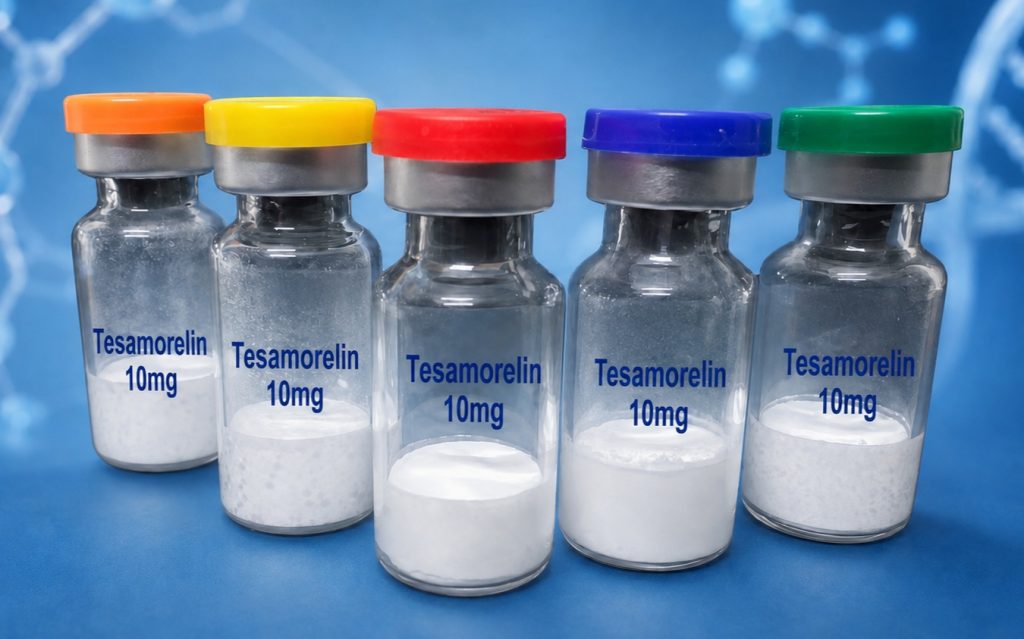
What Is Tesamorelin?
Tesamorelin is a synthetic analogue of human growth hormone-releasing factor, also known as GHRH or GRF.
It contains the 44-amino-acid sequence of human GRF, but it is not structurally identical to native GRF.
A key difference is a modified N-terminus containing a hexenoyl group.
SUNONE supplies research-grade Tesamorelin, CAS 218949-48-5, for qualified laboratory, analytical and manufacturing research.
SUNONE Tesamorelin Product Page:
What Makes Tesamorelin Different From Native GHRH?
Tesamorelin contains the same 44-amino-acid backbone associated with human GRF, but its N-terminal region is chemically modified.
A C6 hexenoyl chain containing a double bond is attached to the N-terminal tyrosine residue.
This modification is important because the N-terminal region of GHRH-related peptides plays a major role in biological activity and peptide stability.
Therefore:
native GHRH sequence ≠ Tesamorelin molecular identity.
For analytical research, the modification should be considered part of the molecule rather than a minor structural detail.
Why Does the N-Terminal Modification Matter?
Peptides can be vulnerable to enzymatic and chemical degradation.
Structural modification is one strategy used to alter peptide stability while preserving receptor-related activity.
In Tesamorelin research, the hexenoyl modification helps distinguish the molecule from native human GHRH.
A useful framework is:
44-aa GHRH backbone → N-terminal modification → Tesamorelin identity → GHRH-receptor signaling.
This is why researchers comparing GHRH-related peptides should first confirm the exact molecular entity used in each study.
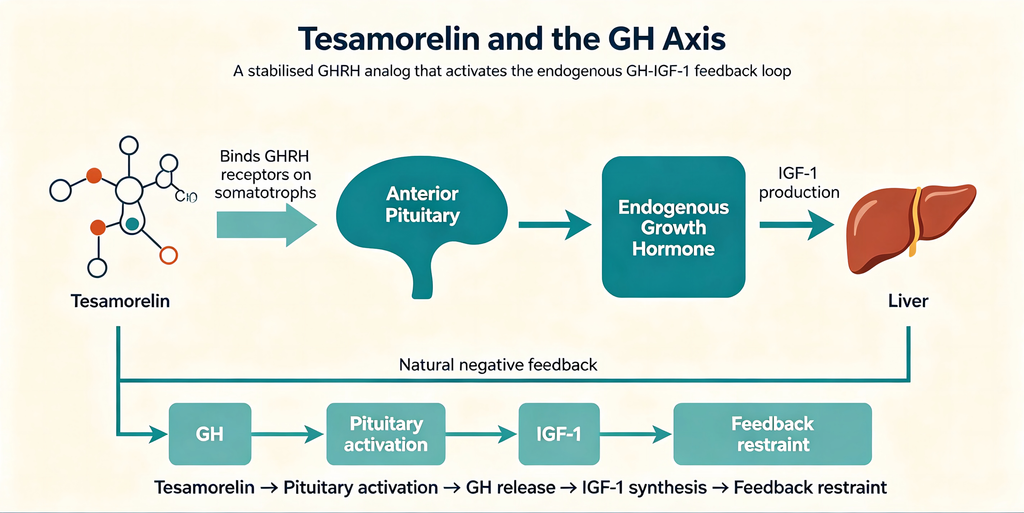
Tesamorelin and the GH Axis
Tesamorelin acts through GHRH receptors on pituitary somatotroph cells.
This stimulates endogenous growth-hormone signaling and can subsequently influence circulating IGF-1.
This mechanism is different from peptides that act primarily through the ghrelin receptor / GHS-R pathway.
For researchers, receptor identity matters because different GH-axis peptides should not automatically inherit one another’s pharmacological evidence.
What Has Pharmaceutical Tesamorelin Been Approved For?
A regulated pharmaceutical form of Tesamorelin is marketed as EGRIFTA WR in the United States.
Its approved indication is the reduction of excess abdominal fat in HIV-infected adults with lipodystrophy.
Importantly, the official label states that it is not indicated for weight-loss management, and its long-term cardiovascular safety has not been established.
This means broad online descriptions such as “Tesamorelin weight-loss peptide” can oversimplify the actual pharmaceutical evidence.
Regulated EGRIFTA WR should also not be considered equivalent to SUNONE Research Grade Tesamorelin.
What Do Tesamorelin Reviews Say?
Current online Tesamorelin reviews are mixed.
Positive anecdotal reports frequently mention:
- perceived reduction in abdominal volume;
- changes in waist appearance;
- improved body-composition perception;
- improved recovery or energy;
- improved sleep in some community discussions.
Negative or neutral reports include:
- muscle or joint discomfort;
- fatigue;
- headache;
- water retention;
- itching or local reactions;
- little or no noticeable improvement.
These experiences vary considerably.
Many online discussions also involve other peptides or medications, which makes attribution difficult.
Therefore:
Tesamorelin reviews are anecdotal search sentiment—not controlled scientific evidence.
Why Chemical Form Also Matters

Another analytical detail is often overlooked.
The regulated pharmaceutical label describes Tesamorelin as an acetate salt, while molecular specifications may also be expressed using the free-base-equivalent molecular weight.
Researchers should therefore pay attention to:
- peptide identity;
- chemical or salt form;
- molecular mass;
- purity;
- related peptide impurities;
- batch-specific analytical documentation.
This is particularly important when comparing data from different suppliers or published studies.
What Should Researchers Check When Choosing a Tesamorelin Supplier?
When evaluating a research-grade Tesamorelin supplier, laboratories should look beyond the product name alone.
Molecular Identity
The supplied material should correspond to the intended Tesamorelin molecule, including the relevant N-terminal structural modification.
HPLC Purity
Batch-specific HPLC documentation should support the stated purity.
Molecular-Mass Characterization
Mass-related analytical data can help support the expected molecular identity.
Chemical Form
Researchers should verify the chemical form stated in the applicable COA and specification documents.
Batch-Specific COA
A current Tesamorelin COA helps support lot traceability and research reproducibility.
SUNONE currently lists:
Product: Tesamorelin
Synonyms: TH9507, TH-9507, (3E)-Hex-3-enoylsomatoliberin (human), GHRH Analog
CAS: 218949-48-5
Formula: C221H366N72O67S
Molecular Weight: 5135.9 g/mol
Purity: ≥99% HPLC
Form: Lyophilized Powder
Grade: Research Grade
Storage: 2–8°C, protect from light
Final Thoughts
A common Google search question is:
“Is Tesamorelin just GHRH?”
The more accurate research answer is:
Tesamorelin is a chemically modified GHRH analogue with a defined N-terminal hexenoyl modification.
That creates a stronger scientific framework:
GHRH backbone → structural modification → molecular identity → receptor signaling → analytical characterization.
For laboratories comparing a Tesamorelin supplier, correct molecular identity, chemical form, HPLC purity and batch-specific analytical documentation should take priority over generalized claims about GH, weight loss or body composition.
SUNONE research peptide is for qualified labrtorynt, diagnois, druc tor mmatct or veteimant, use.research only, Not for human consumption, clinical treame.
Leave a Reply